
13.5 million never reached. 7.3 million reached and then lost. Decoding WHO & UNICEF’s 2026 global immunization data. |
From First Dose to Full Protection: What WHO and UNICEF’s 2026 Data Reveals
Reviewed by Fabrice Sewolo Matondo, MD, MPH, MSc — PhD Student, Epidemiologist
Published 17 August 2026 · 6 min read
Paradox Worth Understanding. On July 2026, the World Health Organization and UNICEF released their annual global immunization estimates. The headline was cautiously positive: 90% of the world's infants, nearly 116 million children, received at least one dose of the diphtheria–tetanus–pertussis (DTP) vaccine in 2025, and 750,000 fewer children were left completely unvaccinated than in the previous year. [1,2]
Yet in that same year, 57 countries reported extensive or disruptive measles outbreaks. [1] And by late July 2026, the United States had recorded its highest measles case count in 35 years. [3,4,5,16]
How can coverage be improving while outbreaks accelerate?
The answer lies in a distinction most immunization programs still miss: the difference between children we never reach and children we reach but fail to keep. That difference will define the next decade of vaccine equity work.
1. Two Different Failures Require Two Different Solutions
Global immunization has long tracked one number closely: the "zero-dose" child, the infant who never receives a single vaccine. In 2025, that figure fell to 13.5 million, continuing a 25-year trend that has reduced zero-dose numbers by 40%. [1]
But this year's data appears to be a quieter failure. An estimated 7.3 million infants received their first DTP dose and then disappeared before their first measles dose. [1,2]
These are not children we failed to find. These are children we found, registered, and then lost. The two failures have fundamentally different causes:
- Zero-dose: Largely an access problem — conflict, displacement, geographic distance, and insecurity. More than half of all zero-dose children live in fragile, conflict-affected or vulnerable settings, although these contexts contain only about one third of the world's child population. [1]
- Drop-out: Largely a retention problem — missed appointments, absent reminder systems, weak follow-up, eroding caregiver trust, and health workers without the tools to trace who is missing.
A program that solves one will not automatically solve the other. According to current evidence, the world is performing better on the first than on the second.
A child who missed any dose was never in our hands. The child who was lost after the first dose was.
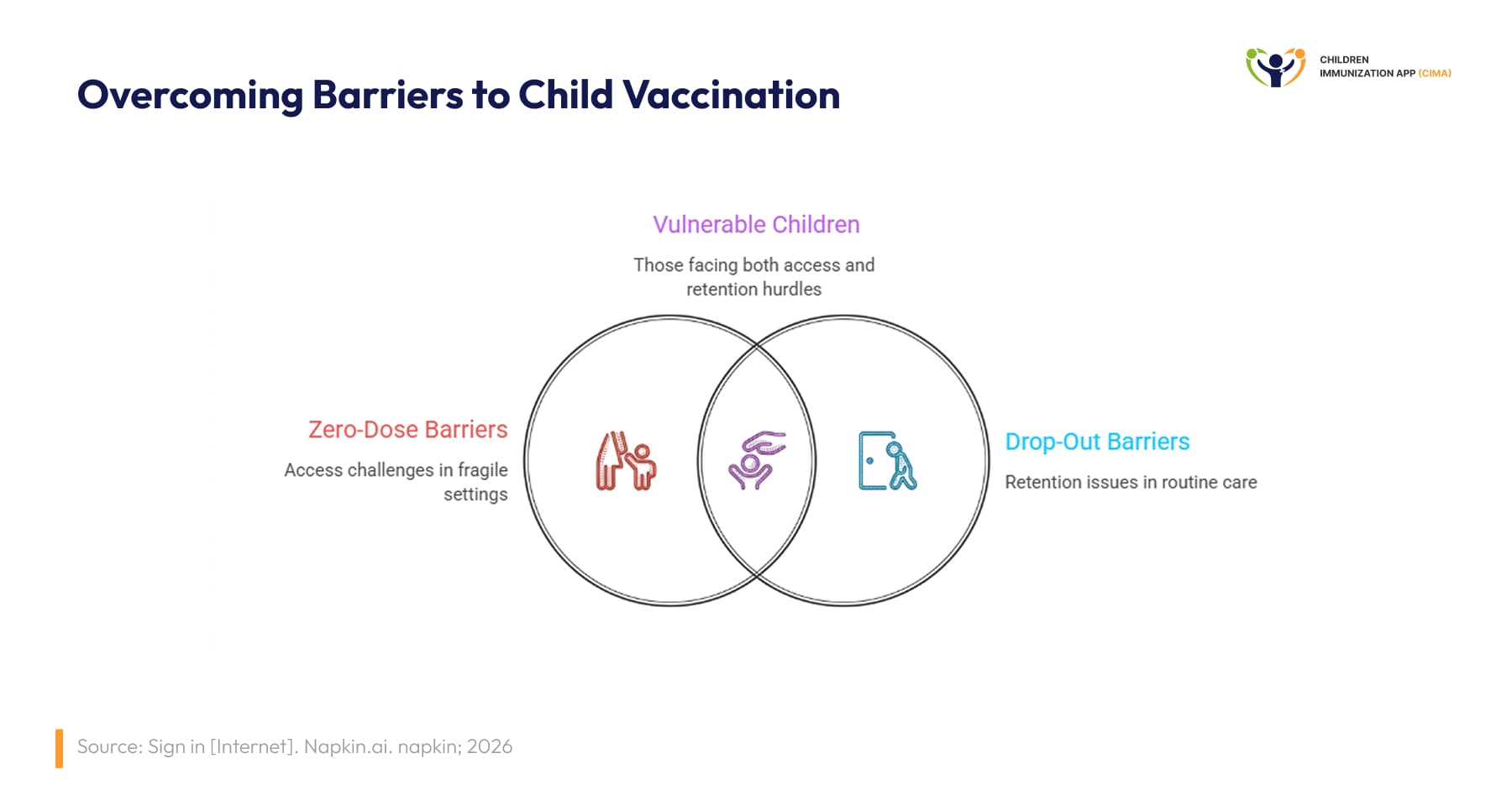
Zero-dose is an access failure. Drop-out is a retention failure. Some children face both.
2. Why Measles Is the System's Thermometer
Measles requires 95% two-dose coverage to interrupt transmission, a higher bar than almost any other vaccine, because a single case can infect up to 18 susceptible individuals. [6]
In 2025, global first-dose measles coverage (MCV1) stood at 84% and second-dose coverage (MCV2) at 77%. Both fall far short of the threshold. [1,2]
This is not only a measles problem. It is a diagnostic. Measles is the first disease to return when coverage slips, which makes it the most sensitive available indicator of overall system health. When measles broke through, the cracks were already there.
Where the Consequences Are Now Visible:
- United States: 2,318 confirmed cases by late July 2026, surpassing the full 2025 total (2,287) and the highest count since 1991. Some 93% of cases occurred in people who were unvaccinated or had unknown vaccination status; the two-dose MMR vaccine is 97% effective. [3,4,5,6]
- Canada: Lost measles elimination status on 10 November 2025 following more than 5,200 cases and two infant deaths. [7,8]
- WHO European Region: Armenia, Austria, Azerbaijan, Spain, the United Kingdom and Uzbekistan lost elimination status in January 2026 following sustained community transmission. [9,10]
Elimination is not permanent; it lasts only as long as vaccination coverage does.
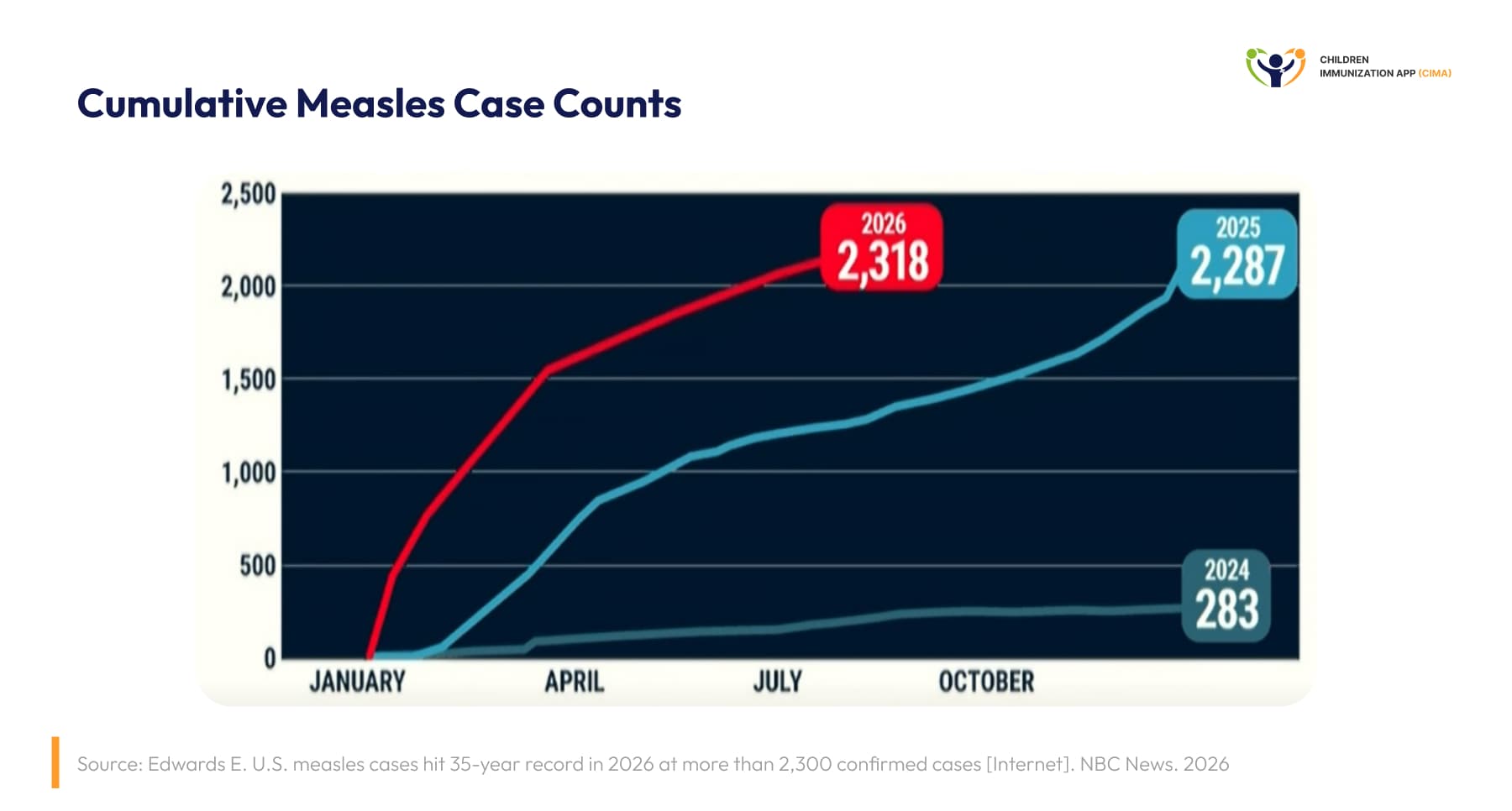
By July 2026, measles cases had reached 2,318. Surpassing the total for all of 2025 and exceeding the 2024 total eightfold.
3. Access Is Not Always the Barrier
The 2026 data challenge the assumption that vaccination gaps are primarily problems of vaccine supply or physical access. In fragile, conflict-affected, and vulnerable settings, access often remains the central challenge: more than half of all zero-dose children live in these settings, where immunization programs can be strained by political upheaval, insecurity, or chronic underfunding.
But the WHO–UNICEF data also show that coverage can decline in middle- and high-income countries even where vaccines are fully accessible.
South Africa's first-dose diphtheria, tetanus, and pertussis (DTP1) vaccine coverage has fallen by 20 percentage points since 2019 and has continued to decline in 2025.
Bosnia and Herzegovina recorded the largest increase in first-dose measles-containing vaccine (MCV1) coverage in 2024. However, it experienced a 23-percentage-point decline the following year.
In such settings, the release points to shifting political commitment, structural challenges, and rising vaccine hesitancy, not simply lack of vaccine availability, as important reasons why coverage can slip. [1]
Here, in most cases barrier is not the vaccine. It is confidence, communication, competing priorities, and the quality of the conversation between a health worker and a caregiver.
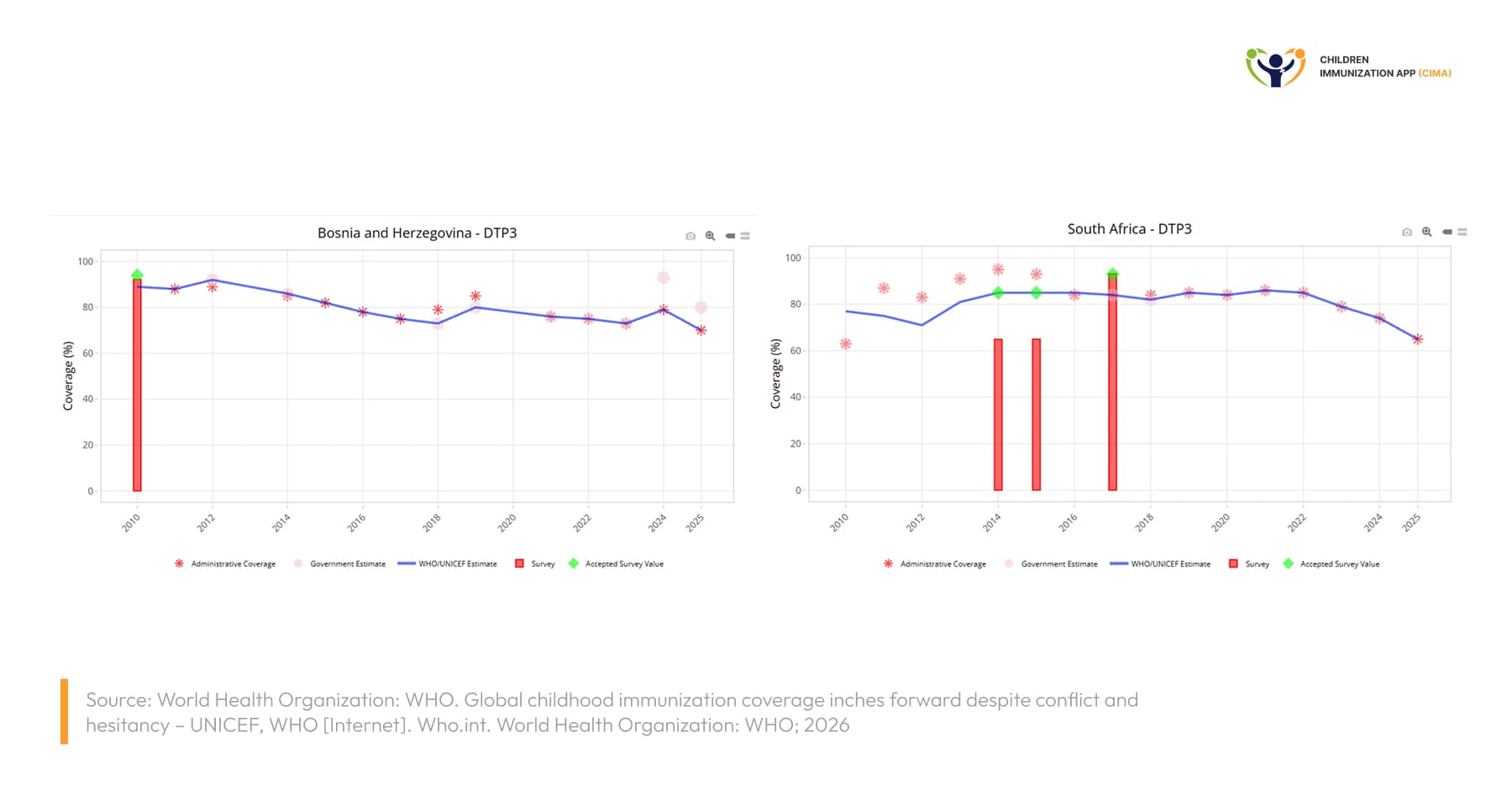
Where access is not the barrier: two middle-income countries, both once above 90%, losing 23 and 20 coverage points with vaccines available.
4. Sudan Proves That Context Is Not Destiny
The 2025 global immunization estimates show that conflict does not automatically prevent improvement in childhood vaccination coverage. Despite ongoing conflict, Sudan recorded the world's largest single-country increase: coverage with the first dose of the diphtheria, tetanus, and pertussis (DTP1) vaccine rose by 35 percentage points. In comparison, first-dose measles-containing vaccine (MCV1) coverage rose by 22 percentage points in one year.
In the same period, Syria lost 6 percentage points in DTP1 coverage and 12 percentage points in MCV1 coverage. These contrasting trends show that countries facing conflict can have very different immunization outcomes. WHO and UNICEF identify Sudan's gains as evidence of what can be achieved when access to vaccination services improves, even during ongoing conflict. [1]
Conflict makes immunization delivery more difficult, but it does not make progress impossible.
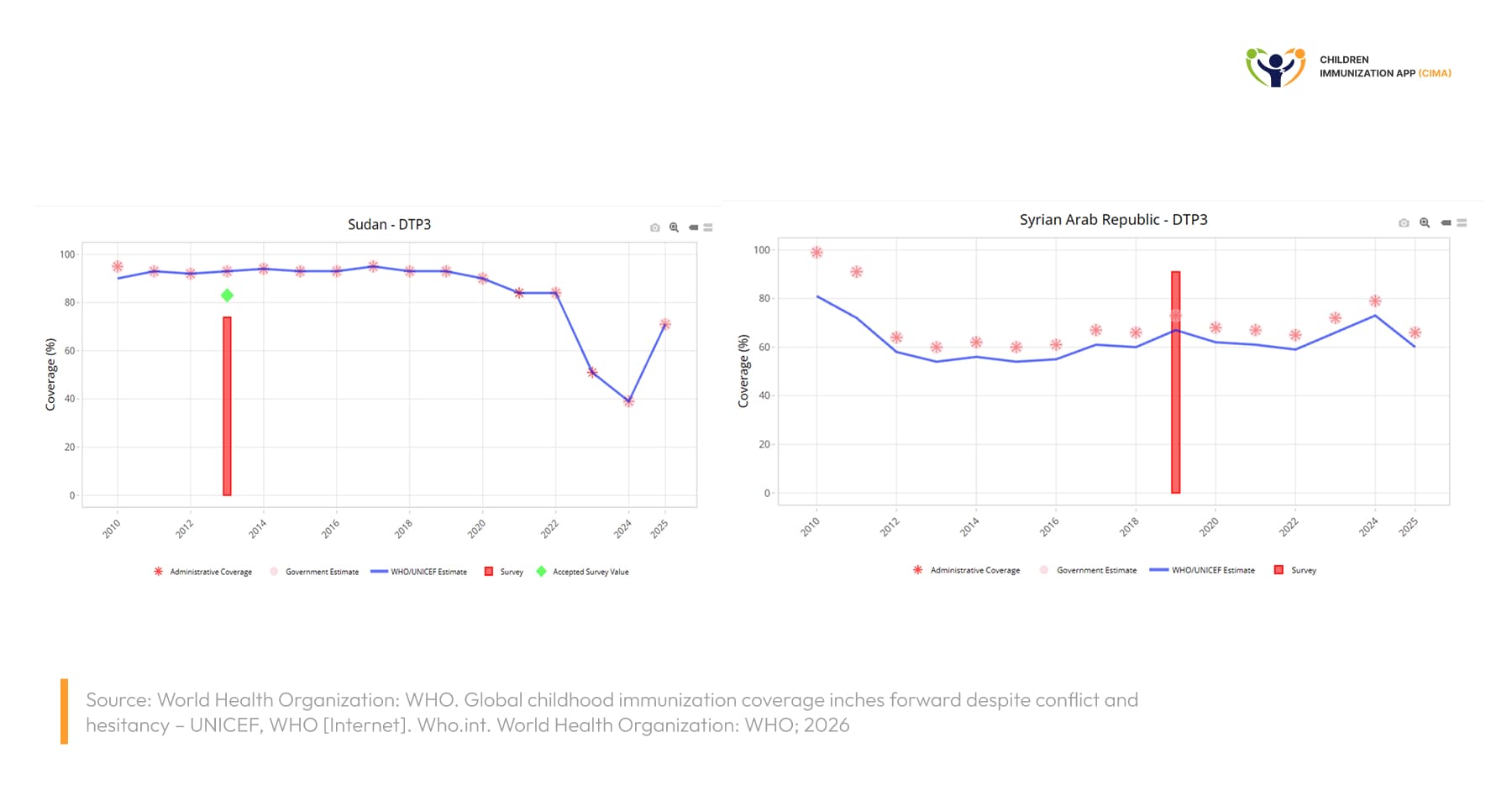
Two conflict-affected countries, opposite directions in the same year. Sudan's DTP1 climbed 35 points out of its 2024 collapse; Syria's MCV1 fell 12. Conflict shaped the difficulty, not the outcome.
5. A quieter crisis: losing sight of the gaps
One of the most concerning findings is a sharp decline in the number of national immunization surveys available to guide action. Only 18 surveys were finalized and submitted in this reporting round, compared with 50 in 2024 and an average of 33 per year between 2015 and 2019. These surveys provide the high-quality data countries need to see where children are being missed and to understand the true gaps in vaccination coverage. When fewer surveys are completed, health authorities have less reliable information to identify underserved populations, direct services where they are most needed, and respond before immunity gaps contribute to outbreaks. [1]
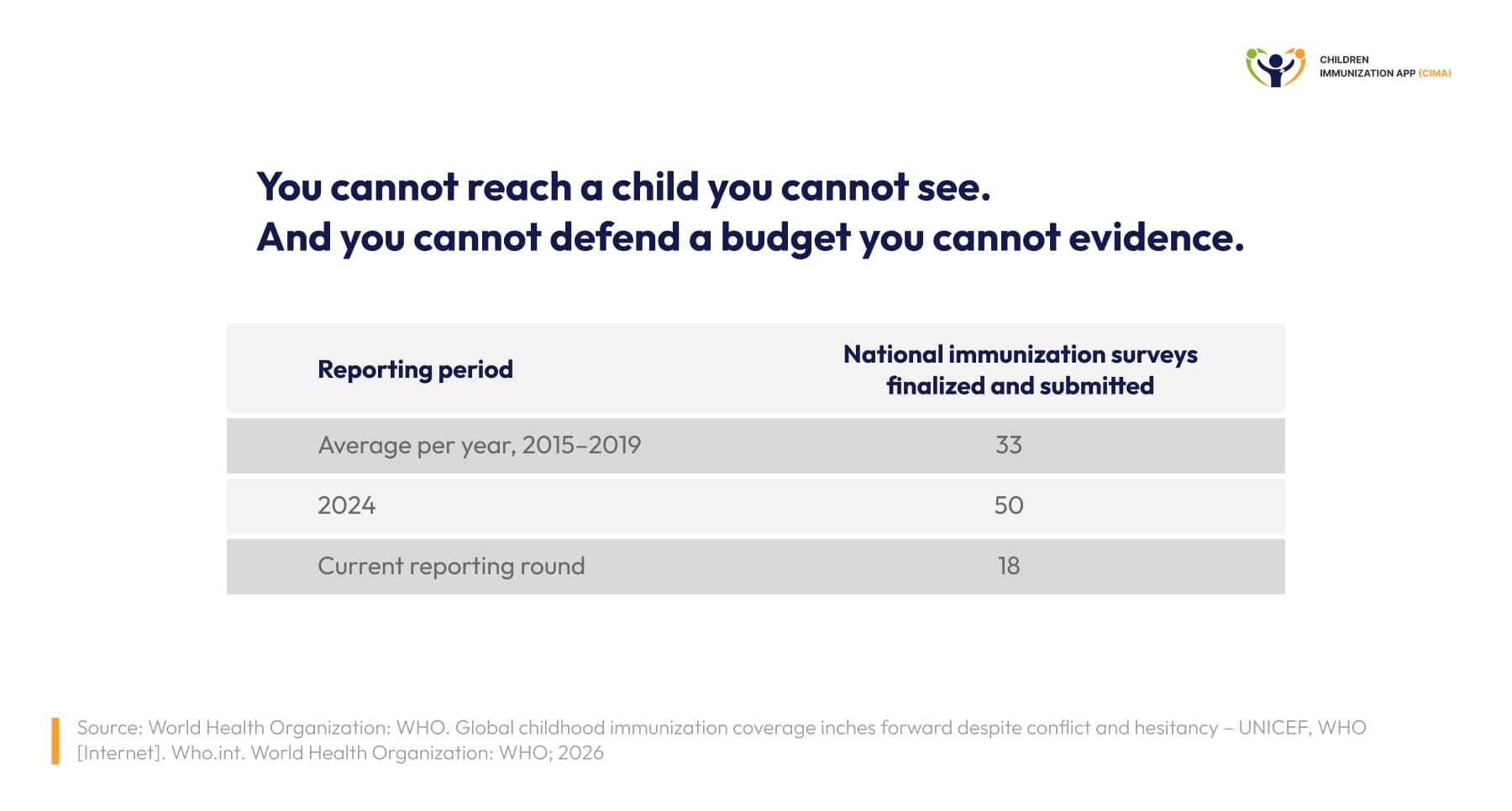
A shrinking evidence base for immunization action. Fewer high-quality surveys leave countries with less reliable evidence to identify missed children, locate coverage gaps, and direct immunization services where they are most needed.
6. From Data to Daily Practice
WHO and UNICEF identify four priorities for restoring and sustaining childhood immunization progress:
1-Reach children missed by routine immunization, especially in fragile, conflict-affected, and vulnerable settings. These settings account for more than half of the world's zero-dose children and face particular challenges from insecurity, displacement, political disruption, and chronic underfunding. [1] Retention requires systems that function offline, follow families as they move, and automatically flag defaulters.
2-Address misinformation and vaccine hesitancy to increase uptake. Vaccine availability alone is not enough when false information, distrust or uncertainty leads families to delay or refuse vaccination. [1] This is a clinical communication skill; teachable, structured, and measurable. It is not a personality trait.
3-Increase and sustain investment in immunization. Progress depends on reliable national and international funding for vaccination programs, including the systems needed to deliver vaccines equitably. [1] Advocacy requires evidence. Health workers who can quantify their coverage gap can defend their resources.
4-Strengthen immunization data and disease-surveillance systems. Timely, reliable data are essential for identifying children who have missed vaccines, detecting immunity gaps and responding before outbreaks spread. [1] Every immunization encounter is a data point; whether it becomes usable intelligence depends on how it is captured. For frontline health workers, the practical message is straightforward: every missed child, every question about vaccination, and every recorded dose matters. [1,11]
Strong immunization programs depend on reaching children, maintaining trust, securing resources, and using accurate data to identify where action is needed most.
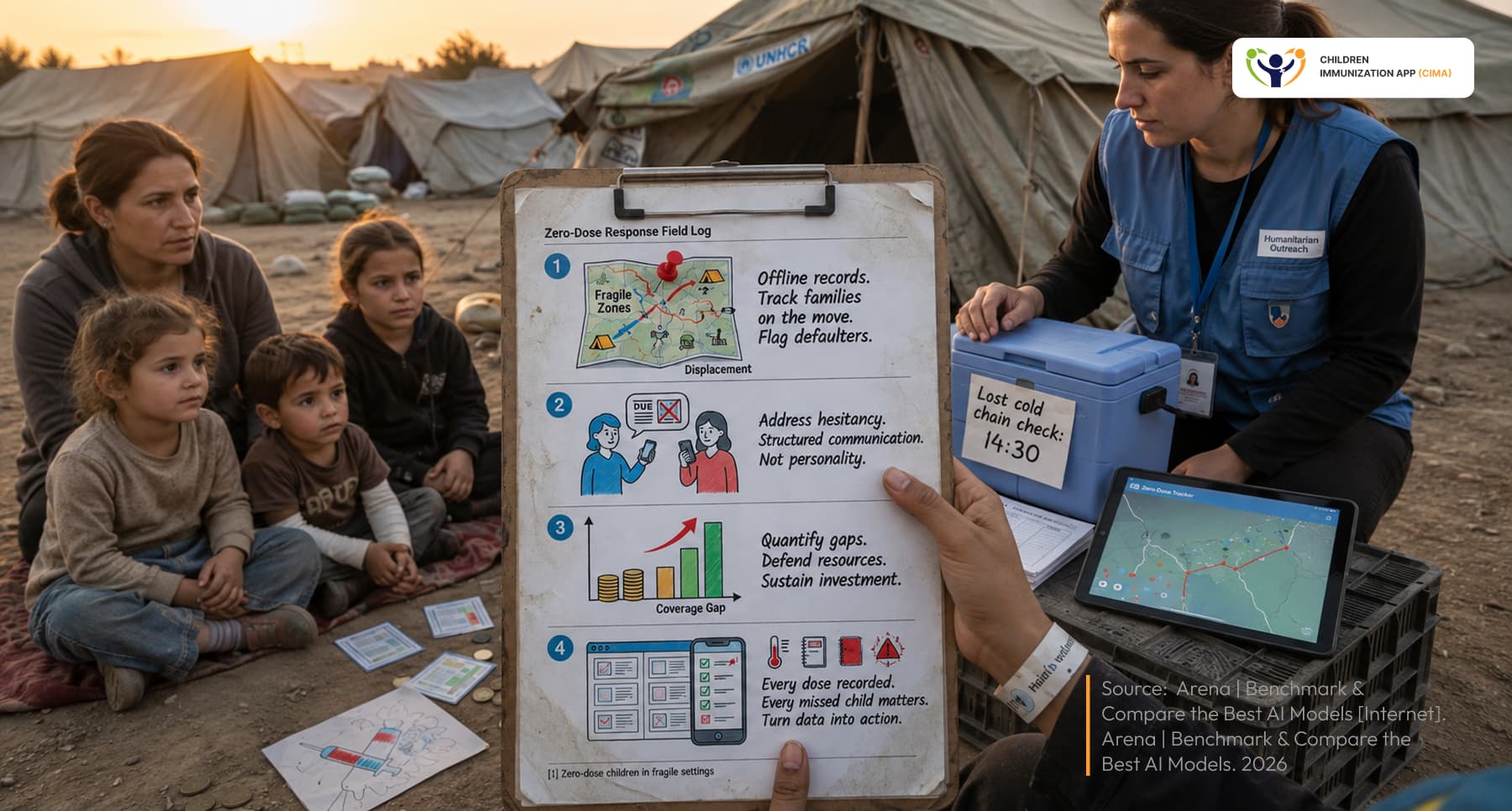
Four global priorities on one clipboard. This is where strategy becomes practice.
7. How CIMA Care Is Responding
Our work is built around this gap, between reaching a child once and protecting that child completely.
- The Children Immunization App (CIMA): Designed for retention rather than mere registration: offline-capable digital records, automated SMS reminders to caregivers, defaulter identification, heat maps showing administrators exactly where children are being lost, and DHIS2 compatibility so that data strengthens national systems rather than sitting in silos. In implementation settings, this approach has supported measurable gains, including a 23% increase in coverage in Cameroon's Bamenda region and a 19% increase in Jordan's Zaatari refugee camp. [12]
- CIMA Care Health Academy: The Academy addresses the human side of that gap. Now serving more than 4,000 healthcare professionals across 77+ countries, it holds institutional membership of the UK's CPD Certification Service (Member No. 19938), with five courses independently CPD-certified: Vaccination Programs; Global Immunization Recovery; Nutrition-Immunization Intervention Synergy; Using ChatGPT in Healthcare and Vaccination; and Adverse Events Following Immunization (AEFI). Separately, five courses hold national accreditation from Lebanon's Order of Nurses for Continuous Nursing Education. Curricula cover vaccine science, AEFI recognition and management, the GATHER approach to hesitancy, zero-dose outreach through the RED strategy, and immunization program recovery — the competencies that determine whether a registered child completes the schedule. [13]
- Open-Access Evidence Translation: Formal training happens periodically; misinformation circulates daily. To close that interval, CIMA Care publishes continuously: more than 20 expert articles on our profile with the UK's CPD Certification Service, [14] and over 54 evidence briefs on cima.care, each grounded in recent peer-reviewed literature and written for two audiences at once: health workers who need current evidence between training cycles, and caregivers who encounter vaccine claims without the means to weigh them. All are accessible, without registration. [15] Where a 23-point fall in coverage can follow a single year of eroding confidence, as it did in Bosnia and Herzegovina. [1]
Keeping clear and sourced evidence in circulation is not a communications activity. It is an infrastructure.

Three responses to one gap: registration & retention tools, trained workers, evidence in circulation.
Closing the Distance Between Reached and Protected
The 2026 data is neither a success story nor a failure story. It is a redirection. We know how to find children who have never been reached. We are still learning how to keep the children we have already found.
CIMA Care invites healthcare professionals, immunization program managers, ministries of health, academic institutions, and global health fellows to join us in closing the distance between reached and protected.
CONFLICTS OF INTEREST
The author and reviewer declare no financial or non-financial conflicts of interest in relation to the content of this page. Full declarations are held on file only, and are available on request.
LICENCE
From First Dose to Full Protection: What WHO and UNICEF's 2026 Data Reveals © 2026 by CIMA Care GmbH is licensed under CC BY-NC-ND 4.0 


Image References
- 1. Napkin AI. Sign in [Internet]. 2026 [cited 2026 Sep 3]. Available from: https://www.napkin.ai/?utm_source=chatgpt.com
- 2. World Health Organization, United Nations Children's Fund. Global childhood immunization coverage inches forward despite conflict and hesitancy – UNICEF, WHO [Internet]. Geneva: World Health Organization; 2026 Jul 15 [cited 2026 Sep 3]. Available from: https://www.who.int/singapore/news/detail-global/15-07-2026-global-childhood-immunization-coverage-inches-forward-despite-conflict-and-hesitancy---unicef--who?utm_source=chatgpt.com
- 3. Edwards E. U.S. measles cases hit 35-year record in 2026 at more than 2,300 confirmed cases [Internet]. NBC News; 2026 [cited 2026 Sep 3].
- 4. Arena. Benchmark & compare the best AI models [Internet]. 2026 [cited 2026 Sep 3]. Available from: https://arena.ai/?utm_source=chatgpt.com
Blog Resources
- 1- World Health Organization: WHO. Global childhood immunization coverage inches forward despite conflict and hesitancy – UNICEF, WHO [Internet]. Who.int. World Health Organization: WHO; 2026 [cited 2026 Aug 9]. Available from: https://www.who.int/news/item/15-07-2026-global-childhood-immunization-coverage-inches-forward-despite-conflict-and-hesitancy---unicef--who
- 2- Global childhood immunization coverage inches forward despite conflict and hesitancy – UNICEF, WHO [Internet]. unicef. 2026 [cited 2026 Aug 9]. Available from: https://www.unicef.org/press-releases/global-childhood-immunization-coverage-inches-forward-despite-conflict-and-hesitancy
Enjoyed this article?
Share it with your friends on LinkedIn: From First Dose to Full Protection: What WHO and UNICEF’s 2026 Data Reveals 
Follow us on LinkedIn for more updates and insights: Cima Care GmbH