
Web Story
From Forgotten to Protected: The Regional Coordinator's Testimony on CIMA Care's Unprecedented Vaccination Breakthrough |
November 04, 2025

Reading Time: 12 Minutes
In a groundbreaking television interview on Star TV, Dr. Cornelius Chebo, EPI Coordinator for the Northwest Region of Cameroon, reveals the transformative impact of CIMA Care's digital health platform in one of Africa's most challenging healthcare environments.
Against the backdrop of Bamenda's complex healthcare landscape, marked by regional crisis, lockdowns, and ghost towns, CIMA Care emerges as more than an app. It represents a lifeline for families, a partner to healthcare workers, and a scalable solution for transformative impact. This is the story of measurable transformation: from manual reminder cards to automated SMS systems, from countless lost-to-follow-up children to a documented 99% success rate, and from local pilot to national expansion vision.
From lost to protected: How CIMA Care's reminders rescue children who may miss or have missed their vaccine doses.
When Public Health Meets Digital Innovation: The Birth of a Solution
Dr. Chebo introduces CIMA Care with remarkable clarity: "It is actually coming to help us identify children that have missed out on vaccines and bring them back up to date." His opening statement resonates with urgency and hope. "Once any child is registered in the application, the application sends reminder messages so that parents or caregivers can actually, even if they have forgotten, they can now come back and their children get immunized." As he explains, his words capture the essence of a system that transforms forgotten appointments into timely interventions. This simple mechanism addresses the persistent crisis of children missing vaccine doses across regional health systems.

EVIDENCE-BASED INSIGHT:
SMS reminders can increase childhood vaccination coverage and timeliness in low- and middle-income countries, with the greatest impact in lower-income settings. [1]
The Numbers Do Not Lie: Achieving remarkable success in decreasing rates of children who are not missing vaccines
When public health officials speak of "results-oriented" programs, this is what success looks like. The interview reaches its most powerful moment as Dr. Chebo reveals CIMA Care's documented impact: "If you look at the performance in the health facilities where the CIMA project is being implemented, in fact, we have more than 99% success rates of children that are not missing out on vaccines as compared to the other areas where it is not." This stark comparison between CIMA-enabled facilities and traditional approaches provides irrefutable evidence of digital health transformation. The coordinator's assessment is unequivocal: "That's already a very, very big success. Just the fact that parents are reminded, once they forget, is already a very, very big step in bringing them back."
The numbers speak: 99% of children protected with CIMA Care vs. numerous lost without it.
EVIDENCE-BASED INSIGHT:
In 2024, 54.1% of children were fully vaccinated in SSA. To achieve the WHO`s global vaccination coverage target of 90% by 2030 in SSA, vaccination programs must address regional, subregional, and national inequities. [2]
From paper cards to smart tech: How CIMA Care automated vaccination scheduling, tracking & reminders.
From Manual Card Sorting to Automated Intelligence: The Digital Transformation of Vaccination Tracking
The coordinator's explanation reveals CIMA Care's elegant solution to a persistent operational challenge. Traditional reminder cards, physical documents requiring manual review and sorting—represented bottlenecks in busy healthcare facilities. CIMA Care's automated system eliminates this burden while simultaneously strengthening the safety net. "But now with the technology available, you don't need to—those reminder cards are no longer necessary because the app itself sends messages to the parents and even to the health facility." This dual notification system transforms missed appointments from inevitable losses into recoverable opportunities.
EVIDENCE-BASED INSIGHT:
Digital health interventions that streamline existing workflows and support clinical autonomy are adopted by healthcare workers more often, with proven sustainability and impact across African mHealth programs. [3]
From Bulky Registers to Smart Planning: The Administrative Revolution Healthcare Workers Needed
The coordinator's testimony resonates with every healthcare worker who has struggled against overwhelming administrative demands. In high-volume facilities processing hundreds of children daily, manual tracking becomes untenable. The vivid picture of pre-CIMA reality is painted by Dr. Chebo: “Our vaccination registers are quite bulky. And if you are in a very busy center, you spend a lot of time trying to sort that out. Imagine somebody in the regional hospital, somebody in Azire, and somebody in the district hospital, where they receive hundreds of children every day." The system even enables predictive planning: "These are the number of children that we are expected to receive today that have not come."
From overwhelmed to organized: How CIMA Care gives healthcare workers their time back.
EVIDENCE-BASED INSIGHT:
In under-resourced African health settings, administrative tasks take up much more time than direct patient care; digital tools that reduce this burden improve job satisfaction, lower turnover, and reclaim hours per week for patient care, enhancing service delivery.[4]
Can you not read it? No problem: CIMA Care's supported voice calls reach every parent to protect every child.
Beyond Literacy: How CIMA Care's Human Touchpoint Complements Digital Innovation
The host raises a critical question that exposes real-world complexity: what about parents who cannot read? Dr. Chebo's response reveals CIMA Care's thoughtful design: "That is why I said even the health facility receives notification also. Because when the parent cannot read, the health facility now has the opportunity to call." The system's redundancy becomes a strength, not a weakness. Even illiterate parents can answer phone calls, and health facilities can provide verbal reminders with full context: "Madam, on this particular day, a child was supposed to come to the health center or to the health facility to receive a vaccine. And that child has not come." This human touchpoint, enabled by digital infrastructure, ensures inclusivity. The coordinator's emphasis on vaccination schedule adherence adds medical urgency: "Vaccines work better when we respect the schedule for which they are supposed to be administered."
EVIDENCE-BASED INSIGHT:
Reports highlight that a high percentage of rural populations in sub-Saharan Africa are functionally illiterate, with women most affected, and emphasize the need for inclusive, multi-modal communication to improve reach and impact.[5]
No Stone Left Unturned: How CIMA Care Mobilizes Community Health Workers as Vaccination Advocates
CIMA Care's architecture reveals a sophisticated understanding of rural healthcare realities. When the host questions whether CIMA Care requires families to travel to health facilities, Dr. Chebo unveils the system's community-level integration. "We also have outreach sessions, and during these outreach sessions, some of these children that are met on outreach are also registered." CIMA Care extends beyond facility walls, supporting mobile vaccination teams who register children in villages and send reminders about upcoming community-based sessions. The coordinator's statement resonates with a comprehensive strategy: "Remember we have community health workers in almost all the communities in our region." These frontline workers receive names and phone numbers of lost-to-follow-up children, creating a human follow-up layer atop the digital infrastructure. Dr. Chebo's declaration captures the holistic approach: "We use all the available opportunities, including the technological and the physical ones, the human aspect of it."
No stone unturned: Community health workers + CIMA Care tech = every child reached.
EVIDENCE-BASED INSIGHT:
Digital tools and mobile technologies increase CHW efficiency, enable access to data, and improve the quality-of-care delivery across sub-Saharan Africa. [6]
99% protected despite lockdowns & conflict: CIMA Care succeeds where traditional methods fail.
The Regional Crisis Context: Why CIMA Care's Success Matters More Than the Numbers Suggest
The host's question about general effectiveness elicits a response that situates CIMA Care within Cameroon's complex humanitarian landscape. Dr. Chebo provides a sobering assessment of pre-CIMA realities before delivering the triumph. His evaluation is crystal clear: CIMA Care "has actually helped us to bring out many children that were lost to follow-up and indirectly now improved on the performance of vaccination activities as far as these health facilities are concerned." The 99% success rate emerges not in isolation but against a backdrop of ongoing regional challenges. The coordinator acknowledges the context: "We know the other reasons, the lengthy lockdowns, the ghost towns, and all of that prevent parents from being able to reach where they are supposed to reach and take vaccines." Yet even when security situations normalize, areas without CIMA Care continue experiencing losses to follow-up, while CIMA-enabled facilities maintain extraordinary coverage. This controlled comparison validates the platform's specific impact.
EVIDENCE-BASED INSIGHT:
Recent studies have demonstrated that armed conflict reduces immunization coverage, with affected sub-Saharan African regions falling below those in peaceful areas; digital solutions help maintain vaccination services amid instability. [7]
When Success Demands Scaling: The Roadmap from Pilot to National Implementation
The interview captures a pivotal moment in CIMA Care's evolution, the transition from a successful pilot to a scalable national program. Dr. Chebo acknowledges that even within Bamenda, coverage remains incomplete: "Bamenda Health District is a very big district. Bamenda 3 is another district that is still in Bamenda." Yet the coordinator's vision extends far beyond the Northwest Region: "We want to see how we can scale this up. We are already discussing with some partners, especially GAVI, to see how they can help us based on the successes that have been scored in this first phase of the project to implement it—why not in the rest of the country, if it is possible?" His pragmatic acknowledgment that scaling "entails funding" balances optimism with operational realism. With GAVI engagement, national transformation becomes feasible.
From Bamenda pilot to national vision: Collaborations and support can scale CIMA Care nationwide.
EVIDENCE-BASED INSIGHT:
Scaled digital health programs succeed when they are cost-effective, government-led, integrated with health systems, and supported by strategic partnerships, requiring sustained financing. [8]
Beyond technology: Community trust and partnership make CIMA Care truly transformative.
Beyond Technology and Medicine: Why Community Trust Determines Vaccination Success
The regional coordinator's final message transcends CIMA Care specifics to address fundamental public health principles. His observation that communities may reject even well-equipped facilities lacking their trust reveals a critical truth: technology and infrastructure are necessary but insufficient for health system success. CIMA Care's SMS health messages work precisely because they reinforce rather than replace community relationships. The platform enables health facilities to honor community preferences—respecting preferred communication languages, accommodating cultural practices, and responding to locally expressed concerns. Dr. Chebo's reference to "dialogue structures" highlights formal mechanisms for community voice in health facility governance. This institutional architecture ensures that digital innovations like CIMA Care emerge from community priorities rather than being imposed upon them. The coordinator's parting wisdom encapsulates participatory public health: understanding what communities want, delivering it through government systems, and ensuring "the population stays healthier."
EVIDENCE-BASED INSIGHT:
Community engagement interventions, especially dialogue-based participatory approaches, boost vaccination rates and reduce dropouts, outperforming top-down delivery by building trust and community ownership. [9]
THE TRANSFORMATION STORY: FROM REGIONAL PILOT TO NATIONAL VISION
This Star TV interview with Dr. Cornelius Chebo represents far more than routine program coverage—it captures an inflection point in Cameroon's public health evolution. Over the course of this candid conversation, viewers witness the systematic unpacking of how digital innovation, when thoughtfully designed and community-centered, can overcome barriers previously considered insurmountable.
Dr. Chebo's testimony weaves together multiple transformation narratives: healthcare workers liberated from administrative drudgery to focus on clinical care; illiterate parents reached through dual-channel communication strategies; community health workers empowered with actionable data for targeted follow-up; and most critically, thousands of children recovered from lost-to-follow-up status and protected against preventable diseases. The documented 99% success rate stands not as marketing hyperbole but as empirical evidence validated by the regional EPI coordinator himself.
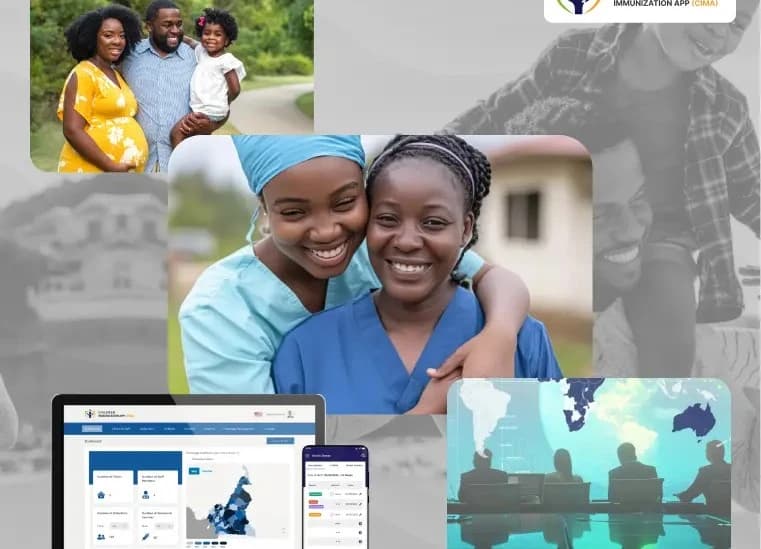
Where technology meets humanity, we can empower healthcare workers, reconnect families, protect children, and equip policymakers with data for life-saving decisions.
When technology embraces humanity rather than replacing it, when innovation strengthens partnership rather than disrupting it, and when success is measured not in downloads but in children protected—that's when digital health fulfills its promise.
That's CIMA Care in Northwest Cameroon.
Resources
- 1- Eze P, Lawani LO, Acharya Y. Short message service (SMS) reminders for childhood immunisation in low-income and middle-income countries: a systematic review and meta-analysis. BMJ Global Health. 2021 Jul;6(7):e005035.
- 2- Simon DJ, Kondo C, Kassoum Dianou, Osaretin Christabel Okonji, Serge Madjou. Regional, subregional and country-level full vaccination coverage in children aged 12-23 months for 34 countries in sub-Saharan Africa: a global analysis using Demographic and Health Survey data. BMJ Global Health [Internet]. 2025 Mar 15;10(e18333). Available from:.(PDF) Regional, subregional and country-level full vaccination coverage in children aged 12-23 months for 34 countries in sub-Saharan Africa: a global analysis using Demographic and Health Survey data
- 3- Frankline Sanyuy Nsai, Palle John Ngunde, Njunda AL, Tendongfor N, Cho Sabastine Anye, Nabyonga-Orem J, et al. Attitudes of mHealth end-users toward integrating mobile technology in HIV program monitoring in Cameroon. Digital Health [Internet]. 2025 May 1;11. Available from: Attitudes of mHealth end-users toward integrating mobile technology in HIV program monitoring in Cameroon
- 4- Awosiku OV, Gbemisola IN, Oyediran OT, Egbewande OM, Lami JH, Afolabi D, et al. Role of digital health technologies in improving health financing and universal health coverage in Sub-Saharan Africa: a comprehensive narrative review. Frontiers in Digital Health. 2025 May 16;7.
- 5- UNESCO. Global education monitoring report, 2020: Inclusion and education: all means all [Internet]. UNESCO : Building Peace through Education, Science and Culture, communication and information. 2020. Available from: https://unesdoc.unesco.org/ark:/48223/pf0000373718
- 6- Owoyemi A, Osuchukwu JI, Azubuike C, Ikpe RK, Nwachukwu BC, Akinde CB, et al. Digital Solutions for Community and Primary Health Workers: Lessons From Implementations in Africa. Frontiers in Digital Health. 2022 Jun 3;4.
- 7- Ciccacci F, Ruggieri E, Scarcella P, Moramarco S, Carestia M, Di Giovanni D, et al. Between war and pestilence: the impact of armed conflicts on vaccination efforts: a review of literature. Frontiers in Public Health. 2025 Jul 1;13.
- 8- WHO. Global strategy on digital health 2020-2025 [Internet]. 2021. Available from: https://www.who.int/docs/default-source/documents/gs4dhdaa2a9f352b0445bafbc79ca799dce4d.pdf
- 9- Liu J, Zhang Y, Zhang H, Tan H. Estimating the effects of interventions on increasing vaccination: systematic review and meta-analysis. BMJ Global Health [Internet]. 2025 Apr 1;10(4):e017142–2. Available from: https://gh.bmj.com/content/10/4/e017142
Source of the Videos' Cover Images
- 1- Happy African female in spectacles types a message on a modern smartphone while her boyfriend stands near her and looks at the screen | Free Photo [Internet]. Freepik. 2020 [cited 2025 Nov 2]. Available from: https://www.freepik.com/free-photo/happy-african-female-spectacles-types-message-modern-smart-phone-while-her-boyfriend-stands-near-her-looks-screen_9591746.htm#fromView=image_search&page=1&position=2&uuid=7a1e3bc9-61df-44c0-bc19-d503a9d99b66
- 2- Generated using Google Gemini AI (2024/2025).
- 3- Female nurse at the clinic practicing medicine | Free Photo [Internet]. Freepik. 2022 [cited 2025 Nov 2]. Available from: https://www.freepik.com/free-photo/female-nurse-clinic-practicing-medicine_33757801.htm
- 4- in. Laptop, black women, or doctors in celebration of success for healthcare goals, achievement, or hospital targets. Tablet, happy medical winners or nurses celebrating a victory, good news, or a deal Stock Photo | Adobe Stock [Internet]. Adobe Stock. 2025 [cited 2025 Nov 2]. Available from: Laptop, black women or doctors in celebration of success for healthcare goals, achievement or hospital targets. Tablet, happy medical winners or nurses celebrating winning victory, good news or deal Stock Photo | Adobe Stock
- 5- service. Medicine, online service, and healthcare concept - African American female doctor or nurse with headset and laptop having a conference or video call at a hospital. Stock Photo | Adobe Stock [Internet]. Adobe Stock. 2025 [cited 2025 Nov 2]. Available from: medicine, online service and healthcare concept - african american female doctor or nurse with headset and laptop having conference or video call at hospital Stock Photo | Adobe Stock
- 6- in. African female doctor in a white coat, holding a tablet displaying health data, reads intently in a rural village setting. Stock Photo | Adobe Stock [Internet]. Adobe Stock. 2025 [cited 2025 Nov 2]. Available from: African female doctor in a white coat, holding a tablet displaying health data, reads intently in a rural village setting. Stock Photo | Adobe Stock
- 7- Photo montages compiled from royalty-free/licensed images for illustrative purposes.
- 8- Generated using Google Gemini AI (2024/2025).
- 9- son. An African mother and her son in a doctor's office, accompanied by a doctor and a nurse. Stock Photo | Adobe Stock [Internet]. Adobe Stock. 2025 [cited 2025 Nov 2]. Available from: african mother and her son in doctor's office with doctor and nu Stock Photo | Adobe Stock
- 10- Photo montages compiled from royalty-free/licensed images for illustrative purposes.