
Polio Eradication: A Crucial Mission in Public Health |
October 23, 2024 . 6 Minutes read
Polio Eradication: The Unfinished Journey in Global Health
In the ongoing battle against polio, we stand at a critical crossroads. Explore the latest advancements and persistent challenges and discover how healthcare professionals can contribute to this vital public health mission.
The Current State of Polio Eradication
The fight against polio represents a pivotal chapter in global health history. As we navigate the complexities of this enduring challenge, it's crucial to understand the current landscape, recent breakthroughs, and the obstacles that lie ahead in our quest for a polio-free world.
Recent data paints a complicated picture of polio eradication:
- Polio case reduction: According to the Center for Disease Control and Prevention (CDC), last updated in September 2024, polio cases have decreased by more than 99% since the Global Polio Eradication Initiative (GPEI) launch in 1988, preventing an estimated 20 million cases of paralysis in children. [1] A Kaiser Family Foundation fact sheet (updated October 3, 2022) further highlights this progress, showing a drop from 350,000 wild poliovirus (WPV) cases in 1988 to just 6 cases in 2021. [2]
- Endemic WPV1 cases: According to the Global Polio Eradication Initiative (GPEI), in 2024, Afghanistan and Pakistan reported five new wild poliovirus type 1 (WPV1) cases until June 14, 2024. Both countries are among the few where WPV1 remains endemic, with this year's cases nearly matching the six reported by each in 2023. [3]
Key Challenge: The continuation of WPV1 remains the primary obstacle to global eradication.
Global polio cases descend. 99% reduction since 1988, but challenges persist.
Global Trends and Challenges in Polio Cases
- Vaccine-derived polio: From the beginning of 2024 until July 12, six countries, mainly in Africa, reported additional polio cases involving two types of vaccine-derived poliovirus. Angola confirmed two new circulating vaccine-derived poliovirus type 2 (cVDPV2) cases, bringing its total to five. At the same time, Chad and the Democratic Republic of the Congo (DRC) also reported more cases, with the DRC counting its fifth cVDPV1 case. Guinea, Mozambique, and Yemen also reported new cases, with Yemen recording six more cVDPV2 infections, raising its total to 21. [4] Notably, during 2022, a total of 859 cVDPV cases happened, which shows an increase of 23% from 698 cases in 2021.
- Global cVDPV trends: Unfortunately, circulating vaccine-derived polioviruses (cVDPVs) were detected in regions where poliovirus transmission had been previously eliminated, such as Canada, Israel, the United Kingdom, and the United States.
- Simultaneous Poliovirus Circulation: In several countries worldwide, including the Democratic Republic of the Congo (DRC), Israel, Malawi, Mozambique, the Republic of the Congo, and Yemen, multiple types of poliovirus circulated simultaneously in 2022. [5]
- Decrease in Polio Cases: Encouragingly, the number of polio cases attributed to cVDPVs decreased from 881 in 2022 to 524 in 2023. [6]
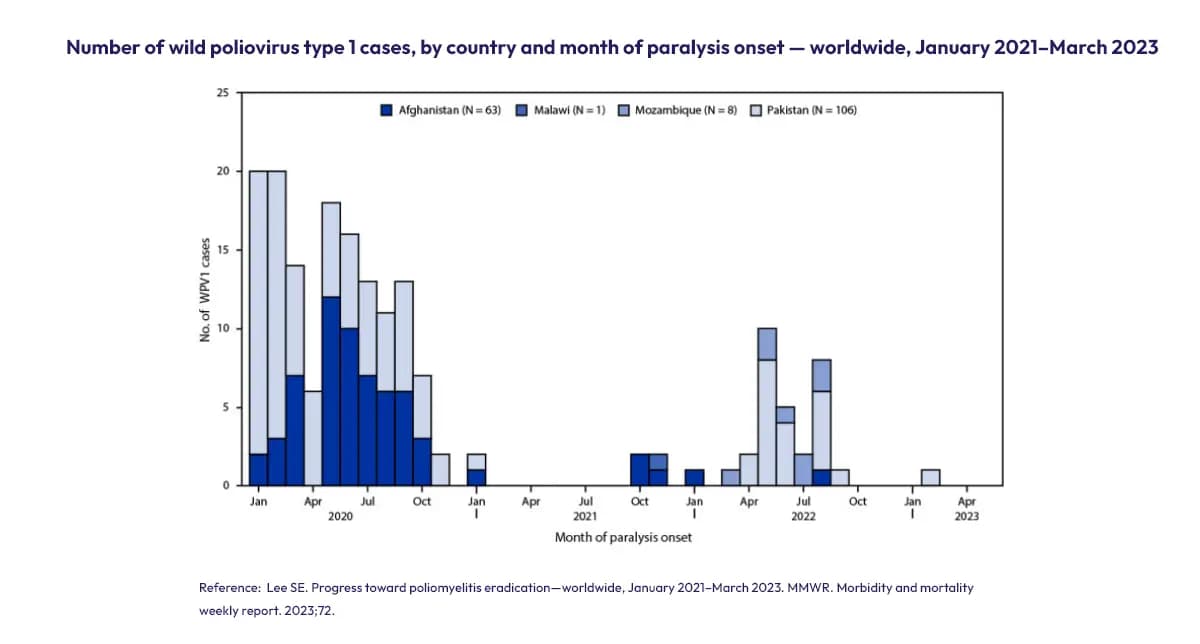
WPV1 cases by country: Afghanistan, Pakistan lead 2020-2023 polio persistence.
Ongoing Declarations and Innovations
- New cVDPV Outbreaks: cVDPV outbreaks were reported in 32 countries in 2023, eight of which had not experienced outbreaks the previous year.
- cVDPV1 and cVDPV2 Cases: Of the total cases in 2023, 133 were identified as cVDPV1, while 391 were classified as cVDPV2. [6]
- Innovation Spotlight: A 2024 study indicates that the novel oral polio vaccine type 2 (nOPV2), with improved genetic stability compared to the Sabin OPV, shows promise in lowering the risk of circulating vaccine-derived poliovirus type 2 (cVDPV2). Approximately one billion doses have been administered under Emergency Use Listing (EUL) across 35 countries from March 2021 to December 2023. [7]
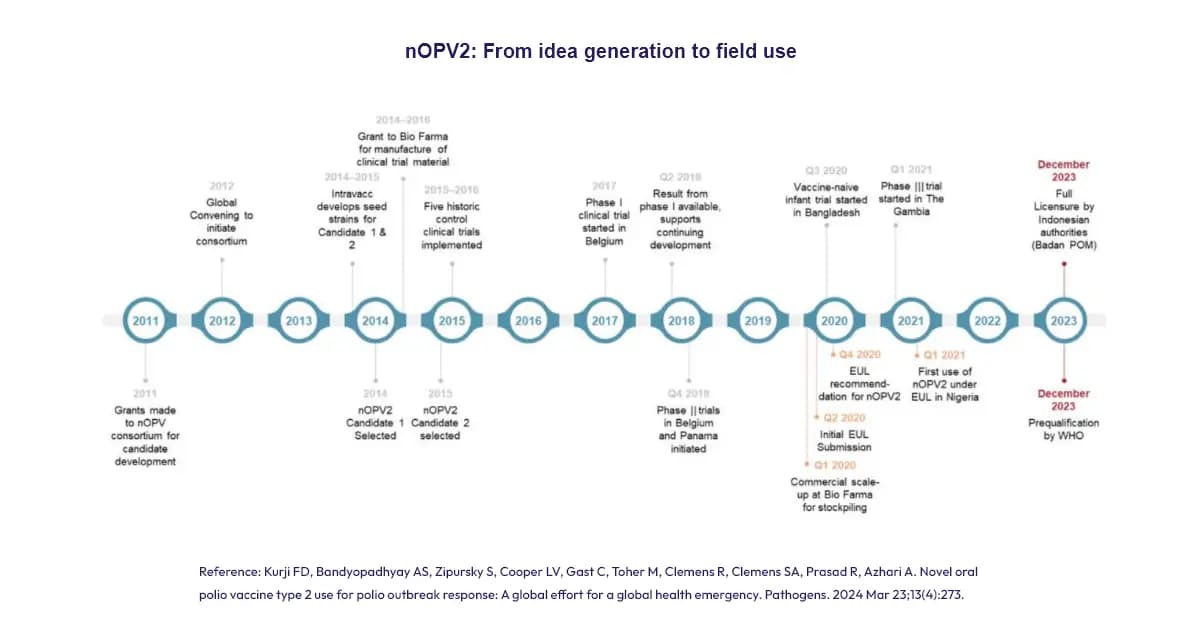
nOPV2 Timeline: From 2011 research to 2023 WHO prequalification for polio eradication.
Environmental Surveillance: The Unsung Hero
Wastewater surveillance has become a critical and valuable tool in detecting silently circulating poliovirus in wastewater in various locations, helping public health officials monitor and respond to potential outbreaks.
- 2022 Sequencing Confirmation: In 2022, analyzing the genetic material of the poliovirus (sequencing) verified the presence of poliovirus in 100 samples from various counties in New York State. [8]
- Wastewater Testing Results: Out of 1,076 wastewater samples collected from 48 sewer systems in at least five New York counties, 89 (or 8.3%) from 10 sewer systems in Rockland County tested positive for poliovirus type 2. [9]
- Canada Detection Report: According to a Canadian government report, the Public Health Agency of Canada detected signs of vaccine-derived poliovirus in two wastewater samples collected in August 2022 from Montreal, Quebec. This report was confirmed on December 23, 2022. [10]
Action Point: An article from the Global Polio Eradication Initiative, published in May 2024, mentions that 15 new wastewater surveillance sites were established in affected countries in southern Africa over two years. [11] We can advocate for strengthened environmental surveillance in our region for early detection of potential polio circulation.
Environmental surveillance: Crucial tool in detecting silent poliovirus circulation.
Polio-free smiles: Children showcase the human impact and future earning potential of successful eradication efforts
The Economic Imperative of Polio Eradication
The financial benefits of polio eradication are significant.
- Polio Program Transition: A February 2024 study reveals that shifting polio programs in eight WHO Eastern Mediterranean countries could generate US$289.2 billion in benefits by merging polio resources into broader health initiatives.
- Investment Return: With a total cost of US$7.5 billion, this transition returns nearly US$39 for every dollar invested.
- Surveillance Program Return: For every dollar invested in improving surveillance and emergency response programs by reusing polio program resources, there is a return of US$36.40. [12]
Key Message: investing in polio eradication is not only essential for public health but also a smart economic decision.
Innovative Approaches to Reach the Latest Mile
New strategies are being employed to overcome the final hindrances
- Geospatial Technology Benefits: Studies show that geospatial tools like Geographic Information Systems (GIS) mapping can enhance immunization coverage and equity by identifying missed settlements and areas with the most zero-dose and under-immunized children. This helps immunization managers better allocate resources and place health services effectively. [13 & 14]
- Mobile Technology Impact: Mobile technology is key in boosting vaccination efforts, particularly in remote areas. It improves data collection, planning, communication, and access to information while enhancing decision-making through better data analysis and monitoring. [15 & 16]
Key Strategy: Implement culturally sensitive, technology-driven outreach programs to boost vaccination rates in your community.
Empowering global health through digital innovation and community outreach.
Diverse medical professionals united in the battle against Polio.
The Role of Healthcare Professionals in Polio Eradication
As frontline workers, our actions are crucial
- Investigate Suspected Cases: Examine suspected polio cases to identify potential virus transmission and take action to control its spread.
- Immediate Reporting: Report any patient with suspected poliomyelitis to the state or local health department immediately. [17]
- Maintain Immunization Coverage: Ensure high routine vaccination rates to prevent polio outbreaks.
- Community Education: Educate communities on the importance of vaccines and address concerns about vaccine hesitancy.
Call to Action: Join the global polio eradication effort. Your expertise and dedication can help achieve a polio-free world.
Advancing Vaccination Efforts with CIMA Care's Digital Solutions and Training
At CIMA Care, we're committed to supporting healthcare professionals, Parents, and policymakers in the fight against polio. Our digital platform offers tools for tracking vaccination coverage, identifying high-risk areas with higher defaulter rates, and helping parents be confident about vaccination and show up on time for their children's appointments. Through our CIMA Health Academy, we provide up-to-date training on vaccination strategies and catch-up endeavors.
The eradication of polio remains an urgent global health priority. Your expertise and dedication are crucial in this final push towards a polio-free world. Visit www.cima.care to explore how you can collaborate with CIMA Care and make a significant impact on public health. Together, we can turn the page on polio and pave the way for future health triumphs
CIMA Care's tools Enhance child immunization tracking and management and help parents and healthcare workers make better-informed decisions.
Image References
- 1- Adobe Stock. [Internet]. Adobe Stock; [cited 2025 Aug 18]. Available from: https://stock.adobe.com/236077728
- 2- Freepik. Small black boy receiving vaccine due to COVID-19 pandemic [Internet]. Freepik; [cited 2025 Aug 18]. Available from: https://www.freepik.com/free-photo/small-black-boy-receiving-vaccine-due-covid19-pandemic_26766397.htm
- 3- NCBI. Figure F1 [Internet]. PMC; [cited 2025 Aug 18]. Available from: https://www.ncbi.nlm.nih.gov/pmc/articles/PMC10208367/figure/F1/
- 4- NCBI. Figure F7 (pathogens-13-00273) [Internet]. PMC; [cited 2025 Aug 18]. Available from: https://www.ncbi.nlm.nih.gov/pmc/articles/PMC11054755/figure/pathogens-13-00273-f007/
- 5- Adobe Stock. [Internet]. Adobe Stock; [cited 2025 Aug 18]. Available from: https://stock.adobe.com/709985841
- 6- Adobe Stock. [Internet]. Adobe Stock; [cited 2025 Aug 18]. Available from: https://stock.adobe.com/311487387
- 7- Adobe Stock. [Internet]. Adobe Stock; [cited 2025 Aug 18]. Available from: https://stock.adobe.com/399508348
- 8- Adobe Stock. [Internet]. Adobe Stock; [cited 2025 Aug 18]. Available from: https://stock.adobe.com/955059637
- 9- Adobe Stock. [Internet]. Adobe Stock; [cited 2025 Aug 18]. Available from: https://stock.adobe.com/980113335
- 10- Adobe Stock. [Internet]. Adobe Stock; [cited 2025 Aug 18]. Available from: https://stock.adobe.com/21297285
- 11- Adobe Stock. [Internet]. Adobe Stock; [cited 2025 Aug 18]. Available from: https://stock.adobe.com/784395667
- 12- Adobe Stock. [Internet]. Adobe Stock; [cited 2025 Aug 18]. Available from: https://stock.adobe.com/494955567
Blog Resources
- 1- CDC. About Global Polio Eradication [Internet]. Global Polio Vaccination. 2024. Available from: About Global Polio Eradication
- 2- The U.S. Government and Global Polio Efforts [Internet]. The Henry J. Kaiser Family Foundation. 2019. Available from: The U.S. Government and Global Polio Efforts | KFF
- 3- Center for Infectious Disease Research and Policy [Internet]. University of Minnesota Twin Cities. 2024 [cited 2024 Oct 15]. Available from: Afghanistan, Pakistan report more wild poliovirus cases
- 4- Center for Infectious Disease Research and Policy [Internet]. University of Minnesota Twin Cities. 2024 [cited 2024 Oct 15]. Available from: Seven countries report more polio cases, including wild-type in Afghanistan
- 5- Lee SE. Progress toward poliomyelitis eradication—worldwide, January 2021–March 2023. MMWR. Morbidity and mortality weekly report. 2023;72.
- 6- Geiger K. Progress Toward Poliomyelitis Eradication — Worldwide, January 2022–December 2023. MMWR Morbidity and Mortality Weekly Report [Internet]. 2024;73. Available from: Progress Toward Poliomyelitis Eradication ...
- 7- Kurji FD, Bandyopadhyay AS, Zipursky S, Cooper LV, Gast C, Toher M, Clemens R, Clemens SA, Prasad R, Azhari A. Novel oral polio vaccine type 2 use for polio outbreak response: A global effort for a global health emergency. Pathogens. 2024 Mar 23;13(4):273.
- 8- Polio Wastewater Surveillance [Internet]. www.health.ny.gov. Available from: Polio Wastewater Surveillance
- 9- Ryerson AB. Wastewater Testing and Detection of Poliovirus Type 2 Genetically Linked to Virus Isolated from a Paralytic Polio Case — New York, March 9–October 11, 2022. MMWR Morbidity and Mortality Weekly Report [Internet]. 2022;71. Available from: Wastewater Testing and Detection of Poliovirus Type 2 ...
- 10- Center for Infectious Disease Research and Policy [Internet]. University of Minnesota Twin Cities. 2023 [cited 2024 Oct 15]. Available from: Canada detects poliovirus in wastewater samples
- 11- GPEI-Timely outbreak response, enhanced surveillance halts wild poliovirus transmission in Southern Africa [Internet]. GPEI-Homepage. 2024 [cited 2024 Oct 15]. Available from: GPEI-Timely outbreak response, enhanced surveillance halts wild poliovirus transmission in Southern Africa
- 12- Administrator. Sustaining polio investments offers a high return [Internet]. World Health Organization - Regional Office for the Eastern Mediterranean. 2023 [cited 2024 Oct 15]. Available from: Sustaining polio investments offers a high return
- 13- Chaney SC, Mechael P, Thu NM, Diallo MS, Gachen C. Every Child on the Map: A Theory of Change Framework for Improving Childhood Immunization Coverage and Equity Using Geospatial Data and Technologies. Journal of medical Internet research. 2021 Aug 3;23(8):e29759.
- 14- GIS MAPPING EVIDENCE BRIEF Evidence on pro-equity interventions to improve immunization coverage for zero- dose children and missed communities [Internet]. Available from: https://zdlh.gavi.org/sites/default/files/2023-09/6._evidence_brief_gis.pdf
- 15- Oliver-Williams C, Brown E, Devereux S, Fairhead C, Holeman I. Using mobile phones to improve vaccination uptake in 21 low-and middle-income countries: systematic review. JMIR mHealth and uHealth. 2017 Oct 4;5(10):e7792.
- 16- The Use of Digital Technologies and Approaches for Real-Time Monitoring of Supplementary Immunization Activities Good practices and lessons learned [Internet]. Available from: https://www.unicef.org/media/93781/file/gavi-unicef-digital-technology-immunization-2021.pdf
- 17- CDC. Clinical Guidance for Investigating a Suspected Case of Polio [Internet]. Polio. 2024. Available from: Clinical Guidance for Investigating a Suspected Case of Polio
Enjoyed this article?
Share it with your friends on LinkedIn: Polio Eradication: The Unfinished Journey in Global Health 
Follow us on LinkedIn for more updates and insights: Cima Care GmbH