
Evidence-Based Insight: How Smart Vaccine Switches Reach More Children with Safety, Efficiency, and Equity |
Smaller Vials, Fewer Shots, Safer Polio Vaccines: The Science Behind Africa's Vaccine Switches
Reviewed by Fabrice Sewolo Matondo, MD, MPH, MSc — PhD Student, Epidemiologist
Published 16 November 2026 · 6 min read
Sometimes a child misses a vaccine not because the vaccine is unavailable, but because of vial size. A nurse holding a 10-dose measles vial may wait for ten children before opening it to avoid wasting doses. Meanwhile, measles keeps spreading. In 2024, there were an estimated 95,000 measles deaths globally, mostly among unvaccinated or under-vaccinated children under the age of 5, [32] and about 80 percent of deaths were in Africa and the Eastern Mediterranean. [33]
"Vaccine switches" are one of the most practical answers available today. A switch can change the vial size, the combination of antigens, the route, or the schedule. This article is inspired by the Vaccinology Africa webinar on vaccine switches, hosted by the NITAG Support Hub (NISH) at the University of Cape Town with experts from WHO AFRO, Gavi, the Sabin Vaccine Institute, Linksbridge, Zambia, and Ethiopia, [1] and draws on the newest peer-reviewed evidence.
What Is a Vaccine Switch—and Why Now?
Dr. Sidy Ndiaye of WHO AFRO defined a vaccine switch as replacing one vaccine with another that prevents the same disease but has different product attributes. Those attributes can be the antigens, the formulation, the number of doses per vial, the route of administration, or the schedule. [1]
African countries have experience changing vaccine formulations, packaging, and schedules, although these changes have not occurred uniformly across the continent:
- In 2016, countries switched from the trivalent oral polio vaccine (oral drops protecting against poliovirus types 1, 2, and 3) to the bivalent oral polio vaccine (protecting against types 1 and 3). [2]
- Countries such as South Sudan replaced DTP, the vaccine against diphtheria, tetanus, and pertussis (whooping cough), with a pentavalent, or five-in-one, vaccine that adds protection against hepatitis B and Haemophilus influenzae type b (Hib), a bacterium that can cause meningitis and pneumonia. [3-4]
- Vaccine-packaging changes include trials in Zambia to switch from 10-dose to 5-dose measles–rubella vials: containers holding enough vaccine for 10 or 5 individual doses against measles and rubella. [5]
- Some countries have reduced the number of doses in their human papillomavirus (HPV) vaccination schedule; South Africa, for example, switched to one dose in October 2024 to protect girls against HPV infection, which can cause cervical cancer. [6]
A further transition is now recommended. According to the Global Polio Eradication Initiative's 15 October 2026 explanation, the World Health Organization's Strategic Advisory Group of Experts on Immunization (SAGE), its expert advisory group on vaccination, recommends that countries providing fewer than three doses of inactivated polio vaccine (IPV), an injected vaccine containing killed poliovirus, move without delay to a three-dose IPV-containing infant routine immunization schedule, meaning vaccination delivered through regular infant services. SAGE recommends delivering the third IPV dose, preferably by introducing a hexavalent, or six-in-one, vaccine that combines protection against polio, diphtheria, tetanus, pertussis, hepatitis B, and Hib in one injection. Approximately 40 countries eligible for support from Gavi, the Vaccine Alliance, not necessarily all in Africa, are expected to switch to hexavalent vaccines during Gavi 6.0, the Alliance's 2026–2030 strategy period. [7-8]
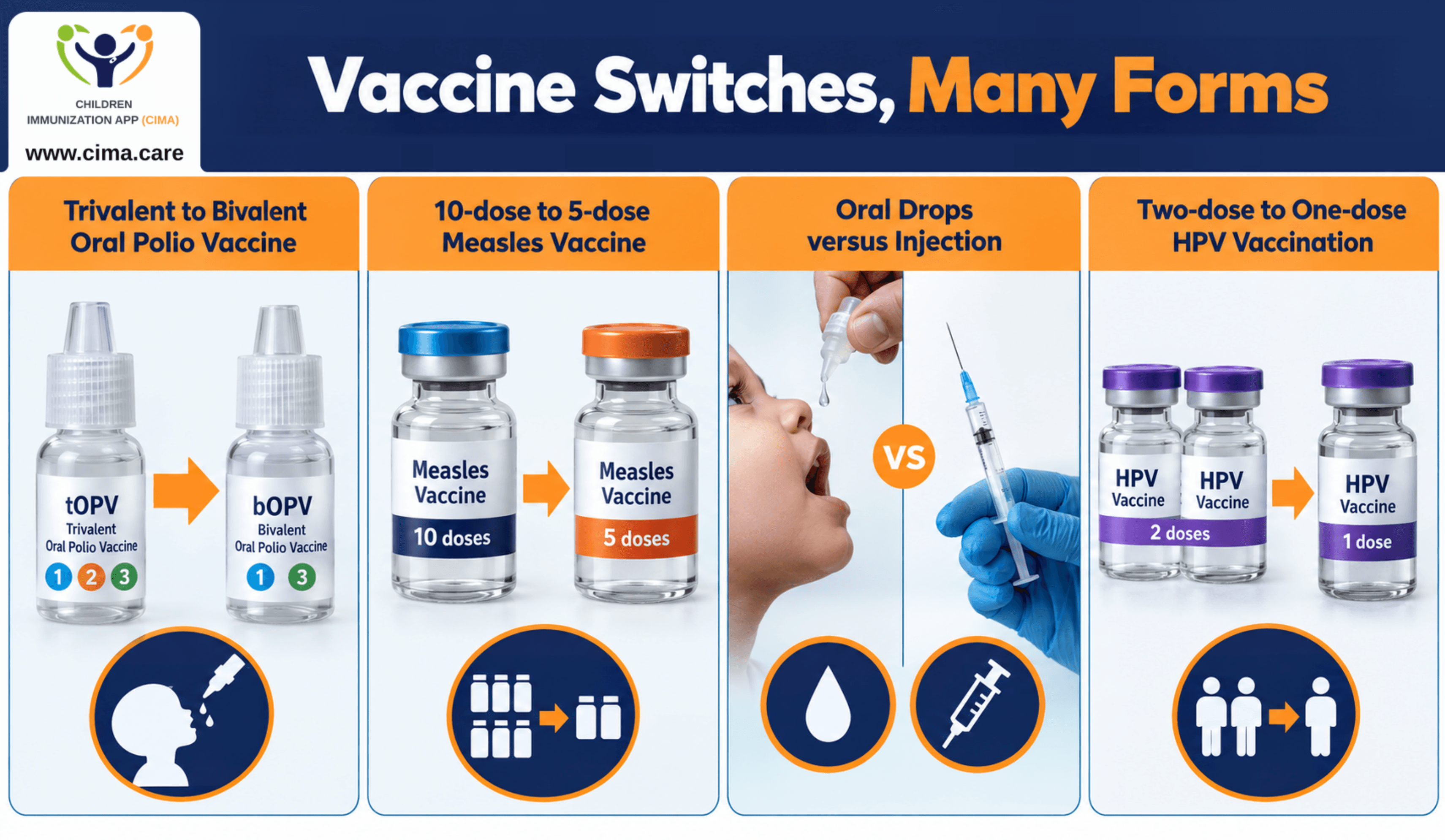
Vaccine switches can change antigen composition, vial size, administration route, or dosing schedule.
Safety First: What Changes and What Does Not
Smaller vials, not smaller doses: Switching from 10-dose to 5-dose measles-containing vaccine vials changes how many vaccinations each container supplies, not the dose each child receives. Staff must use the manufacturer-specified diluent, the liquid mixed with the freeze-dried vaccine, and the correct volume for that product and vial size. [9-10]
The six-hour rule still applies: Reconstitution means mixing the freeze-dried vaccine with its diluent. Reconstituted measles vaccine must be discarded within six hours or at the end of the vaccination session, whichever comes first; keeping it refrigerated does not permit reuse at the next session. WHO documents infant deaths following improper reuse after a session ended, underscoring the importance of safe preparation and disposal. The separate rule allowing some opened multi-dose vaccines to be kept for up to 28 days applies only to specifically eligible products, not reconstituted measles vaccine. [11-12]
Six-in-one: reassuring, product-specific evidence: HEXASIIL is a hexavalent, or six-in-one, vaccine against diphtheria, tetanus, pertussis (whooping cough), hepatitis B, polio and disease caused by Haemophilus influenzae type b (Hib). Its whole-cell pertussis component contains killed pertussis bacteria. In a phase III trial, a large comparative study before licensing, its immune responses met the predefined non-inferiority criteria, meaning they were not unacceptably worse than those produced by pentavalent (five-in-one) vaccine plus a separate inactivated polio vaccine (IPV), which contains killed poliovirus. Side-effect patterns were comparable, and no serious event was judged vaccine-related; this does not mean that no side effects occurred. [13]
A lower-risk oral polio vaccine, not zero risk: Oral polio vaccine contains weakened live virus. When it circulates for prolonged periods in under-vaccinated communities, it can change genetically and regain the ability to cause paralysis; continued spread is called circulating vaccine-derived poliovirus (cVDPV). Novel oral polio vaccine type 2 (nOPV2) was designed to resist these changes. Modeling informed by field data estimated an 82% lower risk of cVDPV type 2 emergence than with the older Sabin type 2 oral polio vaccine. That figure refers only to the risk of a new outbreak occurring in a community, not the risk that an individual child would become paralyzed. Uganda's campaign safety surveillance recorded adverse events following immunization (AEFI)—medical problems occurring after vaccination, not necessarily caused by it—in 1,128 children. Of 109 serious events, six were assessed by the National AEFI Committee as consistent with a causal association with nOPV2 immunization; no vaccine-associated paralytic polio was detected. [14-15]
The takeaway: a switch is also a safety moment. Health workers must report any adverse event following immunization (AEFI), meaning any health problem that occurs after vaccination, whether or not the vaccine caused it.
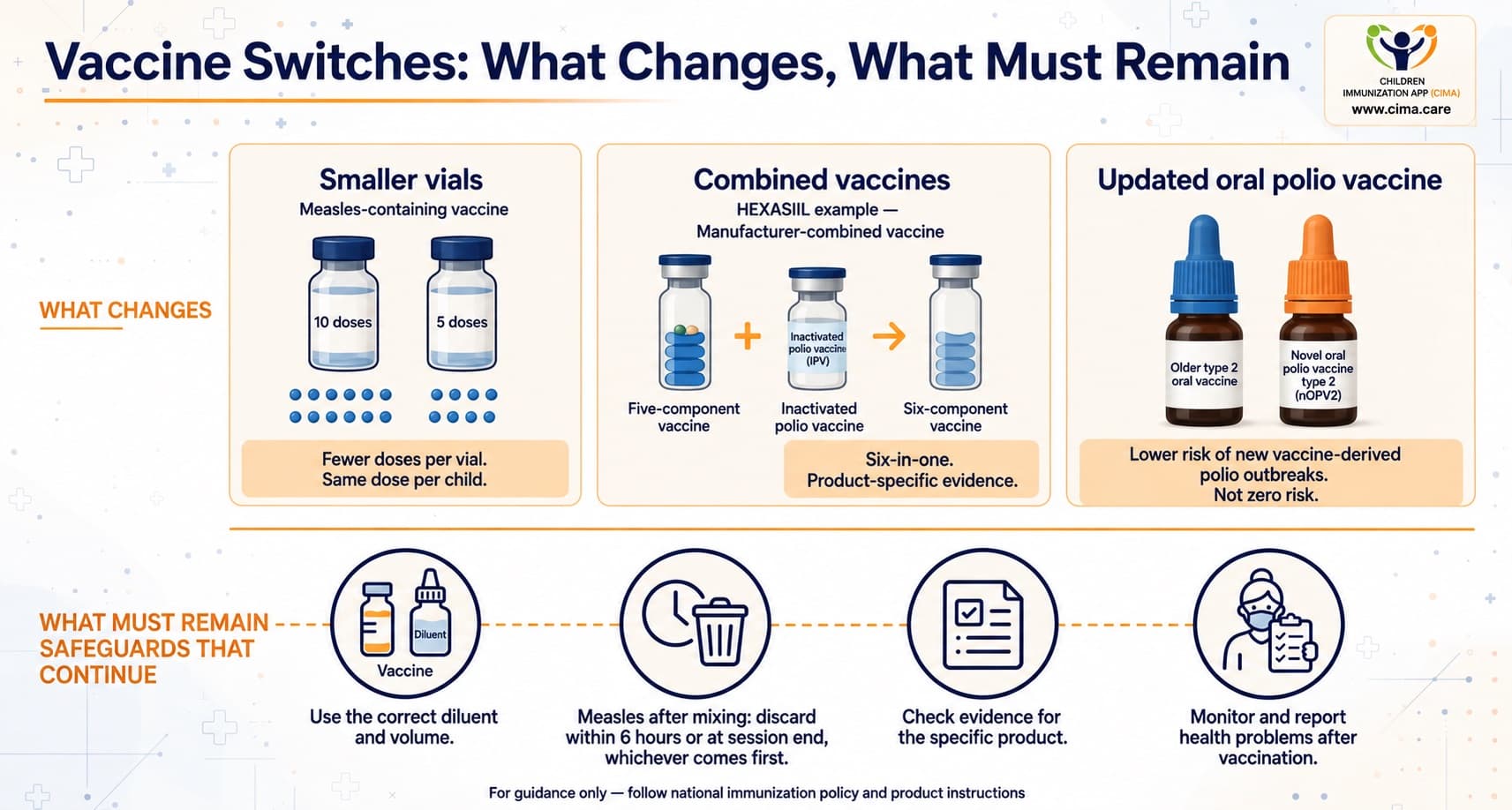
Vaccine switches change products or packaging; correct handling, product-specific evidence and safety monitoring remain essential.
The Measles 5-Dose Switch: Smaller Vials, Fewer Missed Vaccination
Zambia: higher coverage and less waste: In Zambia, researchers paired 14 districts and randomly assigned seven to use 5-dose measles–rubella vaccine vials, which protect against both diseases; seven continued using 10-dose vials. After 11 months, vaccination cards supplemented by caregivers' recall showed estimated improvements attributable to the switch of 4.9 percentage points in first-dose coverage and 3.5 points in second-dose coverage, compared with districts retaining 10-dose vials. Coverage is the proportion of children in the assessed age group vaccinated; percentage points measure the difference between percentages. However, when vaccination cards alone were used, the additional improvement from the switch was not statistically significant, meaning the analysis did not clearly distinguish an effect from chance variation. [16]
With 5-dose vials, about 16 of every 100 vaccine doses were discarded unused after opening, compared with about 31 of every 100 doses with 10-dose vials. This represents approximately 47% less waste. Facilities managed the switch using their existing cold chain, the refrigerated system that stores and transports vaccines. Once the savings from fewer discarded doses were included, the vaccine cost per dose given to a child was almost the same with either vial size. [16, 17]
Ethiopia: more timely vaccination: A 15-month trial randomly assigned 60 woredas (districts) to three groups:
- Usual practice: continue using 10-dose measles vaccine vials under existing procedures.
- New instructions, same vial size: continue using 10-dose vials, but instruct staff to open one even if only one child is eligible for vaccination. Provide additional vaccine supplies to support this approach.
- New instructions, smaller vials: give staff the same instructions and additional supplies as Group 2, but replace 10-dose vials with 5-dose vials.
Compared with Group 1 (usual practice), Group 3, which used smaller 5-dose vials, instructed staff to open a vial even for one eligible child, and received additional vaccine supplies, achieved:
- First-dose vaccination on time, at nine months: an estimated 18 additional children vaccinated on time for every 100 children assessed.
- Second-dose vaccination: an estimated 17 additional children receiving their second dose for every 100 children assessed.
- Less vaccine waste: an estimated seven fewer doses discarded unused for every 100 doses supplied.
However, Group 3 did not show a statistically clear increase in the proportion of children who received their first dose at any time. In other words, the intervention improved the likelihood that children received their first dose on time, without clearly increasing the overall number who received it.
Group 2, which received the same instructions and additional supplies but continued using 10-dose vials, showed no statistically clear improvement in these vaccination measures compared with usual practice. "No statistically clear improvement" means the study could not confidently distinguish the observed differences from chance variation. [18]
Across Africa: promising but uneven evidence: A 2025 review of seven countries in the WHO African Region reported greater willingness to open vials, more flexible services and, in some settings, higher coverage and lower wastage. However, much of the evidence came from interviews and routine program reports rather than controlled comparisons, so countries cannot confidently attribute the improvements to vial size alone. [19]
By June 2025, 17 countries in the region were using measles-containing vaccines in vials holding five or fewer doses. Smaller vials can help reduce missed vaccinations, but countries still need to assess storage, delivery costs and staff training before switching. [18, 19]
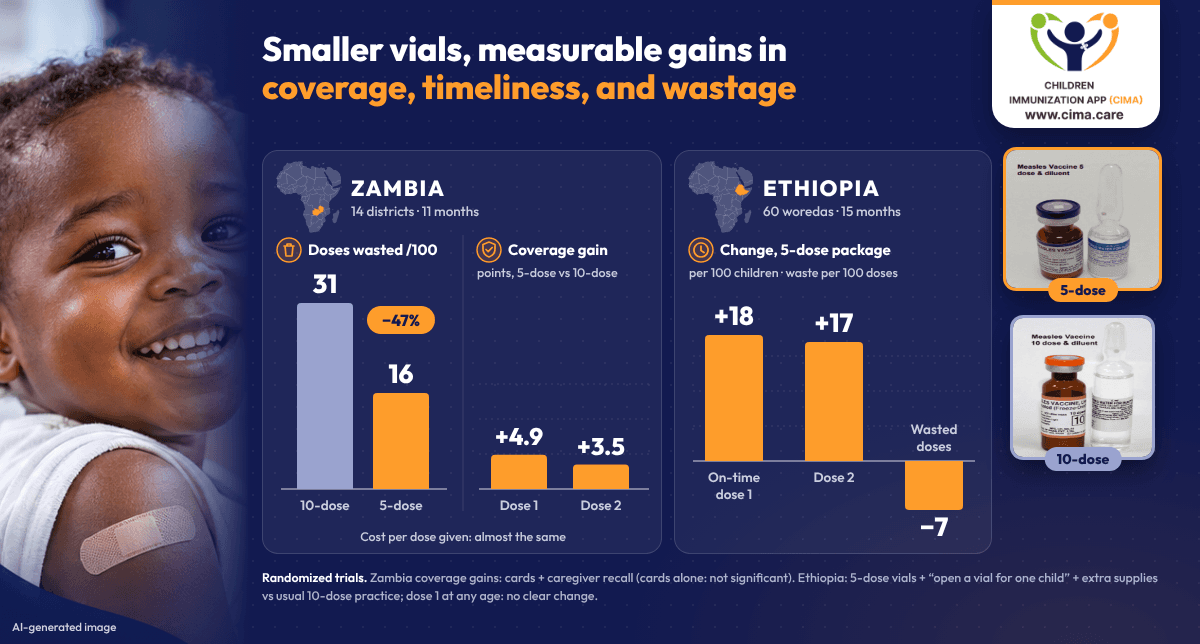
Five-dose vaccine strategies improved vaccination outcomes and reduced wastage in Zambia and Ethiopia.
Six Diseases, One Injection: Hexavalent Arrives in Africa
Hexavalent means six-in-one: each injection protects against diphtheria, tetanus, pertussis (whooping cough), hepatitis B, polio, and disease caused by Haemophilus influenzae type b (Hib), a bacterium that can cause serious infections, including meningitis and pneumonia. It combines the existing pentavalent (five-in-one) vaccine with inactivated polio vaccine (IPV), which contains killed poliovirus. Children still need the recommended series of doses; "six-in-one" does not mean one injection completes their vaccination. [20-22]
On July 1st, 2025, Mauritania and Senegal introduced the vaccine with support from Gavi, the Vaccine Alliance. Gavi described these launches as its first rollout of this six-in-one vaccine in low-income countries. In Senegal, the change replaces separate pentavalent and IPV injections with one combined injection when both are due and increases the infant IPV series from two doses to three before six months of age. [21-23]
The aim is to help more children receive polio protection alongside their other routine vaccines, with fewer injections. Gavi's July 2025 article reported average coverage, the proportion of children vaccinated, of 83% for the third dose of a DTP-containing vaccine (against diphtheria, tetanus and pertussis), compared with 42% for the second IPV dose. Combining these vaccines could help narrow that gap, although improved uptake is expected, not guaranteed. [22, 23]
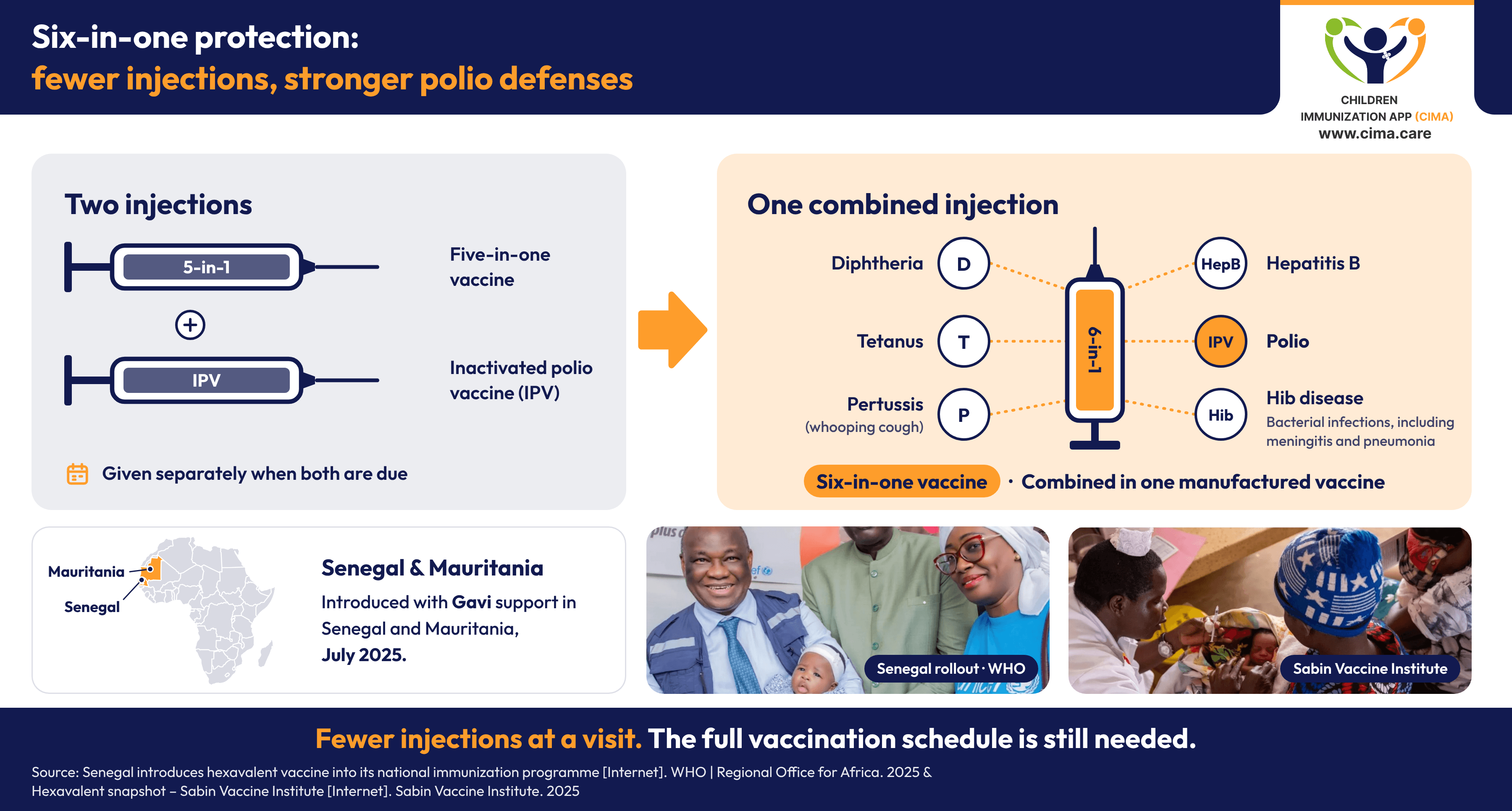
Six-in-one vaccination combines five-in-one and polio vaccines in one injection; the full dose schedule remains essential
One Dose Instead of Two: The HPV Switch
One Dose Instead of Two: The HPV Switch: Human papillomavirus (HPV) is a group of viruses, some of which cause cervical cancer—cancer of the cervix, the lower part of the womb. Vaccination prevents infections that can lead to this cancer. [24]
Strong evidence for one dose: The ESCUDDO trial in Costa Rica randomly assigned 20,330 girls aged 12–16 to receive one or two doses of either a bivalent HPV vaccine, targeting two virus types, or a nonavalent vaccine, targeting nine. SCUDDO stands for the Spanish name meaning “Study Comparing One and Two Doses of Vaccines Against Human Papillomavirus”—began in Costa Rica in November 2017. In Over five years, one dose of either vaccine met the study's non-inferiority criterion: protection was not unacceptably worse than with two doses.
The outcome measured was new infection with cancer-causing HPV types 16 or 18 that persisted for at least six months, not cervical cancer itself. This distinction matters: the trial directly demonstrated protection against persistent infection, an important step toward preventing cancer. [25]
Countries are simplifying their schedules: By January 2026, 89 countries had adopted single-dose HPV vaccination, according to Johns Hopkins’ International Vaccine Access Center. Separately, Gavi, the Vaccine Alliance, reported that more than 95 million girls (the cumulative reach of Gavi-supported HPV vaccination) had been vaccinated against HPV with its support by the end of 2025. This cumulative total includes different vaccination schedules; it is not a count of girls receiving one dose alone.
One dose is not appropriate for everyone. WHO allows a single-dose option for eligible young people, but those with weakened immune systems, including people living with HIV, should receive at least two doses and, where possible, three. [26]
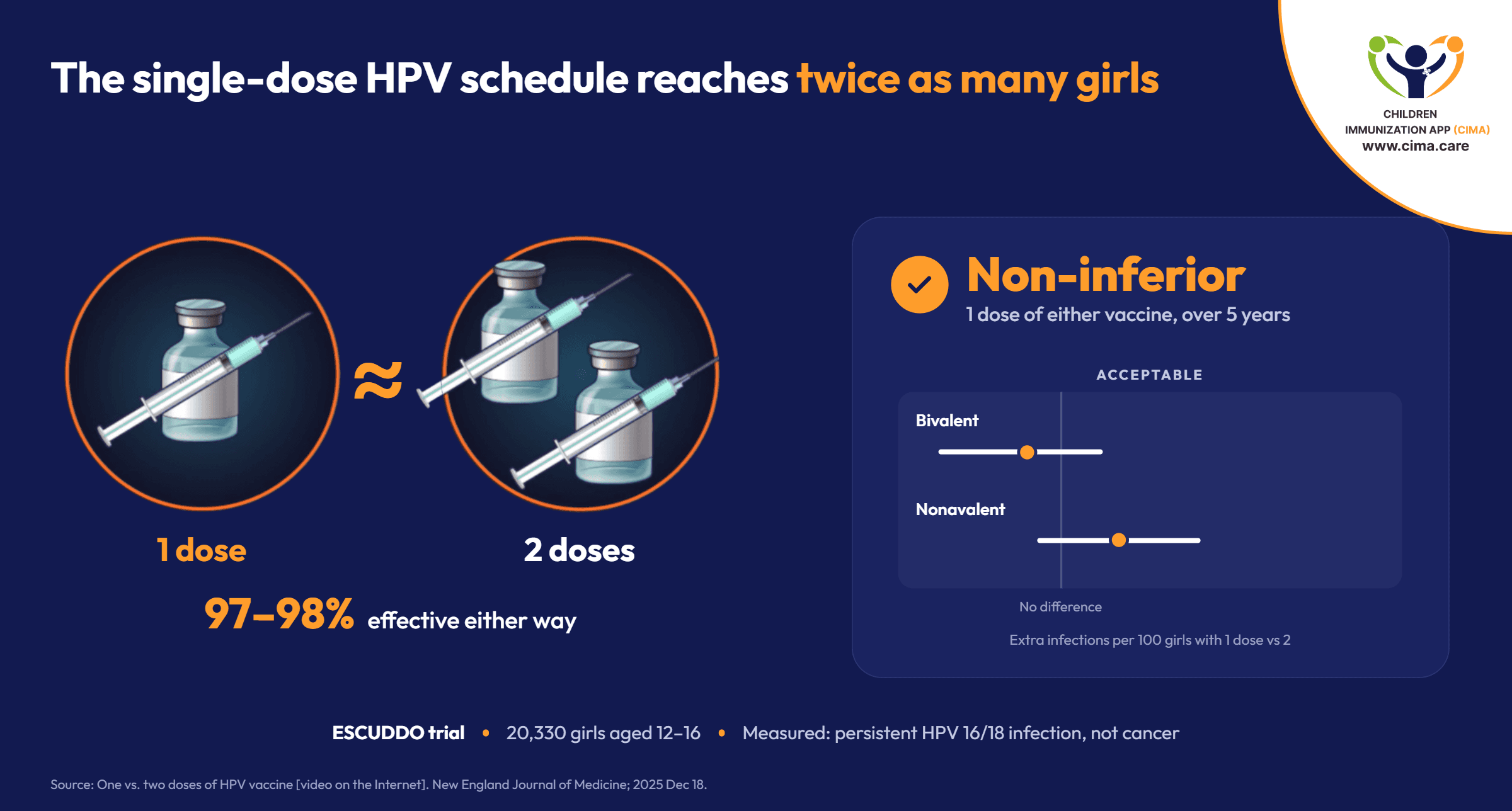
In the ESCUDDO trial, one HPV vaccine dose provided protection comparable to two against persistent HPV16/18 infection over five years.
How Countries Decide and Succeed
Review the evidence
National Immunization Technical Advisory Groups (NITAGs) are expert committees that advise governments on vaccination policy. An Evidence-to-Recommendation framework provides a structured way to assess benefits and risks, costs, acceptability, equity (fair access to vaccination), and feasibility, or whether the change can work in practice. Cost-effectiveness considers the health benefits gained for the resources spent. [27, 28]
Plan funding and delivery
Gavi, the Vaccine Alliance, offers eligible countries financial and technical support, including support for vaccine switches and refrigerated storage systems. Countries must assess their specific funding options and plan vaccine orders, delivery dates, and use of remaining stocks to avoid shortages or unnecessary waste. [29-31]
Prepare staff and systems
TechNet-21’s guidance for switching to 5-dose measles-containing vaccine vials outlines five phases: assess and decide; update guidance and tools; train staff; prepare supplies and delivery systems; and implement, monitor and evaluate. Preparation includes checking the cold chain, the refrigerated storage and transport system, and updating stock records and instructions for opening vials.
Estimate effects, then check results
An Excel-based assessment tool available through TechNet-21 helps countries compare expected vaccination coverage, the proportion of eligible children vaccinated, unused doses, storage needs, supply requirements and costs. These are estimates, not guaranteed outcomes; countries should monitor actual results and adjust orders, training and delivery arrangements after the switch. [10]
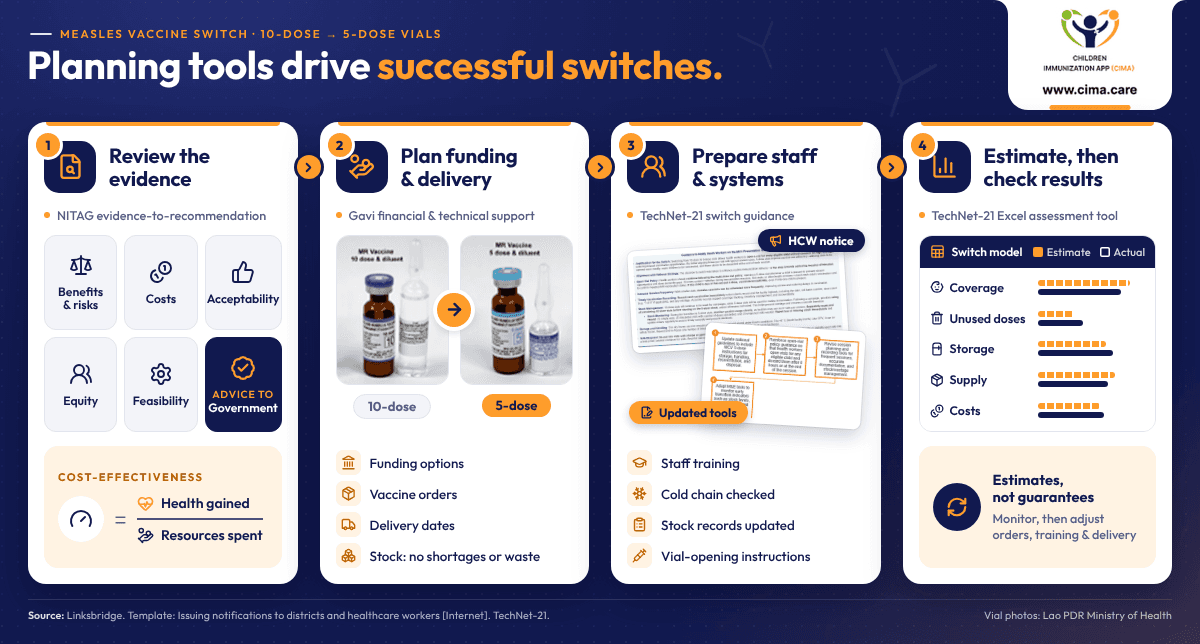
Switching to smaller measles vaccine vials requires evidence review, funding, staff preparation and monitoring of actual results.
From Evidence to Every Child: Making Vaccine Switches Work
The science is clear. Well-planned switches, such as smaller measles vials, six-in-one combinations, single-dose HPV vaccination, and safer polio vaccines, help more children get protected on time, safely. A switch succeeds only when the evidence, safety practices, supply planning, and the people delivering vaccines move together.
Ready to lead the next switch in your program?
CIMA Care supports both parts of that equation:
- CIMA Health Academy offers CPD-certified courses on prophylactic healthcare, including vaccination programs, immunization recovery, HPV vaccination, and AEFI management. These courses help health workers apply new products and safety rules with confidence.
- The CIMA platform helps keep immunization programs aligned as vaccines and schedules change. As vaccine formulations, packaging, and schedules evolve, immunization programs need tools that adapt just as quickly. The CIMA Care platform lets administrators update the local vaccine schedule in real time, adding new doses or discontinuing old ones when products change. This keeps every health facility working from the same current schedule rather than from outdated paper charts. The platform also tracks children who miss doses and sends SMS reminders that bring families back for the more frequent vaccination sessions that smaller vial sizes make possible. These capabilities are built on five connected features. Flexible schedule management allows national policy changes to be reflected across all facilities at once, while comprehensive vaccination tracking follows every child through the complete immunization schedule. Geographic coverage visualization turns this data into heat maps and dashboards that show program managers where coverage is weakest and where resources are needed most. Defaulter identification and follow-up flag children who miss a dose and ensure health workers reach them before gaps in protection grow. Finally, automated multilingual health messaging keeps families informed and engaged in their own language, building the trust and understanding that brings them back for every visit. Together, these features ensure that as vaccines switch, no child is left behind.
Vaccines switch, and schedules change, but protection should not. From smart data to trained hands to informed families, CIMA Care connects it all, so every child gets every vaccine, on time.
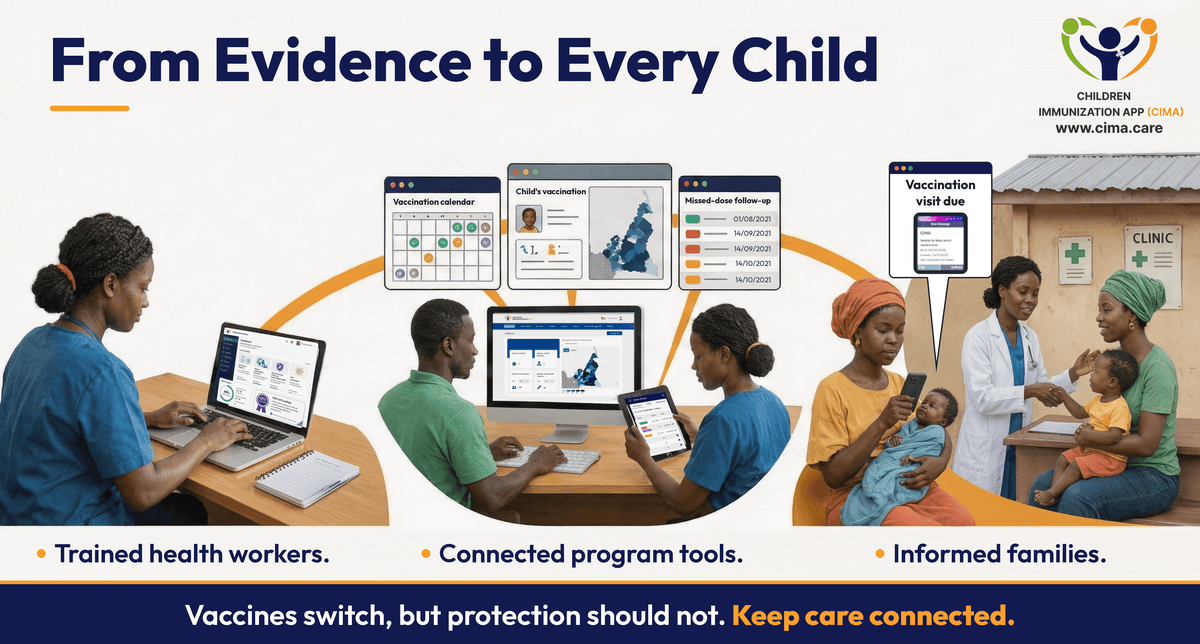
CIMA Care connects training, digital tools and families to support vaccine switches.
CONFLICTS OF INTEREST
LICENCE


Image References
1. NITAG Support Hub, University of Cape Town. Rationale and evidence to support vaccine switches in Africa [webinar on the Internet]. Cape Town: University of Cape Town; 2024 Dec 11 [cited 2026 Nov 5]. Available from: https://health.uct.ac.za/nish/webinar-recordings2. United Nations Children’s Fund. Switching from ten-dose to five-dose vials may equal more children vaccinated from measles [Internet]. UNICEF Supply Division; [date unknown] [cited 2026 Nov 5]. Available from: https://www.unicef.org/supply/switching-ten-dose-five-dose-vials-may-equal-more-children-vaccinated-measles3. World Health Organization Regional Office for Africa. Senegal introduces hexavalent vaccine into its national immunization programme [Internet]. 2025 Jul 1 [cited 2026 Nov 5]. Available from: https://www.afro.who.int/countries/senegal/news/senegal-introduces-hexavalent-vaccine-its-national-immunization-programme4. Sabin Vaccine Institute. Supporting the transition from pentavalent to hexavalent vaccines [Internet]. [date unknown] [cited 2026 Nov 5]. Available from: https://www.sabin.org/supporting-hexavalent-transition/5. One vs. two doses of HPV vaccine [video on the Internet]. New England Journal of Medicine; 2025 Dec 18 [cited 2026 Nov 5]. doi: 10.1056/NEJMdo008299. Available from: https://www.nejm.org/do/10.1056/NEJMdo008299/full/6. Linksbridge. Template: issuing notifications to districts and healthcare workers [Internet]. TechNet-21; 2026 Jan 21 [cited 2026 Nov 5]. Available from: https://www.technet-21.org/en/resources/guidance/template-issuing-notifications-to-districts-and-healthcare-workers
Blog Resources
- 1- NITAG Support Hub (NISH), University of Cape Town. Vaccinology Africa Webinar: Vaccine Switches in Africa. December 2024. Available from: https://health.uct.ac.za/nish/webinar-recordings#vaccinology-africa
- 2- World Health Organization (WHO). Seychelles has “SWITCHED”- from tOPV to bOPV [Internet]. WHO | Regional Office for Africa. 2016 [cited 2026 Oct 28]. Available from: https://www.afro.who.int/countries/seychelles/news/seychelles-has-switched-topv-bopv
- 3- Government of South Sudan, GAVI Alliance, WHO Regional Office for Africa, UNICEF. South Sudan launches five-in-one pentavalent vaccine. WHO Regional Office for Africa [Internet]. 2014 July 16 [cited 2026 Oct 28];16 July 2014. Available from: https://www.afro.who.int/countries/south-sudan/news/south-sudan-launches-five-one-pentavalent-vaccine
- 4- Pentavalent vaccine (DTwP-HepB-Hib): Market & supply update UNICEF supply division [Internet]. 2017 [cited 2026 Oct 28]. Available from: https://www.unicef.org/supply/media/541/file/Pentavalent%20vaccine(DTwP-HepB-Hib)%20market%20and%20supply%20update.pdf
- 5- Measles and measles-rubella combination vaccines: Supply and demand update UNICEF supply division [Internet]. 2022 [cited 2026 Oct 28]. Available from: https://www.unicef.org/supply/media/14281/file/Measles-Measles-Rubella-Combination-Vaccines-Market-Supply-Note-Oct-2022.pdf
- 6- The Conversation. South Africa’s HPV vaccination drive to protect girls from cervical cancer is working – what we know after 10 years [Internet]. gavi. 2026 [cited 2026 Oct 28]. Available from: https://www.gavi.org/vaccineswork/south-africas-hpv-vaccination-drive-protect-girls-cervical-cancer
- 7- IPV in routine immunization and polio outbreak response [Internet]. GPEI. 2026 [cited 2026 Oct 28]. Available from: https://polioeradication.org/news/strengthening-use-of-inactivated-polio-vaccines-ipvs-in-routine-immunization-and-outbreak-response/
- 8- Phase 6 (2026–2030) [Internet]. Gavi.org. 2026 [cited 2026 Oct 28]. Available from: https://www.gavi.org/our-work/strategy/phase-6-2026-2030
- 9- WHO guidance note: Vaccine diluents, revision 2015 [Internet]. www.who.int. [cited 2026 Oct 29]. Available from: https://www.who.int/publications/i/item/WHO-IVB-15.08
- 10- Halsted S. Measles/measles-rubella vial optimisation (10-dose to 5-dose) for routine immunization: resources for switch decision-making and implementation [Internet]. TechNet-21; [date unknown] [cited 2026 Oct 29]. Available from: https://www.technet-21.org/en/topics/service-delivery/5-dose-measles-and-measles-rubella-vaccine-presentation
- 11- Serum Institute of India Pvt. Ltd. Measles vaccine live attenuated (freeze-dried) [package insert on the Internet]. Pune: Serum Institute of India Pvt. Ltd.; 2026 Jan [cited 2026 Oct 29]. Available from: https://extranet.who.int/prequal/sites/default/files/vwa_vaccine/FVP-P-145-146-147-148_Measles_SIIPL_PI_UNICEF-2025.pdf
- 12- Measles vaccine (live) | WHO - prequalification of medical products (IVDs, medicines, vaccines and immunization devices, Vector Control) [Internet]. Who.int. 2026 [cited 2026 Oct 29]. Available from: https://extranet.who.int/prequal/vaccines/p/measles-vaccine-live
- 13- Sharma H, Parekh S, Pramod Pujari, Sunil Shewale, Desai S, Anand Kawade, et al. A phase III randomized-controlled study of safety and immunogenicity of DTwP-HepB-IPV-Hib vaccine (HEXASIIL®) in infants. npj Vaccines. 2024 Feb 22;9(1).
- 14- Lopez Cavestany R, Eisenhawer M, Diop OM, Verma H, Quddus A, Mach O. The last mile in polio eradication: Program challenges and perseverance. Pathogens [Internet]. 2024 Apr 1 [cited 2026 Oct 29];13(4):323. Available from: https://www.mdpi.com/2076-0817/13/4/323
- 15- Longley AT, Nsubuga F, Gilani Z, Tobolowsky FA, Kisakye A, Greene SA, et al. Safety of nOPV2 administered during a supplementary immunisation activity in Uganda, 2022: Data triangulation from a prospective cohort event monitoring programme and vaccine safety surveillance reports. Lancet Glob Health [Internet]. 2025 July [cited 2026 Oct 29];13(7):e1213–20. Available from: https://pubmed.ncbi.nlm.nih.gov/40414241/
- 16- Krudwig K, Knittel B, Karim A, Kanagat N, Prosser W, Phiri G, et al. The effects of switching from 10 to 5-dose vials of MR vaccine on vaccination coverage and wastage: A mixed-method study in Zambia. Vaccine [Internet]. 2020 Aug 18 [cited 2026 Oct 29];38(37):5905–13. Available from: https://pubmed.ncbi.nlm.nih.gov/32703746/
- 17- United Nations Children’s Fund, World Health Organization. Measles and measles-rubella (MR) vaccine five-dose vial presentation: fact sheet 2022–2023 [Internet]. 2022 [cited 2026 Oct 29]. Available from: https://www.technet-21.org/media/com_resources/trl/16566/multi_upload/UNICEF-WHO%20MCV%205-dose%20Fact%20Sheet_Aug%202022.pdf
- 18- Wallace AS, Sugerman C, Getachew B, Almea Matanock, Mekonnen Admassu, Kassahun T, et al. Ethiopia missed opportunities for vaccination study: Cluster-randomized evaluation of 5-dose measles vaccine vials and a flexible open-vial policy, 2021-2022 [Internet]. JoVE Visualize. 2026 [cited 2026 Oct 29]. Available from: https://visualize.jove.com/42623714-ethiopia-missed-opportunities-for-vaccination-study-cluster-randomized-evaluation-of-5-dose-measles-vaccine-vials-and-a-flexible-open-vial-policy-2021-2022
- 19- Masresha BG, Bekele AT, Bowe R, Archbold M, Nsiari-Muzeyi Biey J, Mitula P, et al. Switching from 10-dose to using 5-dose measles-containing vaccine vial presentation: Lessons from 7 countries in the WHO African region. Pan African Medical Journal [Internet]. 2025 Aug 26 [cited 2026 Oct 29];. Available from: https://www.panafrican-med-journal.com//content/article/51/15/full
- 20- Haemophilus influenzae type B (hib) [Internet]. www.who.int. 2017 [cited 2026 Oct 29]. Available from: https://www.who.int/europe/news-room/fact-sheets/item/haemophilus-influenzae-type-b-(hib)
- 21- Senegal introduces hexavalent vaccine into its national immunization programme [Internet]. WHO | Regional Office for Africa. 2025 [cited 2026 Oct 29]. Available from: https://www.afro.who.int/countries/senegal/news/senegal-introduces-hexavalent-vaccine-its-national-immunization-programme
- 22- A six-in-one vaccine is rolling out in low-income countries: Here’s why it’s a game-changer [Internet]. Gavi.org. 2025 [cited 2026 Oct 29]. Available from: https://www.gavi.org/vaccineswork/lifesaving-six-one-vaccine-has-started-roll-out-low-income-countries-heres-why-its
- 23- Hexavalent snapshot – sabin vaccine institute [Internet]. Sabin Vaccine Institute. 2025 [cited 2026 Oct 29]. Available from: https://sabin.org/supporting-hexavalent-transition/
- 24- One dose of HPV vaccine as effective as two [Internet]. National Institutes of Health (NIH). 2026 [cited 2026 Oct 31]. Available from: https://www.nih.gov/news-events/nih-research-matters/one-dose-hpv-vaccine-effective-two
- 25- Kreimer AR, Porras C, Liu D, Hildesheim A, Carvajal LJ, Ocampo R, et al. Noninferiority of one HPV vaccine dose to two doses. New England Journal of Medicine. 2025 Dec 18;393(24):2421–33.
- 26- Summary of WHO position paper on human papillomavirus (HPV) vaccines [Internet]. [cited 2026 Oct 31]. Available from: https://cdn.who.int/media/docs/default-source/immunization/position_paper_documents/hpv/summary-of-who-position-on-hpv-final.pdf?sfvrsn=1bdd5da0_1
- 27- World Health Organization. Development of WHO immunization policy and strategic guidance: Methods and processes applied by the Strategic Advisory Group of experts on immunization (SAGE) to develop evidence-based recommendations [Internet]. Geneva: World Health Organization; 2024 [cited 2026 Oct 31]. Available from: https://iris.who.int/server/api/core/bitstreams/8d534089-f6b2-4771-9568-66b4aaab62e4/content
- 28- World Health Organization (WHO) South-East Asia Region. Regional framework for the prioritization of introduction of new vaccines [Internet]. 2023 Apr [cited 2026 Oct 31] p. 25–8 April 2023 (Workshop in Bangkok, Thailand). Available from: https://iris.who.int/server/api/core/bitstreams/4c8d36b1-cee4-41f6-9d5b-dd50628fe0a7/content
- 29- Health system and immunisation strengthening policy [Internet]. gavi. 2019 [cited 2026 Oct 31]. Available from: https://www.gavi.org/partner-countries/programmatic-policies/hsis-policy
- 30- Immunisation supply chain [Internet]. Gavi.org. 2023 [cited 2026 Oct 31]. Available from: https://www.gavi.org/our-work/health-systems-immunisation-strengthening/immunisation-supply
- 31- Country support [Internet]. Gavi.org. 2019 [cited 2026 Oct 31]. Available from: https://www.gavi.org/partner-countries/country-support
- 32- World Health Organization. Measles [Internet]. World Health Organization. 2024 [cited 2026 Nov 1]. Available from: https://www.who.int/news-room/fact-sheets/detail/measles
- 33- Global measles cases surge as 30 million children miss vaccines, UN health agency warns [Internet]. UN News. 2025 [cited 2026 Nov 1]. Available from: https://news.un.org/en/story/2025/11/1166471
Enjoyed this article?
Share it with your friends on LinkedIn: Smaller Vials, Fewer Shots, Safer Polio Vaccines: The Science Behind Africa's Vaccine Switches 
Follow us on LinkedIn for more updates and insights: Cima Care GmbH