
Evidence-Based Analysis: What Measles Outbreaks Cost Communities in 2026, and Why MMR Remains the Best Investment in Public Health |
The Cost of a Measles Outbreak: Why a Vaccine at a Cost-Effective Price Still Beats a Costly Outbreak Bill
Reviewed by Fabrice Sewolo Matondo, MD, MPH, MSc — PhD Student, Epidemiologist
Published 21 September 2026 · 6 min read
Imagine ten sick children turning into a $491,175 bill. That is exactly what happened in the Denver area this year, where health departments mobilized 189 public health workers and logged nearly 6,900 labor hours to contain a measles cluster of ten cases. [1-2]
That is the real arithmetic of measles in 2026. This is a disease the United States officially eliminated a quarter-century ago — meaning it stopped spreading continuously here — yet it has come roaring back. National case counts have already topped 3,100, the highest annual total in 35 years, making 2026 the second consecutive year the U.S. has broken its own measles record, after 2025 set the previous high. Every new cluster arrives with an invoice attached, paid for by taxpayers, hospitals, and stretched local health departments. [3-4]
So here is the real question this article answers: not just "how dangerous is measles," which has been settled science for decades, but what a single gap in vaccination coverage costs a community in dollars, staff hours, and school closures.
One dose of the measles, mumps, and rubella (MMR) vaccine, the standard childhood shot that protects against all three viruses at once, costs roughly $20-30 per dose through public health contracts. A single small outbreak, by contrast, can cost a community anywhere from tens of thousands of dollars to nearly half a million dollars in public health labor, hospitalization, and containment work. In other words, prevention is a one-time, fixed expense measured in dollars per child. In contrast, the cost of an outbreak is an open-ended, unpredictable expense measured in hundreds of thousands of taxpayer dollars, staff hours, and disrupted schools and workplaces. It keeps recurring every time coverage gaps open the door to a new cluster. [1 & 5-6]
A Ten-Case Cluster, a Half-Million-Dollar Bill
Colorado's 2026 cluster involved just ten confirmed cases, nine children and one adult, yet tracing every place the group had been contagious (grocery stores, schools, fast-food restaurants, and more) took 189 state and local staff logging 6,876 hours. By the time the outbreak was over, investigators had quarantined 91 people, ordered 68 tests, and logged 512 missed school days; the response cost $491,175, with Colorado's state health department alone absorbing $212,676 of it [2]. According to the state's own epidemiology response team, the cluster did not grow larger because both schools involved happened to have vaccination rates above 95 percent—the coverage level at which a single introduction usually cannot find enough susceptible people to sustain a chain of transmission [2,7-8]. That difference can mean an outbreak that wraps up in weeks versus one that drags on for months.
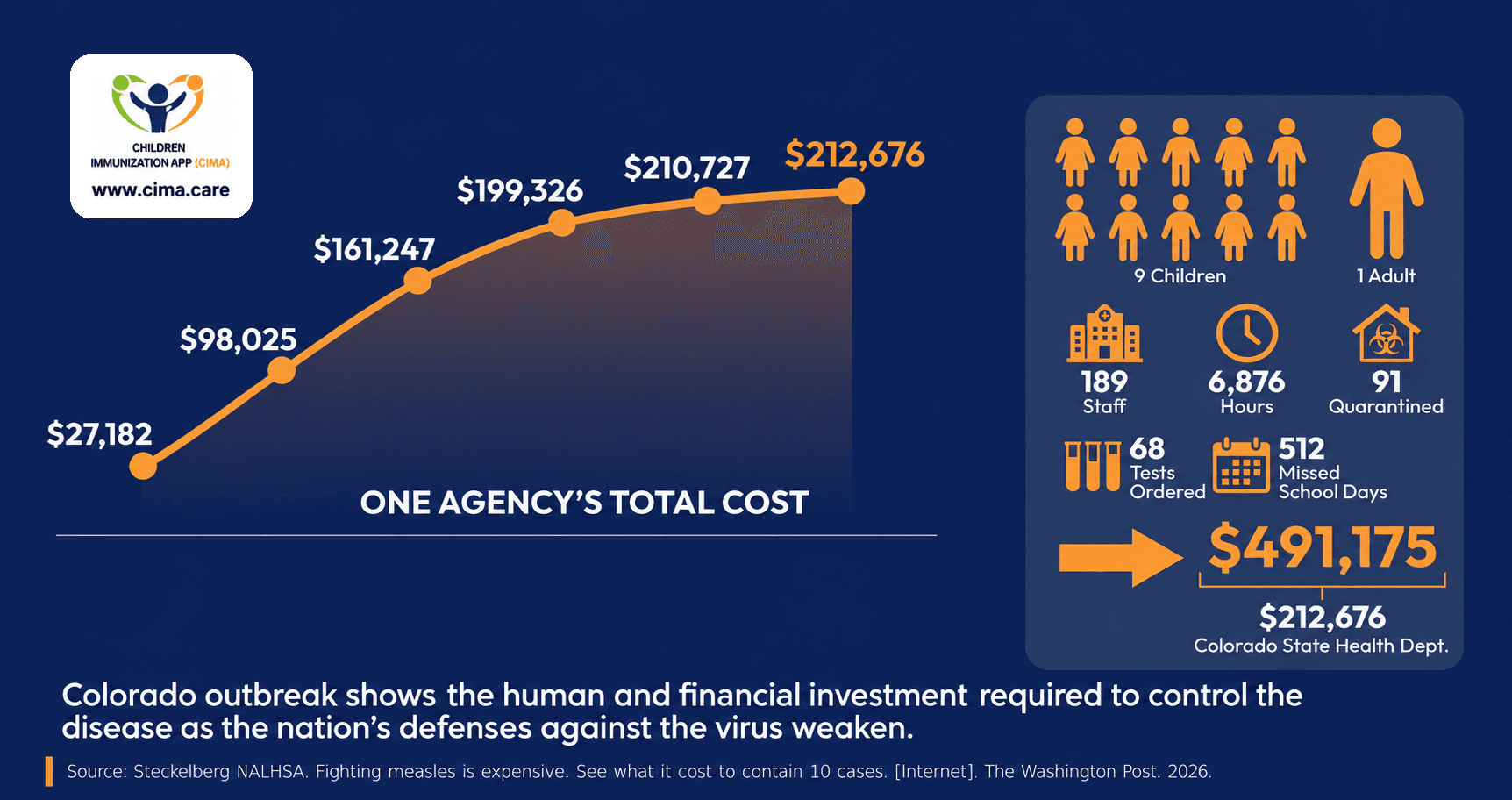
Ten cases, 189 responders, 6,876 hours, and $491,175—$212,676 borne by Colorado's state health department.
The Fixed Cost Every Health Department Already Knows
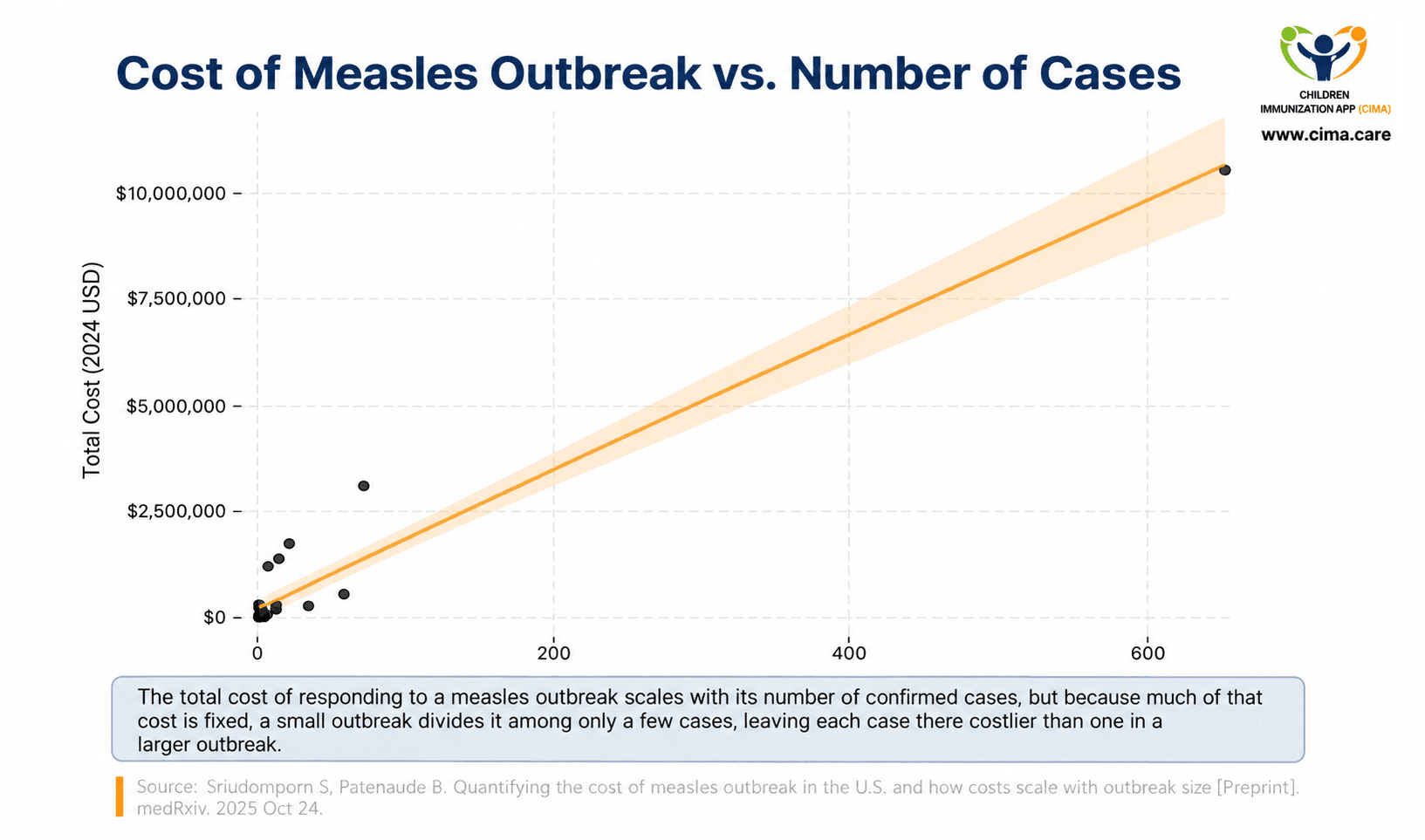
Colorado's bill is not an outlier. It lines up closely with what the evidence predicts. A 2026 study by Johns Hopkins Bloomberg School of Public Health's International Vaccine Access Center, the most comprehensive costing analysis of U.S. measles outbreaks to date, reviewed outbreaks across 18 states ranging from a single case to 802. It found that launching an investigation costs a health department an average of $297,747 before a second case is even confirmed, with each additional case adding roughly $16,300. Averaged across all outbreak sizes reviewed, the cost works out to $43,203.65 per case and $443.46 per traced contact. Because most of that expense is fixed—surveillance, lab testing, contact tracing, and staff mobilization happen, whether an outbreak is one case or a hundred. Small clusters end up costing far more per patient than large ones, exactly the pattern Colorado's ten cases illustrated. [9-11]
Each black dot in the following figure is one real outbreak that researchers studied—its position shows how many cases it had and how much it cost in total. Near zero cases, several dots cluster close together but still sit noticeably above $0—some are already at $250,000, $1,000,000, even $1,750,000 in total cost, despite having very few cases. This is visual proof of "fixed cost": even a tiny outbreak still requires the same basic machinery—lab testing, contact tracing, staff mobilization—so its total cost doesn't start at zero.
Altogether, this graph shows total cost rising with outbreak size (proving large outbreaks cost more overall), while the elevated starting point near zero cases proves that a fixed cost exists, and that fixed cost, spread across very few cases in small outbreaks, is what makes each individual case in a small outbreak far more expensive than each individual case in a large outbreak. [9-10]
Note on cost estimates and uncertainty: In an August 20, 2026, CIDRAP news article, Mary Van Beusekom, MS, summarizing the findings of Sriudomporn and Patenaude's Vaccine study, reports that these figures are subject to wide confidence intervals, meaning real statistical uncertainty surrounds the exact values, and that total outbreak costs show an elasticity of 0.86 with respect to outbreak size, meaning costs rise with outbreak size less than proportionally, both of which reinforce the core conclusion that every measles introduction triggers a large, largely fixed initial expenditure. [11]
Estimated antibody half-lives derived from a long-term cohort, illustrating how antiviral responses to natural infection or live viral antigens leave behind a substantially more durable antibody response than protein/toxoid vaccines
Below the Threshold: New Mexico's $5.4 Million Lesson
Colorado's story shows what containment costs when coverage holds above the herd-immunity threshold. New Mexico's 2025 outbreak shows what happens when it doesn't. Between February and September 2025, 100 confirmed cases spread across nine counties, 85 percent of them in unvaccinated people, leading to seven hospitalizations and one death. A 2026 cost analysis by researchers at the CDC's National Center for Immunization and Respiratory Diseases and the New Mexico Department of Health, published in Annals of Internal Medicine, put the total societal cost at $5.4 million, or $53,522 per case and $1,817 per contact. Of that, roughly $3.2 million went to the public health response alone, and $2.1 million of that was spent on vaccination-related activities, including mobile MMR vaccination clinics, work that is considerably cheaper delivered as routine, pre-outbreak coverage than as emergency response. Direct medical costs added $290,148, and the 133 public health workers who responded logged 22,399 hours between them, tracing 2,946 contacts, 205 of whom had to quarantine. [12-15]
Note on the differing productivity-loss figures: Sources report slightly different numbers for the "lost productivity" component of this outbreak. CIDRAP and Medical Daily both report productivity losses of "more than $1.8 million", while Reuters reports a more precise figure of "nearly $1.6 million" for the same category, and 2 Minute Medicine separately cites "$1.9 million". This spread likely reflects differences in exactly which costs each outlet folded into "productivity loss; for instance, whether lost wages for the one deceased patient, unpaid caregiving time, or missed school days for quarantined children were counted in that bucket or attributed elsewhere in the total. [12-13, 15-17]
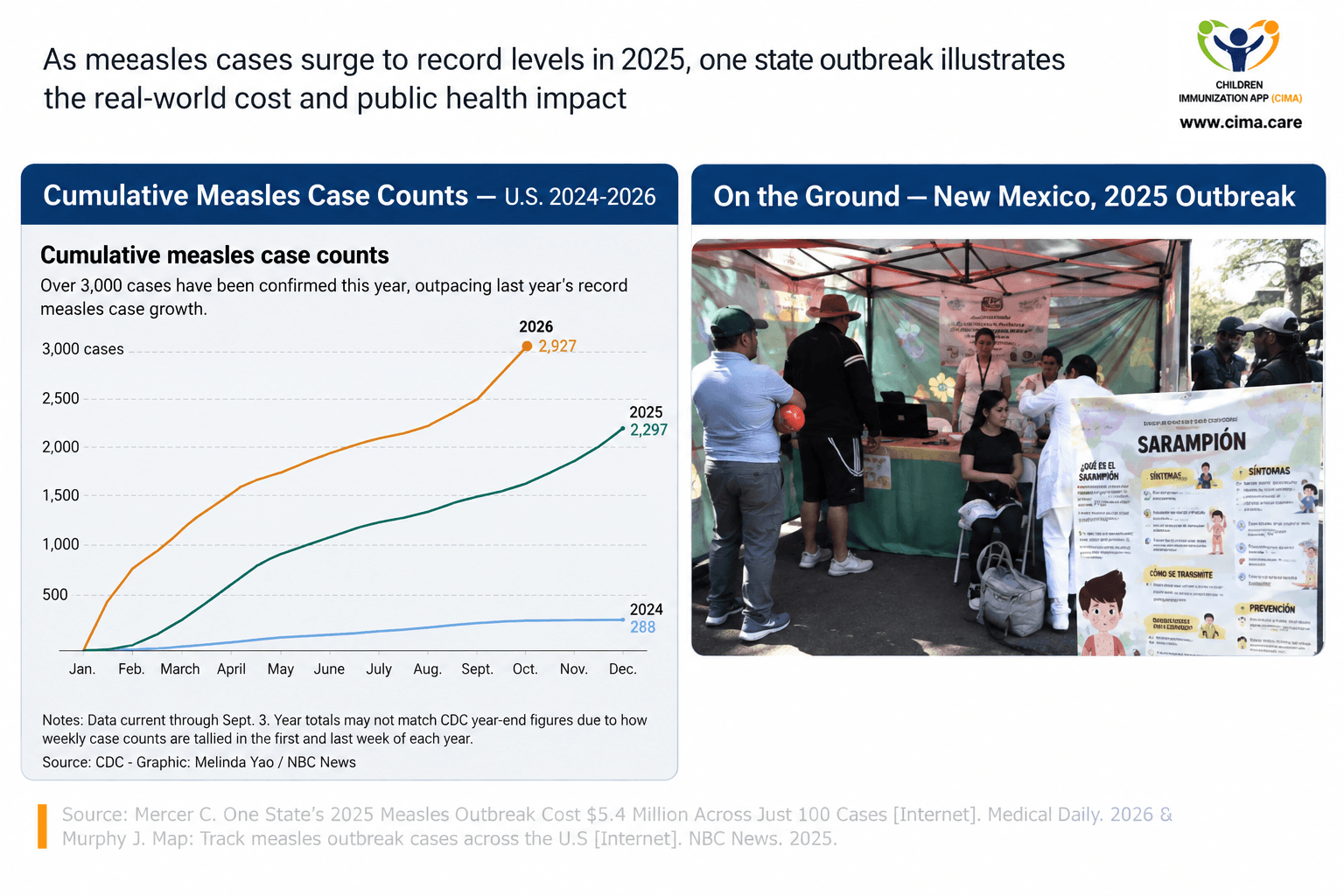
New Mexico’s 100-case outbreak shows how falling below the threshold drives a $5.4 million response.
Pennsylvania, in Real Time
This is not history. As of September 10, 2026, the United States had confirmed 3,294 measles cases for the year, already past all of 2025's final total of 2,289, and the most in any year in over three decades. Ninety-five percent of this year's cases trace back to one of 38 active outbreaks. When vaccination coverage in a community drops even slightly below the safe threshold, the very first thing that breaks down is "herd immunity," the protective effect in which enough vaccinated people in an area prevent a virus from finding new hosts to infect. Pennsylvania is used as "the sharpest illustration" because it shows the effect in its most extreme, visible form: a modest drop in vaccination rates did not just slightly increase cases; it triggered one of the largest state outbreaks in the country this year, with hundreds of cases and three reported deaths.
In other words, Pennsylvania proves that community protection does not fail gradually. It fails suddenly, and severely once coverage dips even a little below the safety threshold.
Lancaster County now accounts for roughly 40 percent of Pennsylvania's cases, which climbed from 460 in late August to 676 across 37 counties by September 11, according to the state's own official update. Statewide, 124 of those patients have required hospitalization, close to one in five confirmed cases. [8, 18-20, 43]
In late August, Pennsylvania health officials and the Lancaster County coroner identified two unvaccinated infants' deaths as measles associated. Both infants were Lancaster County residents in south-central Pennsylvania, the state's first measles deaths in 35 years, and the first reported anywhere in the country in 2026. Both infants had confirmed measles infection alongside other serious complicating medical factors. As of this writing, the CDC's national tally still reflects zero confirmed 2026 measles deaths, and a public dispute has emerged: Health Secretary Robert F. Kennedy Jr. initially questioned both deaths but has since acknowledged that measles caused the second infant's death, citing the Lancaster County coroner's own finding; the coroner's office has not attributed the first infant's death to measles. Pennsylvania's health department maintains both were measles-associated, and the CDC's national tally has not yet incorporated either. [8, 21-23, 44-45] On September 13, the Jefferson County coroner reported a third Pennsylvania death associated with measles, a 40-year-old unvaccinated woman and the state's first fatality outside Lancaster County. Pennsylvania's health department said it was reviewing the case against its own case definition for a measles-associated death, and the CDC had not commented on this case specifically.
Nationally, kindergarten MMR coverage has slipped from 95.2 percent in the 2019–2020 school year to 92.4 percent in 2025–2026, leaving an estimated 280,000 kindergartners in counties below the level needed for reliable community protection. The United States achieved measles elimination status in 2000; Canada lost its own elimination status in November 2025 after more than a year of sustained transmission, and the Pan American Health Organization is expected to determine later this year whether the United States has done the same. [8, 24-26, 43]
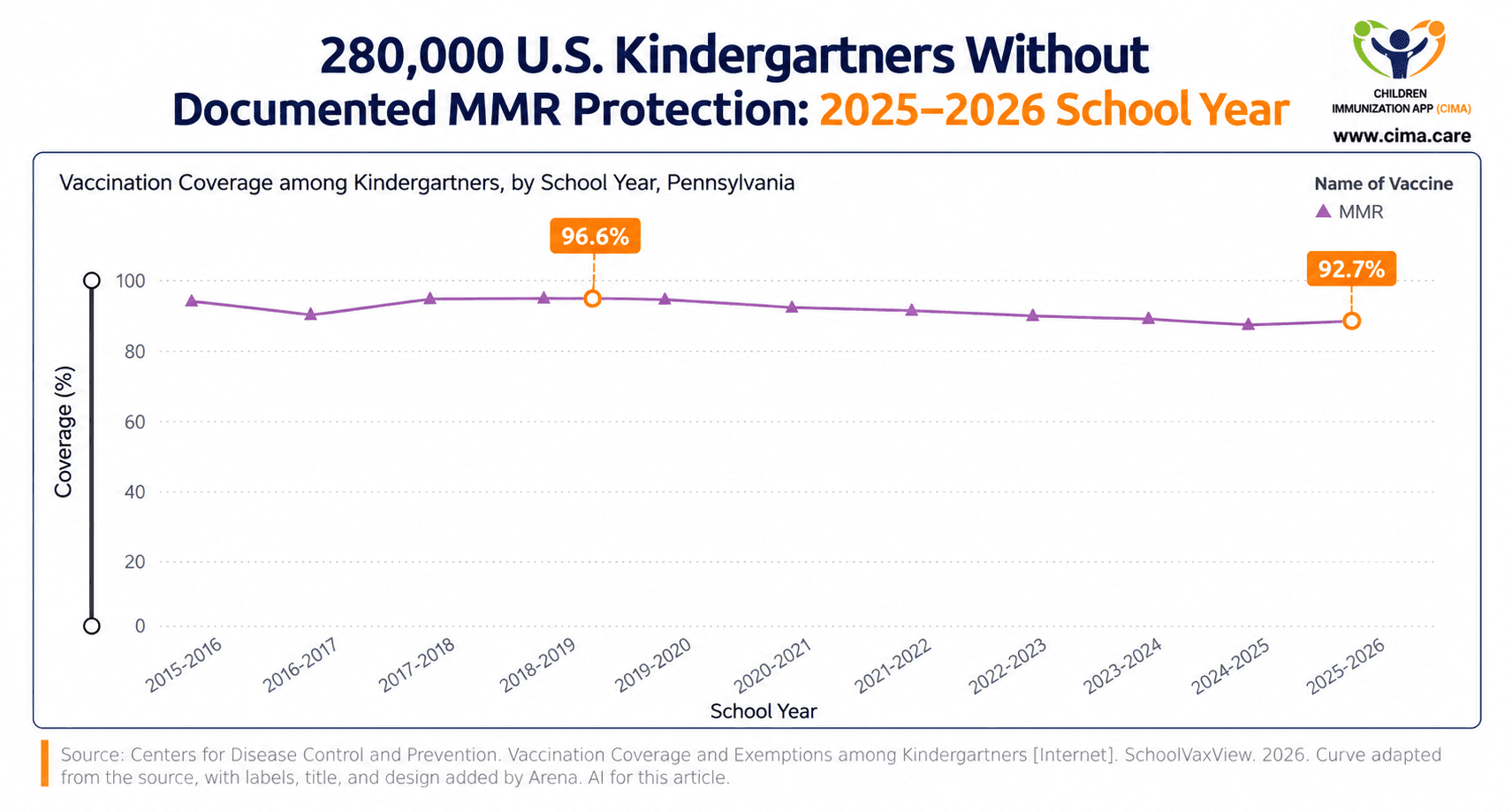
Pennsylvania’s MMR coverage fell from 96.6% to 92.7%, weakening community protection.
Georgia, in Real Time: A Daycare Outbreak Grows
A metro Atlanta daycare outbreak shows the same pattern playing out on a smaller, more immediate scale. Georgia health officials confirmed an initial case on August 18, 2026, four additional closely linked cases on August 28, and three more on September 4, bringing the daycare-linked outbreak to eight cases; two further cases confirmed on September 11 brought the total to ten. All of the children involved were unvaccinated or not fully vaccinated, and the Georgia Department of Public Health has been working to identify and notify others who may have been exposed. [39, 41-42]
Daycare settings carry a specific vulnerability: children under 12 months, the age of the first routine MMR dose, have no vaccine-derived protection of their own and depend entirely on the immunity of the people around them, precisely the dynamic that high community vaccination coverage is meant to provide. [41]
The outbreak has pushed Georgia's confirmed measles count for 2026 to sixteen, compared with ten cases across the entirety of 2025, and state health officials have noted that the State's childhood MMR coverage sits below the 95 percent threshold needed for reliable community protection, the same threshold discussed throughout this piece. [41]
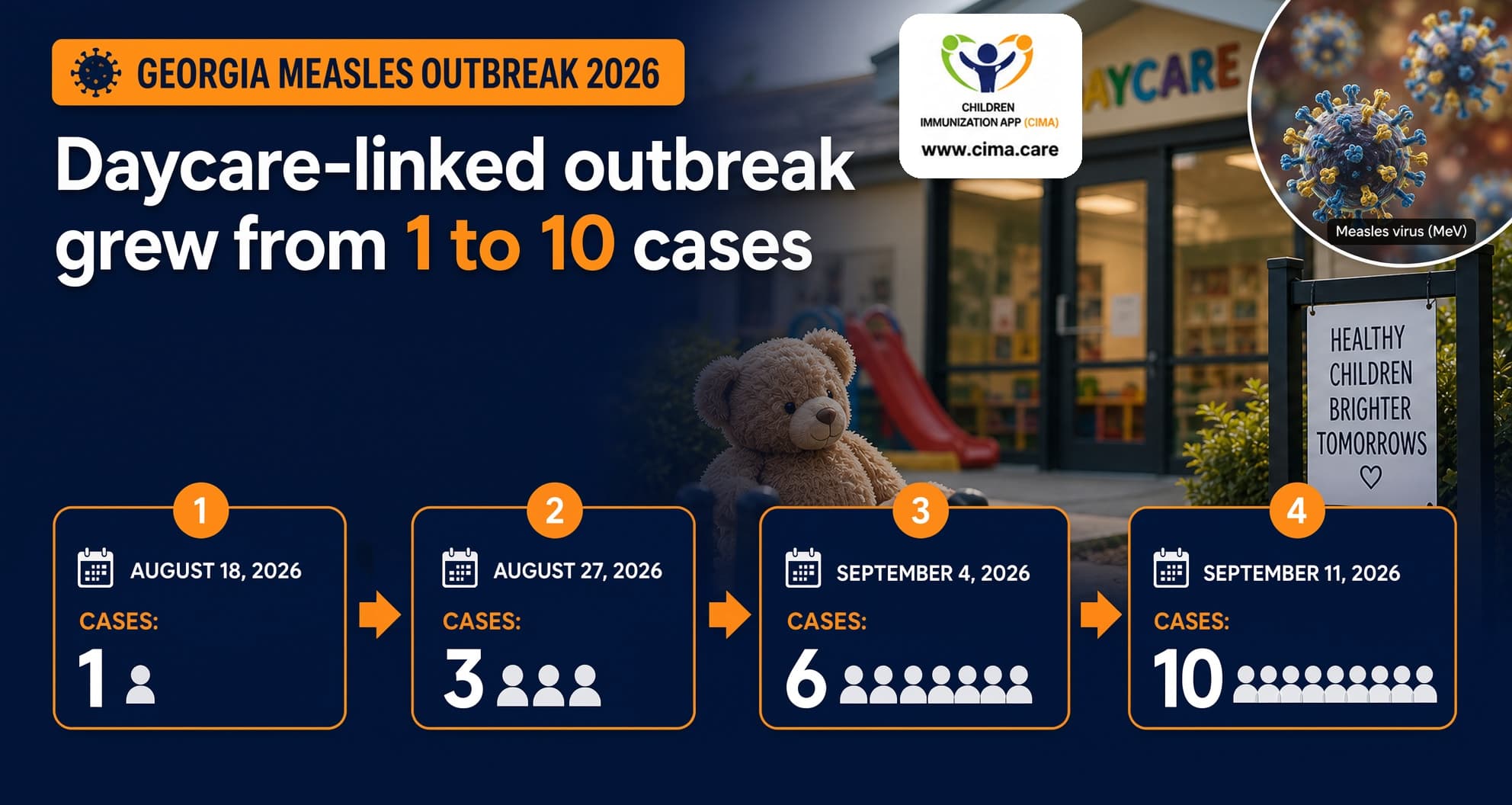
Georgia's 2026 daycare-linked outbreak grew from one case on August 18 to ten by September 11.
What the Invoice Doesn't Capture: The Clinical Reality
Everything discussed so far focuses on the cost of stopping an outbreak, not the danger the disease itself poses. Measles is one of the most contagious diseases known to science. On average, one sick person can infect between 12 and 18 other people if none of them are protected. Scientists call this number the "reproduction number." And within a household, if someone unvaccinated lives with a person who has measles, they have about a 90 percent chance of catching it too. [27-28]
The virus remains in the air for a period after an infected person leaves a room, and patients are contagious for four days before the rash even appears, which is precisely what makes contact tracing so labor-intensive in the first place. [29]
Among people infected in the United States, roughly one in five is hospitalized, and complications include otitis media, bronchopneumonia, laryngotracheobronchitis (croup), and diarrhea. Secondary bacterial infections can cause tonsillitis, otitis media, and pneumonia. Another complication is encephalitis (in about 1 of every 1,000 cases), and death (1 to 3 of every 1,000 infected children), largely from respiratory or neurologic complications. Subacute sclerosing panencephalitis, a fatal degenerative brain disease that can surface years after apparent recovery, affects an estimated 4 to 11 per 100,000 reported cases overall. But for infants infected before their first birthday, a California case review found the rate as high as 1 in 609, a roughly fifteen-fold increase in risk. [29-32]
The complication rates above—roughly one in five hospitalized, about one in a thousand developing encephalitis, and one to three deaths per thousand infected children—reflect general U.S. clinical patterns reported by the CDC's national surveillance and clinical guidance pages, current as of August 2026. [29]
Survival is not the end of the story, either. A landmark 2019 study in 'Science' found that measles infection can erase 11 to 73 percent of a child's previously built antibody repertoire, protection against unrelated pathogens the child had already fought off- a phenomenon called immune amnesia that is not seen after MMR vaccination. [33] All of this, from the immune damage to the hospitalizations, is preventable for the cost of a single pediatric dose of Priorix, the GlaxoSmithKline MMR vaccine sold in a 10-pack of 1-dose vials, priced at $26.33 per dose through the CDC's public pediatric/VFC program, or $95.201 per dose at private-sector rates, according to the CDC's Pediatric/VFC Vaccine Price List as reviewed and updated January 1, 2026. [5]
No antiviral treatment exists for measles; care is entirely supportive. Vitamin A is sometimes raised as an alternative, but it does not prevent measles infection; current guidance reserves it for children with confirmed measles under a clinician's supervision, as supportive care for severe or hospitalized cases. [29, 34]
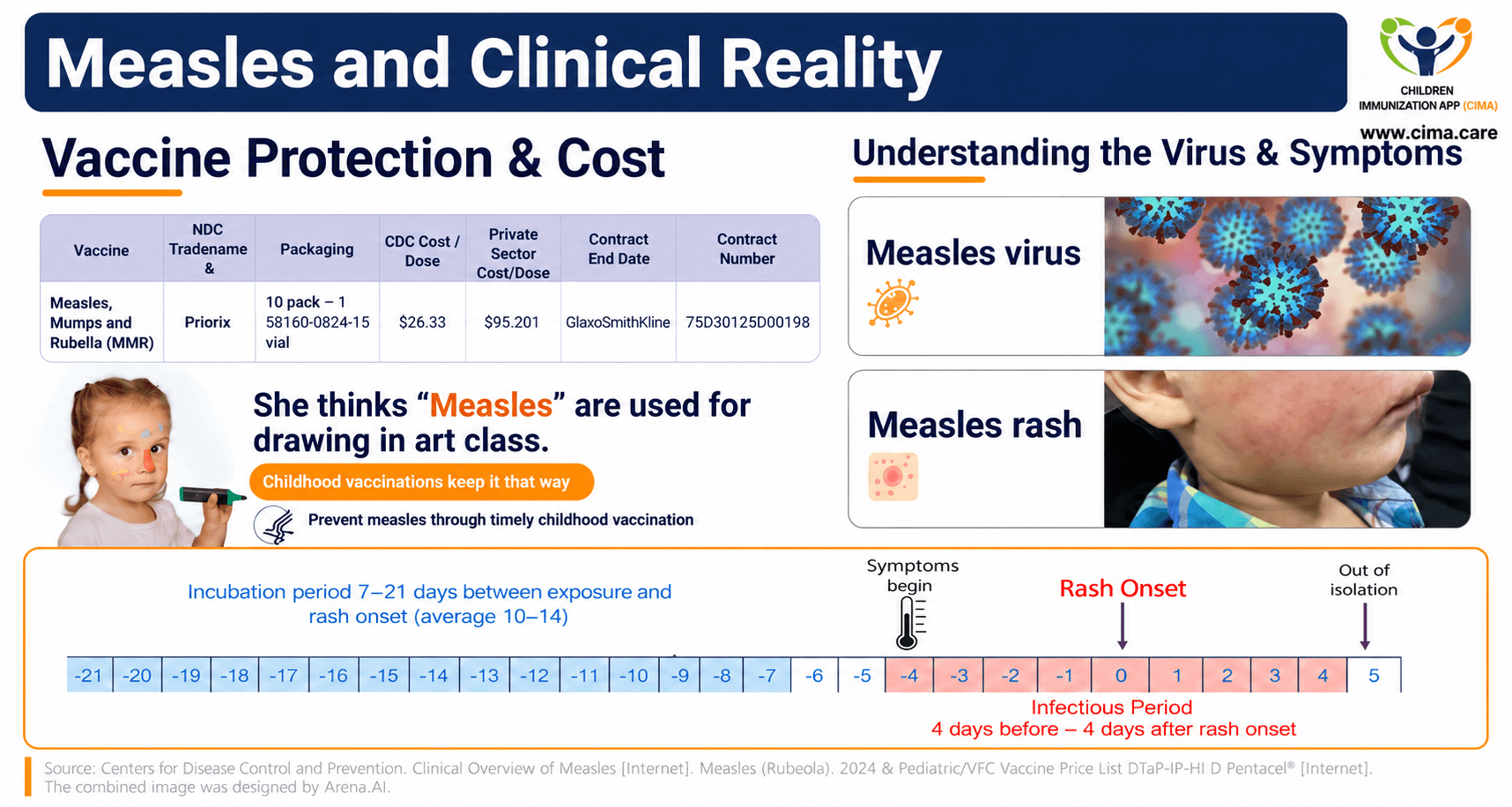
The clinical cost of measles: contagious before rash, severe complications, and the life-saving protection vaccination provides.
The Vaccine Answer
Two doses of MMR vaccine are about 97 percent effective at preventing measles, while a single dose is roughly 93 percent effective. Reaching and maintaining vaccination coverage above 95 percent in a community generally keeps a single imported case from becoming a larger cluster—a pattern consistent with what happened in the Colorado schools that anchored this piece. According to the CDC's current Pediatric/VFC price list, the negotiated public-sector cost for one dose of MMR vaccine is roughly $20 to $ 30, depending on the specific product and time period, with private-sector prices running quite higher. [5, 8, 24]
Now compare that small, one-time cost of MMR vaccination to the figures already discussed in this piece. These include the average cost per case that an outbreak produces, the per-case cost from New Mexico's 2025 outbreak, and the steep fixed cost of simply opening an investigation, which is spent before a second case is even confirmed. These exact numbers will change over time as outbreaks are studied and vaccine prices are updated, but the basic pattern stays the same in every analysis: vaccinating a child is one of the cheapest and most effective things we can do in public health, and leaving a community unvaccinated is one of the costliest risks we can take. [8, 36]
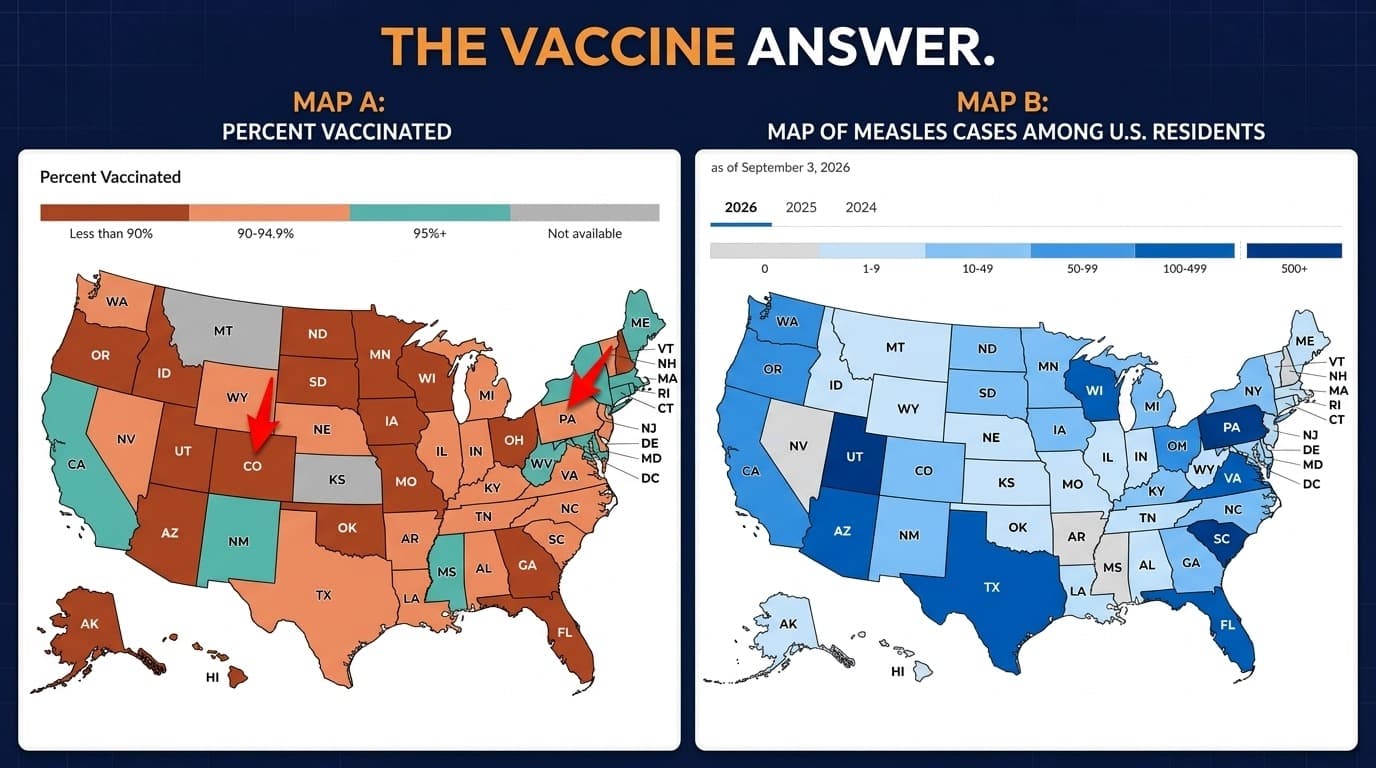
Higher vaccination coverage, lower outbreak risk: a state-by-state view of measles protection. Colorado's arrow reflects statewide coverage, not the two individual schools discussed earlier, which had rates above 95%.
Closing the Gap: What CIMA Care Is Built to Do
This is exactly the gap CIMA Care is designed to close. CDC's latest kindergarten data show that when measles vaccination stays at or above 95 percent in a community, most people are protected through herd immunity and new cases are far less likely to turn into large outbreaks. But when coverage slips into the high 80s or low 90s, that protection breaks down: hundreds of thousands of children nationwide attend school without full MMR protection, and measles introductions are much more likely to spread, driving the kind of long, expensive outbreaks seen in New Mexico, Texas, and Pennsylvania. [8, 24, 36-38] CIMA Care's ecosystem model helps communities move back above that 95 percent line and stay there, so imported cases stay small and containable instead of becoming multimillion‑dollar, multi‑month crises.
Ready to close the coverage gap before it opens?
Explore how CIMA Care's app and CIMA Health Academy can help your clinic, institution, or health system stay on the right side of this math at www.cima.care.
Together, we can make sure the only invoice measles ever produces is the cost-effective charge of vaccination, not a costly outbreak bill.
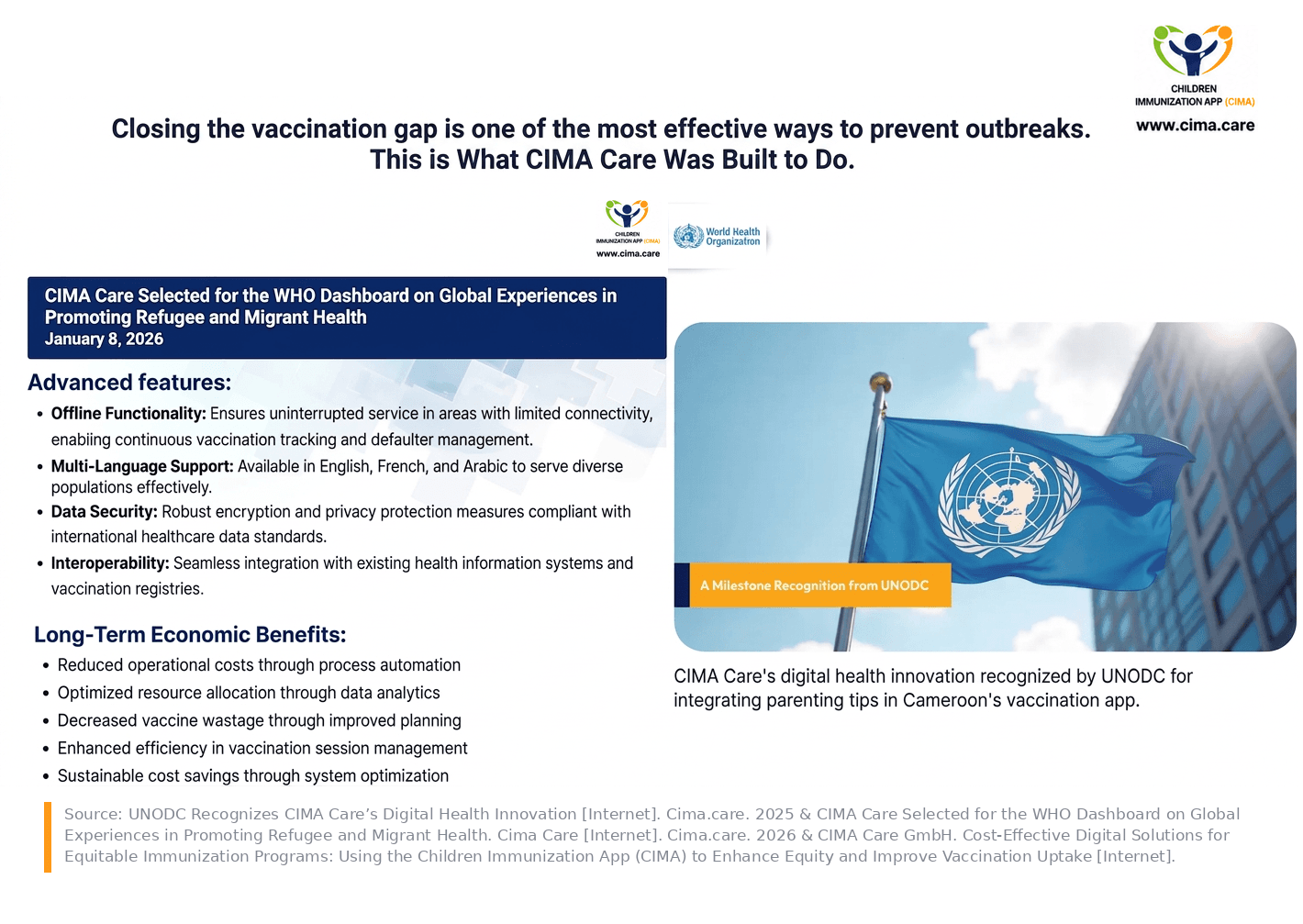
CIMA Care aims to help communities to close vaccination gaps before they become costly outbreaks.
CONFLICTS OF INTEREST
The author and reviewer declare no financial or non-financial conflicts of interest in relation to the content of this page. Full declarations are held on file only, and are available on request.
LICENCE


Image References
1. UNODC recognizes CIMA Care's digital health innovation [Internet]. Vienna (Austria): CIMA Care; 2025 [cited 2026 Sep 10]. Available from: https://www.cima.care/insights/unodc-recognized-digital-technology-child-health/2. CIMA Care selected for the WHO Dashboard on Global Experiences in Promoting Refugee and Migrant Health [Internet]. Vienna (Austria): CIMA Care; 2026 [cited 2026 Sep 10]. Available from: https://www.cima.care/insights/cima-care-who-dashboard-refugee-migrant-health/3. CIMA Care GmbH. Cost-effective digital solutions for equitable immunization programs: using the Children Immunization App (CIMA) to enhance equity and improve vaccination uptake [Internet]. Vienna (Austria): CIMA Care GmbH; [date unknown] [cited 2026 Sep 10]. Available from: https://www.cima.care/CIMA-Cost-Effective-Digital-Solutions-for-Equitable-Immunization-Programs.pdf4. Centers for Disease Control and Prevention. Measles cases and outbreaks [Internet]. Atlanta (GA): CDC; 2025 [cited 2026 Sep 10]. Available from: https://www.cdc.gov/measles/data-research/index.html5. Centers for Disease Control and Prevention. Clinical overview of measles [Internet]. Atlanta (GA): CDC; 2024 [cited 2026 Sep 10]. Available from: https://www.cdc.gov/measles/hcp/clinical-overview/index.html6. Centers for Disease Control and Prevention. Pediatric/VFC vaccine price list [Internet]. Atlanta (GA): CDC; 2026 [cited 2026 Sep 10]. Available from: https://www.cdc.gov/vaccines-for-children/media/pdfs/2026/03/Vaccine-Price-List-01-26-v2-508.pdf7. Centers for Disease Control and Prevention. Clinical overview of measles: diagnosis, laboratory testing and outbreak response [video on the Internet]. San Bruno (CA): YouTube; 2025 [cited 2026 Sep 11]. Available from: https://www.youtube.com/watch?v=o6kEvlad-8E8. 3 more measles cases confirmed in metro Atlanta daycare outbreak [Internet]. Atlanta (GA): Atlanta News First; 2026 Sep 4 [cited 2026 Sep 14]. Available from: https://www.atlantanewsfirst.com/2026/09/04/3-more-measles-cases-confirmed-metro-atlanta-daycare-outbreak/9. Officials confirm 3 new measles cases linked to metro Atlanta daycare [Internet]. Atlanta (GA): FOX 5 Atlanta; 2026 Sep 4 [cited 2026 Sep 14]. Available from: https://www.fox5atlanta.com/news/officials-confirm-3-new-measles-cases-linked-metro-atlanta-daycare10. More measles cases found after outbreak at Atlanta area daycare [Internet]. Atlanta (GA): Georgia Public Broadcasting; 2026 Sep 11 [cited 2026 Sep 14]. Available from: https://www.gpb.org/news/2026/09/11/more-measles-cases-found-after-outbreak-at-atlanta-area-daycare11. Mims B. Measles outbreak linked to metro Atlanta daycare [Internet]. Atlanta (GA): WSB-TV; 2026 Aug 28 [cited 2026 Sep 14]. Available from: https://www.wsbtv.com/news/local/4-measles-cases-linked-with-metro-atlanta-daycare-confirmed/TM6XU537NZA2RBN3RWLZ7UGPAU/12. Specter A. Breaking: measles outbreak spreads through metro Atlanta daycare [Internet]. Sunnyvale (CA): LinkedIn; 2026 [cited 2026 Sep 14]. Available from: https://www.linkedin.com/pulse/breaking-measles-outbreak-spreads-through-metro-atlanta-specter-8pjcc13. Centers for Disease Control and Prevention. SchoolVaxView: vaccination coverage and exemptions among kindergartners [Internet]. Atlanta (GA): CDC; 2024 [cited 2026 Sep 10]. Available from: https://www.cdc.gov/schoolvaxview/data/index.html14. Mercer C. One state's 2025 measles outbreak cost $5.4 million across just 100 cases [Internet]. New York (NY): Medical Daily; 2026 [cited 2026 Sep 9]. Available from: https://www.medicaldaily.com/measles-outbreak-cost-5-4-million-new-mexico-100-cases-study-47700015. Murphy J. Map: track measles outbreak cases across the U.S. [Internet]. New York (NY): NBC News; 2025 [cited 2026 Sep 9]. Available from: https://www.nbcnews.com/data-graphics/track-measles-outbreak-cases-us-map-rcna19893216. Sriudomporn S, Patenaude B. Quantifying the cost of measles outbreak in the U.S. and how costs scale with outbreak size. medRxiv [Preprint]. 2025 Oct 25 [cited 2026 Sep 9]. doi: 10.1101/2025.10.24.25338724. Available from: https://www.medrxiv.org/content/10.1101/2025.10.24.25338724v217. Ahmed N, Sun LH, Steckelberg A. Fighting measles is expensive. See what it cost to contain 10 cases [Internet]. Washington (DC): The Washington Post; 2026 Aug 24 [cited 2026 Sep 9]. Available from: https://www.washingtonpost.com/health/interactive/2026/08/24/fighting-measles-is-expensive-see-what-it-cost-contain-10-cases/18. The importance of a COVID vaccine for New York children [Internet]. Washington (DC): Children's Defense Fund; 2020 [cited 2026 Sep 10]. Available from: http://childrensdefense.org/blog/the-importance-of-a-covid-vaccine-for-new-york-children/19. CDC adds 211 new cases to accelerating US measles outbreak [Internet]. Minneapolis (MN): CIDRAP; 2026 [cited 2026 Sep 10]. Available from: https://www.cidrap.umn.edu/measles/cdc-adds-211-new-cases-accelerating-us-measles-outbreak
Blog Resources
- 1- CDC. Current CDC Vaccine Price List [Internet]. Vaccines for Children Program. 2026 [cited 2026 Sept 9]. Available from: https://www.cdc.gov/vaccines-for-children/php/price-list/index.html
- 2- Steckelberg NALHSA. Fighting measles is expensive. See what it cost to contain 10 cases. [Internet]. The Washington Post. 2026 [cited 2026 Sept 9]. Available from: https://www.washingtonpost.com/health/interactive/2026/08/24/fighting-measles-is-expensive-see-what-it-cost-contain-10-cases/
- 3- Reuters. US CDC records more than 3,100 measles cases so far in 2026 [Internet]. Yahoo News. 2026 [cited 2026 Sept 9]. Available from: https://www.yahoo.com/news/us/articles/us-cdc-records-more-3-155905888.html
- 4- Loehrke J, Petras G, Beard SJ. Graphics capture the resurgence of measles, once eliminated in the US [Internet]. USA TODAY. 2026 [cited 2026 Sept 9]. Available from: https://www.usatoday.com/story/graphics/2026/08/25/measles-cases-map-graphs/91456046007/
- 5- Pediatric/VFC Vaccine Price List DTaP-IP-HI D Pentacel® [Internet]. [cited 2026 Sept 9]. Available from: https://www.cdc.gov/vaccines-for-children/media/pdfs/2026/03/Vaccine-Price-List-01-26-v2-508.pdf
- 6- Lapid N. A single US measles outbreak can cost millions of dollars, study estimates. Reuters [Internet]. 2026 Aug 3 [cited 2026 Sept 9];. Available from: https://www.reuters.com/legal/litigation/single-us-measles-outbreak-can-cost-millions-dollars-study-estimates-2026-08-03/
- 7- CDC. Measles (Rubeola) [Internet]. Yellow Book. 2025 [cited 2026 Sept 9]. Available from: https://www.cdc.gov/yellow-book/hcp/travel-associated-infections-diseases/measles-rubeola.html
- 8- Centers for Disease Control and Prevention. Measles cases and outbreaks [Internet]. Measles (Rubeola). CDC; 2025 [cited 2026 Sept 9]. Available from: https://www.cdc.gov/measles/data-research/index.html
- 9- Sriudomporn S, Patenaude B. Quantifying the Cost of Measles Outbreak in the U.S. and How Costs Scale with Outbreak Size. 2025 Oct 25 [cited 2026 Sept 9];. Available from: https://www.medrxiv.org/content/10.1101/2025.10.24.25338724v2
- 10- Estimating the Financial Costs of Measles Outbreaks | International Vaccine Access Center [Internet]. International Vaccine Access Center. 2025 [cited 2026 Sept 9]. Available from: https://publichealth.jhu.edu/ivac/2025/estimating-the-financial-costs-of-measles-outbreaks
- 11- Van Beusekom M. Each measles case in 2025 US outbreak cost almost $60,000, study estimates, or $134 million total [Internet]. CIDRAP. 2026 [cited 2026 Sept 9]. Available from: https://www.cidrap.umn.edu/measles/each-measles-case-2025-us-outbreak-cost-almost-60000-study-estimates-or-134-million-total
- 12- Pike J, Holzinger N, Xiao HT, Stanislawski E, Leung J, Romero A, et al. Economic Impact of the 2025 New Mexico Measles Outbreak: Highlighting the Cost of Efforts to Prevent Future Outbreaks [Internet]. Annals of internal medicine. United States; 2026 [cited 2026 Sept 9]. p. 10.7326/ANNALS–26-00718. Available from: https://pubmed.ncbi.nlm.nih.gov/42546299/
- 13- Boden S. New Mexico's 2025 measles outbreak cost $5.4 million [Internet]. CIDRAP. 2026 [cited 2026 Sept 9]. Available from: https://www.cidrap.umn.edu/measles/new-mexicos-2025-measles-outbreak-cost-54-million
- 14- Corum J, Rosenbluth T. Measles in the U.S.: Latest Maps and Cases. The New York Times [Internet]. 2025 Mar 12 [cited 2026 Sept 9];. Available from: https://www.nytimes.com/interactive/2025/health/measles-outbreak-map.html
- 15- World Published Aug 03, 2026, 05:07 PM Updated Aug 04, 2026, 06:01 AM. A single US measles outbreak can cost millions of dollars, study estimates [Internet]. Investing.com. 2026 [cited 2026 Sept 9]. Available from: https://www.investing.com/news/world-news/a-single-us-measles-outbreak-can-cost-millions-of-dollars-study-estimates-4832392
- 16- Wong A. New Mexico measles outbreak associated with significant costs [Internet]. 2 Minute Medicine. 2026 [cited 2026 Sept 9]. Available from: https://www.2minutemedicine.com/new-mexico-measles-outbreak-associated-with-significant-costs/
- 17- Mercer C. One State’s 2025 Measles Outbreak Cost $5.4 Million Across Just 100 Cases [Internet]. Medical Daily. 2026 [cited 2026 Sept 9]. Available from: https://www.medicaldaily.com/measles-outbreak-cost-5-4-million-new-mexico-100-cases-study-477000
- 18- Pennsylvania Department of Health Provides Statewide Update on Measles Outbreak as Cases Reach 577 in 37 Counties [Internet]. website. 202 [cited 2026 Sept 9]. Available from: https://www.pa.gov/agencies/health/newsroom/pa-department-of-health-provides-statewide-update-on-measles-out
- 19- Pitt D. Measles outbreak grows: Pa. reports 540 cases in 36 counties, 2 deaths [Internet]. PennLive. 2026 Sep 2 [cited 2026 Sep 9]. Available from: https://www.pennlive.com/health/2026/09/measles-outbreak-grows-pa-reports-540-cases-in-36-countes-2-deaths.html
- 20- James J. Two Unvaccinated Lancaster County Residents Die of Measles in the First Confirmed American Deaths This Year [Internet]. Medical Daily. 2026 [cited 2026 Sept 9]. Available from: https://www.medicaldaily.com/pennsylvania-measles-deaths-lancaster-county-first-us-2026-477747
- 21- Reuters Staff. Kennedy acknowledges one measles death in Pennsylvania. Reuters [Internet]. 2026 Sept 5 [cited 2026 Sept 9];. Available from: https://www.reuters.com/legal/litigation/kennedy-acknowledges-one-measles-death-pennsylvania-2026-09-05/
- 22- Mullin E. The US Just Recorded Its First 2 Measles Deaths This Year [Internet]. WIRED. 2026 [cited 2026 Sept 9]. Available from: https://www.wired.com/story/us-recorded-first-measles-deaths-2026/
- 23- Nojiri M. Pa. Reports Nation’s First Measles Deaths in 2026 [Internet]. HAP. 2026 [cited 2026 Sept 9]. Available from: https://www.haponline.org/News/HAP-News-Articles/Latest-News/ArtMID/666/ArticleID/18264/Pa-Reports-Nation’s-First-Measles-Deaths-in-2026
- 24- Centers for Disease Control and Prevention. Vaccination Coverage and Exemptions among Kindergartners [Internet]. SchoolVaxView. 2024 [cited 2026 Sept 9]. Available from: https://www.cdc.gov/schoolvaxview/data/index.html
- 25- Public. Statement from the Public Health Agency of Canada on Canada’s Measles Elimination Status [Internet]. Canada.ca. Government of Canada; 2025 [cited 2026 Sept 9]. Available from: https://www.canada.ca/en/public-health/news/2025/11/statement-from-the-public-health-agency-of-canada-on-canadas-measles-elimination-status.html
- 26- Update on the review of measles elimination status [Internet]. Paho.org. 2026 [cited 2026 Sept 9]. Available from: https://www.paho.org/en/news/2-3-2026-update-review-measles-elimination-status
- 27- Goodson JL, Filardo T D. Measles (Rubeola) [Internet]. Nih.gov. Centers for Disease Control and Prevention (US); 2025 [cited 2026 Sept 10]. Available from: https://www.ncbi.nlm.nih.gov/books/NBK620906/
- 28- Communicable Diseases (CD) Quarterly Report 2024 1 st Quarter CD Control Program, San Mateo County Health [Internet]. [cited 2026 Sept 10]. Available from: https://www.smchealth.org/sites/main/files/file-attachments/2024_qtr1.pdf?1717433533
- 29- Centers for Disease Control and Prevention. Clinical Overview of Measles [Internet]. Measles (Rubeola). 2024 [cited 2026 Sept 10]. Available from: https://www.cdc.gov/measles/hcp/clinical-overview/index.html
- 30- CDC. Chapter 7: Measles [Internet]. Manual for the Surveillance of Vaccine-Preventable Diseases. 2024 [cited 2026 Sept 10]. Available from: https://www.cdc.gov/surv-manual/php/table-of-contents/chapter-7-measles.html
- 31- Subacute sclerosing panencephalitis [Internet]. Wikipedia. 2022 [cited 2026 Sept 10]. Available from: https://en.wikipedia.org/wiki/Subacute_sclerosing_panencephalitis
- 32- Rota PA, Rota JS, Goodson JL. Subacute Sclerosing Panencephalitis. Clinical Infectious Diseases [Internet]. 2017 Apr 6 [cited 2026 Sept 10];65(2):233–4. Available from: https://www.healio.com/news/infectious-disease/20170411/rate-of-fatal-measles-complication-high-in-unvaccinated-children
- 33- Mina MJ, Kula T, Leng Y, Li M, de Vries RD, Knip M, et al. Measles virus infection diminishes preexisting antibodies that offer protection from other pathogens. Science. 2019 Nov;366(6465):599–606.
- 34- LatiNation. Measles is costing the US millions as cases reach their highest level [Internet]. LatiNation. 2026 [cited 2026 Sept 10]. Available from: https://latination.com/measles-outbreak-costs-highest-level-in-decades
- 35- Reuters. Kennedy acknowledges one measles death in Pennsylvania. Reuters [Internet]. 2026 Sept 4 [cited 2026 Sept 10]. Available from: https://www.reuters.com/legal/litigation/kennedy-acknowledges-one-measles-death-pennsylvania-2026-09-05/
- 36- CDC adds 211 new cases to accelerating US measles outbreak [Internet]. CIDRAP. 2026 [cited 2026 Sept 10]. Available from: https://www.cidrap.umn.edu/measles/cdc-adds-211-new-cases-accelerating-us-measles-outbreak
- 37- kfflizw. Kindergarten Routine Vaccination Rates Continue to Decline | KFF [Internet]. KFF. 2025 [cited 2026 Sept 10]. Available from: https://www.kff.org/medicaid/kindergarten-routine-vaccination-rates-continue-to-decline/
- 38- Gibbs A. Map Shows Vaccine Rates Among Kindergarteners Compared to Outbreak Hotspots [Internet]. Newsweek. 2026 [cited 2026 Sept 10]. Available from: https://www.newsweek.com/map-shows-vaccine-rates-among-kindergarteners-compared-to-outbreak-hotspots-12335436
- 39- 3 more measles cases confirmed in metro Atlanta daycare outbreak [Internet]. Atlanta News First. 2026 Sept 4 [cited 2026 Sept 14]. Available from: https://www.atlantanewsfirst.com/2026/09/04/3-more-measles-cases-confirmed-metro-atlanta-daycare-outbreak/
- 40- Officials confirm 3 new measles cases linked to metro Atlanta daycare [Internet]. FOX 5 Atlanta. 2026 Sept 4 [cited 2026 Sept 14]. Available from: https://www.fox5atlanta.com/news/officials-confirm-3-new-measles-cases-linked-metro-atlanta-daycare
- 41- More measles cases found after outbreak at Atlanta area daycare [Internet]. Georgia Public Broadcasting. 2026 Sept 11 [cited 2026 Sept 14]. Available from: https://www.gpb.org/news/2026/09/11/more-measles-cases-found-after-outbreak-at-atlanta-area-daycare
- 42- Mims B. Measles outbreak linked to metro Atlanta daycare [Internet]. WSB-TV. 2026 Aug 28 [cited 2026 Sept 14]. Available from: https://www.wsbtv.com/news/local/4-measles-cases-linked-with-metro-atlanta-daycare-confirmed/TM6XU537NZA2RBN3RWLZ7UGPAU/
- 43- Pennsylvania Department of Health. Pennsylvania Department of Health provides statewide update on measles outbreak as cases reach 676 in 37 counties [Internet]. 2026 Sept 11 [cited 2026 Sept 14]. Available from: https://www.pa.gov/agencies/health/newsroom/department-of-health-provides-statewide-update-091126
- 44- Adult woman dies of measles complications in growing Pennsylvania outbreak [Internet]. CNN. 2026 Sept 13 [cited 2026 Sept 14]. Available from: https://edition.cnn.com/2026/09/13/health/measles-death-pennsylvania
- 45- Woman dies of complications from measles in western Pennsylvania [Internet]. Reuters, via U.S. News & World Report. 2026 Sept 13 [cited 2026 Sept 14]. Available from: https://www.usnews.com/news/top-news/articles/2026-09-13/woman-dies-of-complications-from-measles-in-western-pennsylvania
Enjoyed this article?
Share it with your friends on LinkedIn: The Cost of a Measles Outbreak: Why the Vaccine Is the Most Cost-Effective Price 
Follow us on LinkedIn for more updates and insights: Cima Care GmbH