
Empowering Communities: How Local Health Workers Drive Vaccine Uptake |
January 15, 2025 . 4 Minutes read
The Role of Community Health Workers in Boosting Vaccination (Part 1)
Community Health Workers (CHWs) are at the frontlines of global health. Their unique position at the intersection of healthcare systems and local communities makes them invaluable support in achieving immunization goals and reducing vaccine hesitancy, particularly in low-resource settings. Explore the multifaceted impact of CHWs and innovative strategies to enhance their effectiveness in immunization programs.
The Power of Local Connection, Knowledge, and Trust
No one understands a community better than those who live there. Community health workers (CHWs) are locally trained healthcare providers who serve their own communities. With less formal training than traditional medical staff, they provide basic healthcare services, promote health awareness, offer counseling support, maintain health records, and act as vital links between communities and the broader healthcare system. [10]
CHWs serve as vital lines of health information, dispelling myths and addressing vaccine hesitancy. They possess a unique advantage: they are often from the communities they serve and understand local customs, languages, and concerns. The WHO guide emphasizes that CHWs' key effectiveness stems from their being trusted community members who understand cultural contexts, can communicate in local languages [1 & 2], and bridge critical gaps and provide equity in healthcare delivery and access to vaccination services by providing education, fostering trust, and administering essential health services. [3] As an instance, a 2024 study in Kenya reported that Community Health Assistants (CHAs) and Volunteers (CHVs) played a critical role in promoting COVID-19 vaccine uptake. According to their analysis, the key barriers included fear of side effects, misinformation, and lack of trust in the government, while CHVs' efforts significantly facilitated and increased the community's vaccine acceptance. [4]
Strategy: Recruit and train CHWs within target communities to leverage existing relationships and cultural understanding. Equip CHWs with up-to-date, culturally appropriate information and communication tools to address community concerns effectively.

Local Leaders: Community Health Workers Building Trust Through Cultural Understanding.
Mobile Technology Integration
Digital tools can help CHWs improve vaccination coverage through appointment adherence and timely vaccination delivery. Studies show that smart devices improve CHWs' knowledge and credibility, digital tools enhance community engagement, and mobile technology helps CHWs deliver more effective health messages. Notably, video content on smartphones is particularly effective for vaccine education. [5] Moreover, electronic tools significantly increased children checked for danger signs of illness compared to paper-based systems (41% to 74%) and improved CHWs' treatment planning, supply management, and service delivery efficiency. [6]
Strategy: Implement user-friendly mHealth solutions that enable CHWs to track vaccinations, send reminders, and access real-time health information.

Digital Health Records: Transforming Vaccination Management Through mHealth Solutions.
Beyond Vaccination: CHWs Combining Immunization with Essential Health Services.
Integrating Immunization with Other Health Services
CHWs can maximize their impact by combining vaccination efforts with other essential health services.
Studies show that CHWs go door to door to conduct in-home health screenings while sharing vaccination knowledge and directing community members to regional health resources. [7]
Research shows that in many regions, CHWs work across communities, schools, and religious facilities, conducting health education alongside vaccination programs and providing personalized service to caregivers that includes multiple health interventions. [2]
A Review of the Global Landscape recommends integrating CHWs into the health system and multiple health workings to boost immunization in under-immunized and zero-dose communities. [8]
Strategy: Teach CHWs to offer comprehensive health services, promoting and administering vaccines during every interaction.
Community Mobilization and Engagement
CHWs are crucial in mobilizing communities and fostering a culture of health-seeking behavior.
- A review of the global landscape shows that HWs provide education to families, organize vaccination events, remind parents about childhood immunization schedules, and track immunization rates in their communities.
- In some countries, like Pakistan and Malawi, CHWs also administer vaccines that have been crucial to reaching under-immunized and zero-dose children. [8]
- Building on the proven impact of CHWs in Malawi's vaccination programs, CIMA Care has recently partnered with the University of Lilongwe (UNILIL), Malawi's leading private university, to further strengthen these crucial community health initiatives. Announced in October 2024, this collaboration focuses on enhancing CHWs' capabilities through specialized training programs and digital tools. The partnership leverages UNILIL's academic excellence and deep understanding of local healthcare needs to develop targeted educational initiatives for healthcare professionals and community development practitioners. This strategic partnership aims to amplify the effectiveness of Malawi's existing CHW programs in vaccine administration and community engagement, particularly in reaching zero-dose and under-immunized children.
- A 2024 study in Missouri shows that pharmacy-based CHWs demonstrated a significant impact of pharmacy-based CHWs in improving vaccination rates and addressing health disparities by engaging over 22,000 patients in >75% of Missouri zip codes. [9]
Strategy: Empower CHWs to organize community occasions, engage local leaders, and cultivate peer support groups to promote vaccination.
Conclusion
Community health workers are indispensable in boosting vaccination rates globally, especially in underserved areas. By leveraging their unique position within communities, equipping them with the right tools and knowledge, and integrating their efforts with broader health systems, we can significantly enhance immunization coverage worldwide.
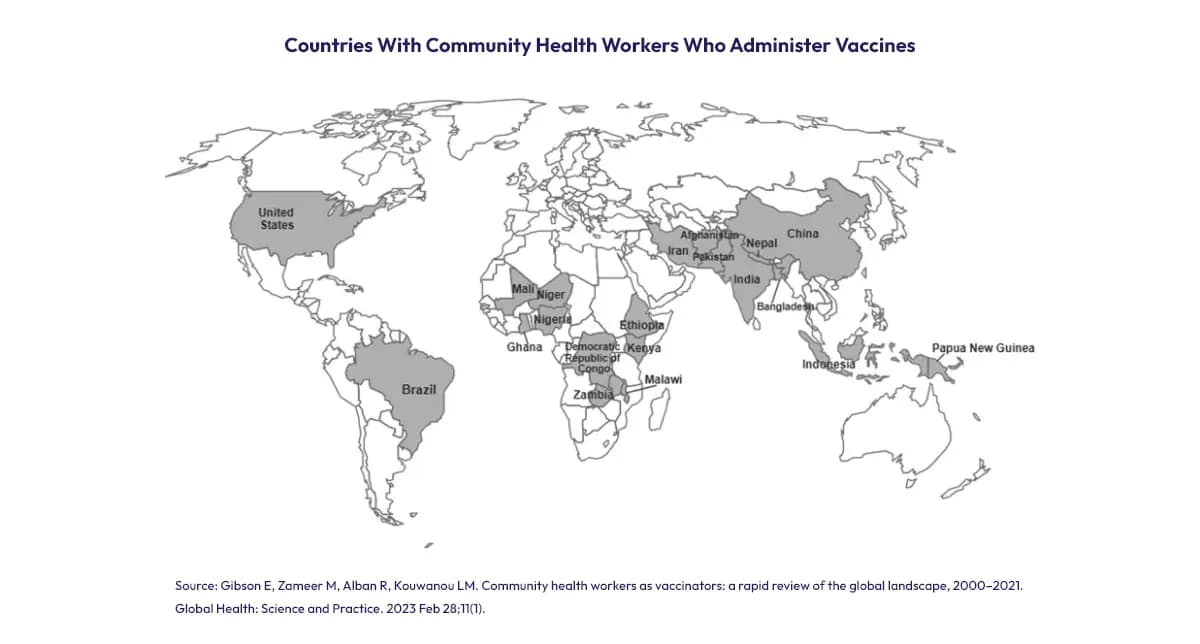
Global Reach: Countries Where Community Health Workers Administer Vaccines (2000-2021).
CIMA Care: Empowering CHWs in the Digital Age
At CIMA Care, we understand that Community Health Workers are the backbone of successful immunization programs, particularly in reaching zero-dose and under-immunized children. Our comprehensive digital ecosystem is designed to amplify CHWs' impact and effectiveness in several keyways:
- Real-Time Data Access: Our user-friendly mobile app and web-based dashboard empower CHWs to identify defaulter children, track vaccination schedules, and remind caregivers in a timely manner, turning data into actionable insights at the community level.
- Supporting Parent Education: Our automated health messages to registered parents complement CHWs' community outreach efforts, reinforcing their health education work and helping build vaccine confidence in their communities.
- Professional Development: CIMA Health Academy offers specialized online training modules covering essential topics from vaccine management to community engagement strategies, helping CHWs build a more skilled and confident workforce.
- Performance Monitoring: Our visualization tools and heat maps enable CHWs and their supervisors to track progress, identify coverage gaps, and target interventions more effectively.
By combining local wisdom with digital innovation, CIMA Care supports CHWs in their crucial mission to ensure every child receives life-saving vaccines. Together, we're building stronger, more resilient health systems that reach the last mile.
Visit www.cima.care to explore how our digital solutions can enhance your community health initiatives and advance global immunization efforts.

CIMA Care's Digital Innovation Can Empower Community Health Workers for Better Vaccination.
Image References
- 1- Adobe Stock. Group of multigenerational people hugging each other – support, multiracial and diversity concept, main focus on senior man with white hair [Internet]. [cited 2025 Aug 19]. Available from: https://stock.adobe.com/nl/images/group-of-multigenerational-people-hugging-each-others-support-multiracial-and-diversity-concept-main-focus-on-senior-man-with-white-hairs/580276581
- 2- Freepik. Africa humanitarian aid doctor taking care of patient [Internet]. [cited 2025 Aug 19]. Available from: https://www.freepik.com/free-photo/africa-humanitarian-aid-doctor-taking-care-patient_18955083.htm
- 3- Adobe Stock. A medical worker fills out a business performance document checklist on a laptop – this digital form includes online surveys, questionnaires and assessment forms [Internet]. [cited 2025 Aug 19]. Available from: https://stock.adobe.com/nl/images/a-medical-worker-fills-out-a-business-performance-document-checklist-on-a-laptop-this-digital-form-includes-online-surveys-questionnaires-and-assessment-forms/890519751
- 4- Adobe Stock. Woman hand touching plus with healthcare medical icon on blue sky background – health insurance, benefit, community treatment concept [Internet]. [cited 2025 Aug 19]. Available from: https://stock.adobe.com/nl/images/woman-hand-touching-plus-with-healthcare-medical-icon-on-blue-sky-background-health-insurance-health-concept-access-to-welfare-health-and-copy-space-benefit-pharmacy-plan-community-treatment/713998839
- 5- GHSP Journal (PMC). Figure F2 [Internet]. [cited 2025 Aug 19]. Available from: https://www.ghspjournal.org/content/ghsp/11/1/e2200307/F2.large.jpg
Blog Resources
- 1- The role of community health workers in COVID-19 vaccination: Implementation support guide [Internet]. www.who.int. Available from: The role of community health workers in COVID-19 vaccination: Implementation support guide
- 2- Ogutu EA, Ellis AS, Hester KA, Rodriguez K, Sakas Z, Jaishwal C, Yang C, Dixit S, Bose AS, Sarr M, Kilembe W. Success in vaccination programming through community health workers: a qualitative analysis of interviews and focus group discussions from Nepal, Senegal and Zambia. BMJ open. 2024 Apr 1;14(4):e079358.
- 3- Health systems resilience toolkit: a WHO global public health good to support building and strengthening of sustainable health systems resilience in countries with various contexts [Internet]. www.who.int. Available from: Health systems resilience toolkit: a WHO global public health good to support building and strengthening of sustainable health systems resilience in countries with various contexts
- 4- Shumba CS, Kiraithe P, Kambo I, Shaibu S. Community Health Volunteers’ experiences of implementing COVID-19 vaccine education and promotion in Kenya: a qualitative descriptive study. Frontiers in Public Health. 2024 Jul 10;12:1406959.
- 5- Greuel M, Sy F, Bärnighausen T, Adam M, Vandormael A, Gates J, Harling G. Community health worker use of smart devices for health promotion: scoping review. JMIR mHealth and uHealth. 2023 Feb 22;11:e42023.
- 6- Mahmood H, Mckinstry B, Luz S, Fairhurst K, Nasim S, Hazir T, Respire Collaboration. Community health worker-based mobile health (mHealth) approaches for improving management and caregiver knowledge of common childhood infections: a systematic review. Journal of global health. 2020 Dec;10(2).
- 7- Supporting vaccination: a toolkit for community health workers [Internet]. Gavi, the Vaccine Alliance. 2022 [cited 2024 Oct 28]. Available from: Supporting vaccination: a toolkit for community health workers
- 8- Gibson E, Zameer M, Alban R, Kouwanou LM. Community health workers as vaccinators: a rapid review of the global landscape, 2000–2021. Global Health: Science and Practice. 2023 Feb 28;11(1).
- 9- Eisenbeis A, Stone A, Logan RN, Galdo JA. The Perfect Ingredient: Vaccine Education With Pharmacy Community Health Workers [Internet]. Pharmacy Times. 2024 [cited 2024 Oct 28]. Available from: The Perfect Ingredient: Vaccine Education With Pharmacy Community Health Workers
- 10- Leveraging the role of community health workers with community groups [Internet]. [cited 2024 Oct 28]. Available from: https://zdlh.gavi.org/sites/default/files/2023-09/8_Community%20Groups%20and%20CHWs_Evidence%20Brief.pdf
Enjoyed this article?
Share it with your friends on LinkedIn: Type 1 Diabetes and Vaccination: Separating Fact from Fiction 
Follow us on LinkedIn for more updates and insights: Cima Care GmbH