
WHO: Vaccines cut antibiotic use, and combat antimicrobial resistance |
novembre 06, 2024 . 5 Minutes read
Vaccines: The Unsung Heroes in the Battle Against Antimicrobial Resistance
In years where antimicrobial resistance (AMR) poses an increasingly severe threat to global health, a new report from the World Health Organization (WHO) highlights the crucial role of vaccines. This article explores how immunization is a powerful tool in our collective efforts to address the challenge of medication-resistant pathogens.
A Staggering Impact: 2.5 Billion Fewer Antibiotic Doses
Antimicrobial resistance (AMR) develops when disease-causing microorganisms - including bacteria, viruses, fungi, and parasites - become unresponsive to medications designed to combat them. This resistance makes infections harder to treat, potentially worsening patients' conditions and allowing these difficult-to-treat infections to spread more quickly. As a result, AMR can lead to increased illness and loss of life.
The World Health Organization's latest report delivers a game-changing revelation: Vaccines targeting 24 specific disease-causing organisms could decrease the global demand for antibiotics by 22%, which equals about 2.5 billion standard daily doses annually. This finding underscores the critical role of immunization in combating AMR, a threat responsible for 1.27 million deaths globally each year. [1]
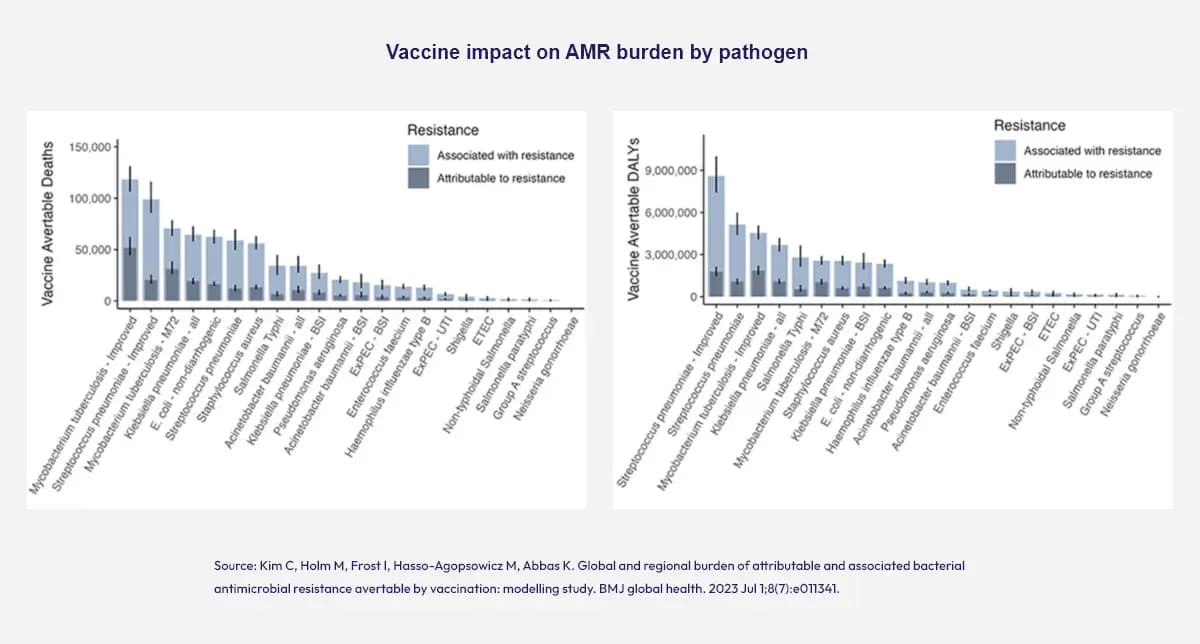
Vaccines cut antibiotic use, averting billions of doses. Attributed burden reduces resistant infections, while associated burden eliminates infections.
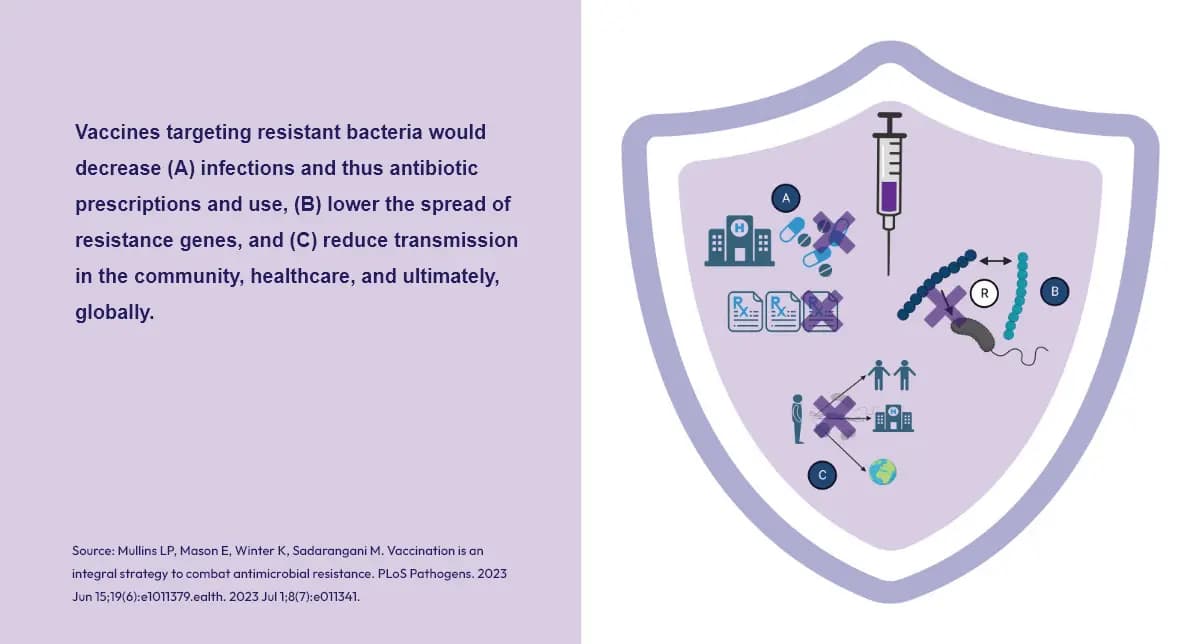
Vaccines prevent infections, lower resistance spread, and reduce global AMR transmission.
The Triple Threat: How Vaccines Combat AMR
Vaccines are crucial in preventing infections and curbing the spread of resistant strains, thus reducing reliance on antibiotics. Vaccines work to reduce the threat of antimicrobial resistance through three key mechanisms:
- 1. Preventing infections before they start.
- 2. Reducing the use and overuse of antibiotics that can lead to AMR.
- 3. Slowing the emergence and spread of drug-resistant pathogens.
Dr. Tedros Adhanom Ghebreyesus, WHO Director-General, emphasizes, ”Prevention is better than cure, and vaccines are among the most powerful tools for doing that”. [1]
Beyond Saving Lives: The Economic Imperative
The economic importance of vaccine-driven AMR reduction is significant. Hospital costs for treating resistant pathogens are estimated at US$ 730 billion annually. Remarkably, the widespread implementation of vaccines against all evaluated pathogens could save up to one-third of these costs. [1]
This economic impact is especially critical as AMR thrives on inequality and inequity, with the burden falling disproportionately on the most vulnerable people, including children and those living in sub-Saharan Africa. AMR is further exacerbated by climate change, conflict, and displacement, making it a complicated, interconnected global health challenge. [8]

Vaccines could reduce AMR costs by a third, benefiting vulnerable populations globally.
World leaders commit to reducing AMR deaths by 10% by 2030 at the UN High-Level Meeting.
A Global Call to Action: The UN High-Level Meeting
The global community is supporting antimicrobial resistance as world leaders prepare for the second High-Level Meeting on Antimicrobial Resistance at the United Nations General Assembly. A recent political declaration commits to reducing AMR-associated deaths by 10% by 2030 and calls for US$100 million in the catalytic budget to support national action plans on AMR by 2030. [2 & 3]
Innovative Approaches: The Power of Technology
Geospatial tools and mobile technology are emerging as game-changers in the combat against AMR. These innovations enhance immunization coverage, improve data collection, and facilitate better decision-making in vaccination efforts.
As stated by Dr. Tedros, WHO Director-General, ”We must harness the power of digital technologies to bridge gaps in access to health services and build resilient systems that can meet the multiple overlapping health challenges of our world, from outbreaks, epidemics and pandemics to climate change and the burden of noncommunicable diseases.” [4]

Digital tools are transforming global efforts to combat AMR and improve vaccines.
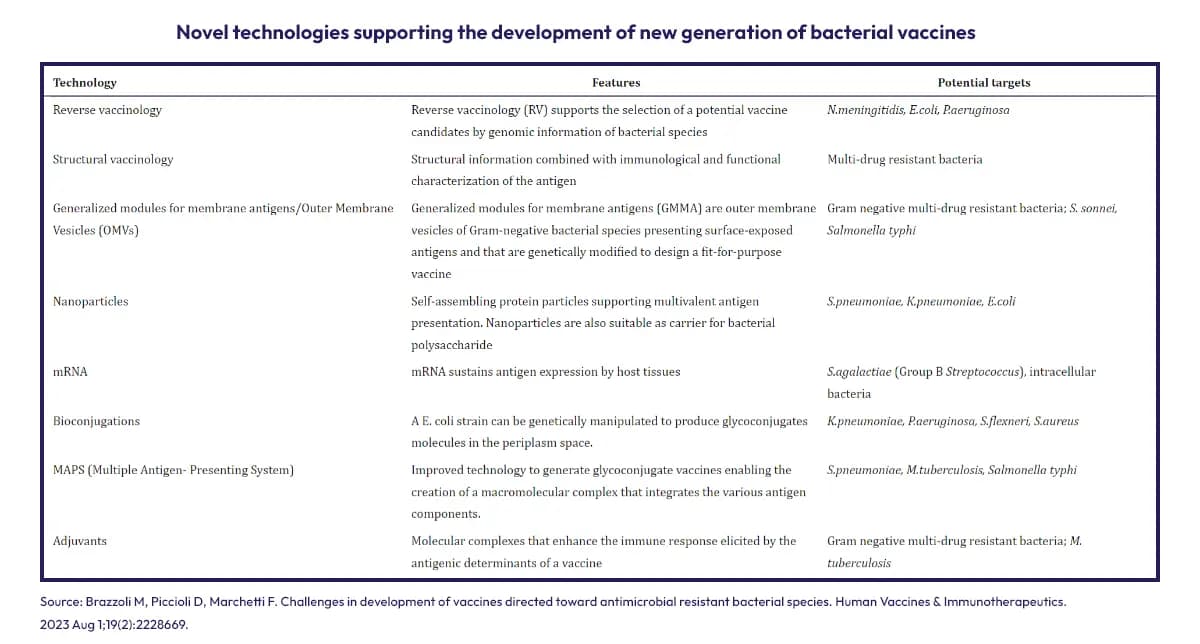
New vaccine technologies aim to overcome AMR challenges, targeting resistant bacterial strains.
The Road Ahead: Challenges and Opportunities
While progress has been made, significant challenges remain in the fight against AMR. The high-potential scenario involves several hurdles, including ensuring effective immunization for adults and the elderly, providing timely vaccines, and addressing vaccine effectiveness in patients with weakened immune systems or multiple health conditions. [5] Vaccine development for antimicrobial-resistant pathogens faces additional complexities, such as lack of correlates of protection, antigenic variability, and immune evasion mechanisms. To overcome these, researchers are exploring new technologies like reverse vaccinology for antigen discovery and novel adjuvants, while improving our understanding of host-pathogen interactions. [9] Managing vaccine demand, addressing financing issues, and scaling up existing vaccine coverage in regions with higher AMR burdens are also critical. The WHO's report emphasizes the need for increased new vaccine development, particularly for pathogens with high potential for lowering AMR burden. Overcoming these obstacles is crucial to successfully implement the high-potential scenario and make significant strides in combating AMR globally. [5]
Quantifying the Impact: Lives Saved and DALYs Averted
Recent modeling studies have provided compelling evidence of the significant impact vaccines can have on reducing the antimicrobial resistance (AMR) burden globally. A 2023 study estimated that in the baseline scenario, vaccines against 15 key pathogens could avert 0.51 million deaths and 28 million disability-adjusted life years (DALYs) associated with AMR annually. In a high-potential scenario, targeting seven pathogens with expanded vaccination strategies could prevent an additional 1.2 million deaths and 37 million DALYs associated with AMR. The impact was particularly pronounced in the WHO Africa and South-East Asia regions, which accounted for about two-thirds of the global vaccine-avertable AMR burden. These findings underscore the critical role of vaccines in combating AMR, especially in areas with the highest burden, and highlight the urgent need for both scaling up existing vaccines and developing new ones to address this global health threat. [5]
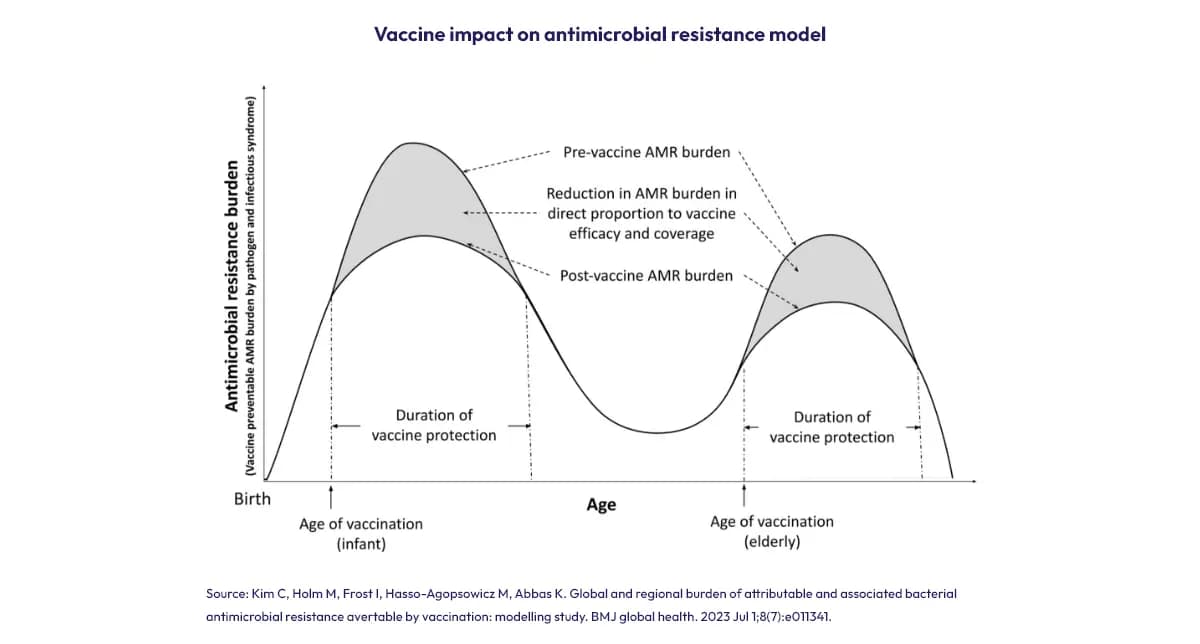
Vaccines can prevent up to 1.2 million deaths and 37 million DALYs from AMR annually.
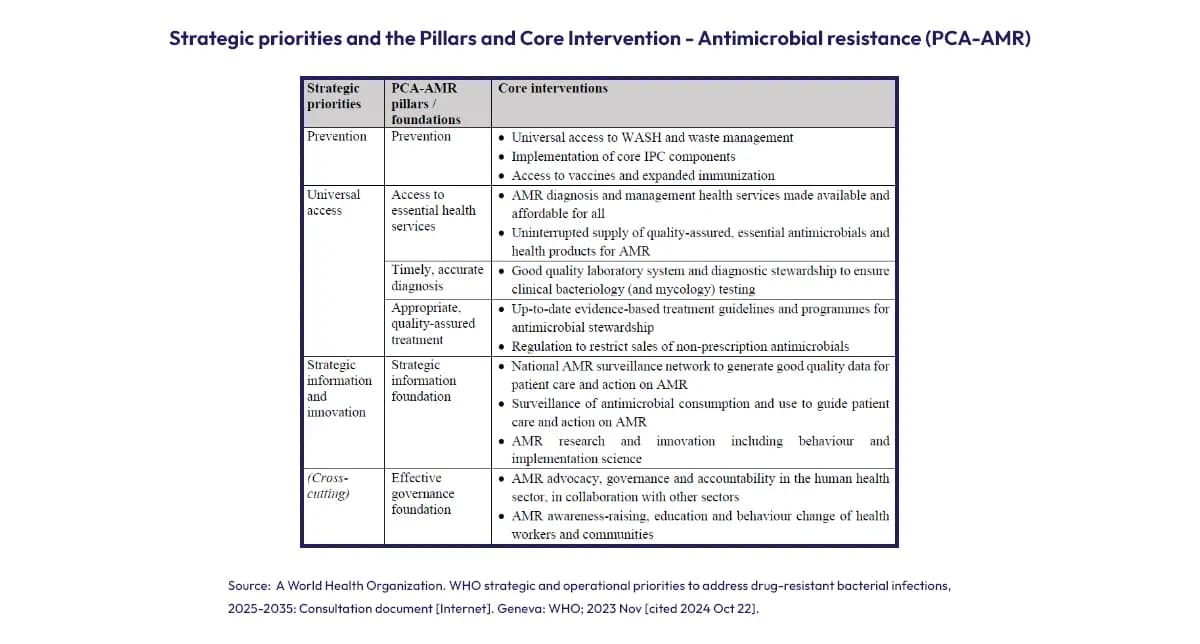
WHO's People-Centered Approach to AMR focuses on prevention, access, strategic info, innovation, and effective governance.
A Global Health Priority: WHO's Strategic Focus
The World Health Organization has developed strategic and operational priorities to address drug-resistant bacterial infections in the human health sector for 2025-2035. This comprehensive approach includes:
1. Prevention of infections
2. Universal access to affordable, quality diagnosis and appropriate treatment
3. Strategic information, science, and innovation
4. Effective governance foundation
These priorities align closely with vaccines' potential to combat AMR, emphasizing the need for a multifaceted approach to this global health challenge. [6]
WHO emphasizes the importance of a 'One Health' approach, involving coordination among various sectors and actors. A global action plan is required to tackle AMR, which includes developing new antibiotics, diagnostic tools, vaccines, and other interventions. This multifaceted strategy highlights the demand for global cooperation and innovative solutions to combat the growing threat of AMR. [7]
CIMA Care: Empowering Global Health Through Digital Innovation
At CIMA Care, we are committed to improving global health outcomes and supporting antimicrobial resistance (AMR) prevention through innovative digital solutions. Our platform offers practical tools designed to enhance vaccination management and public health strategies, which play a crucial role in reducing the need for antibiotics.
CIMA Care recognizes the importance of integrating health emergency preparedness and response capabilities into core health infrastructure. Our tools are designed to support robust, agile, and adaptable health facilities, workforce, and supply chains, essential for routine healthcare delivery and ongoing challenges.
We invite you to explore how CIMA Care can support your health initiatives in the fight against AMR through improved vaccination coverage. Visit www.cima.care to learn more about our tools and join us in our mission to improve global health and combat the threat of antimicrobial resistance.

CIMA Care leverages digital tools to enhance vaccination management and combat antimicrobial resistance.
Image References
- 1- Freepik. Top-view vaccine note written by female, blue background, lab/pandemic theme [Internet]. 2025 [cited 2025 Aug 19]. Available from: https://www.freepik.com/free-photo/top-view-vaccine-note-written-by-female-blue-background-vaccine-color-lab-pandemic-hospital-science-covid-virus-health_13187846.htm
- 2- BMJ Global Health. Figure (graphic-2.large.jpg) [Internet]. 2023 [cited 2025 Aug 19]. Available from: https://gh.bmj.com/content/bmjgh/8/7/e011341/F2/graphic-2.large.jpg
- 3- PLOS Pathogens. Vaccination is an integral strategy to combat antimicrobial resistance [Internet]. 2024 [cited 2025 Aug 19]. Available from: https://journals.plos.org/plospathogens/article?id=10.1371/journal.ppat.1011379
- 4- Adobe Stock. [Image title not specified] [Internet]. 2025 [cited 2025 Aug 19]. Available from: https://stock.adobe.com/nl/573890781
- 5- Adobe Stock. [Image title not specified] [Internet]. 2025 [cited 2025 Aug 19]. Available from: https://stock.adobe.com/nl/755527917
- 6- Adobe Stock. [Image title not specified] [Internet]. 2025 [cited 2025 Aug 19]. Available from: https://stock.adobe.com/nl/846879835
- 7- PMC (NCBI). Table T0002 [Internet]. 2023 [cited 2025 Aug 19]. Available from: https://pmc.ncbi.nlm.nih.gov/articles/PMC10351463/table/t0002/
- 8- BMJ Global Health. Figure (F1.large.jpg) [Internet]. 2023 [cited 2025 Aug 19]. Available from: https://gh.bmj.com/content/bmjgh/8/7/e011341/F1.large.jpg
- 9- WHO. AMR strategic and operational priorities consultation document [Internet]. 2023 [cited 2025 Aug 19]. Available from: https://cdn.who.int/media/docs/default-source/antimicrobial-resistance/amr-spc-npm/people-centred-framework/amr-strategic-and-operational-priorities-consultation-document.pdf?sfvrsn=e259fd22_6
- 10- Adobe Stock. [Image title not specified] [Internet]. 2025 [cited 2025 Aug 19]. Available from: https://stock.adobe.com/nl/847630356
Blog Resources
- 1- Better use of vaccines could reduce antibiotic use by 2.5 billion doses annually, says WHO [Internet]. Who.int. 2024. Available from: Better use of vaccines could reduce antibiotic use by 2.5 billion doses annually, says WHO
- 2- UN General Assembly High-Level Meeting on antimicrobial resistance 2024 [Internet]. www.who.int. Available from: UN General Assembly High-Level Meeting on antimicrobial resistance 2024
- 3- World. World leaders commit to decisive action on antimicrobial resistance [Internet]. Who.int. World Health Organization: WHO; 2024. Available from: World leaders commit to decisive action on antimicrobial resistance
- 4- World. WHO at UNGA: Call for urgent, high-level action to address global scourge of antimicrobial resistance [Internet]. Who.int. World Health Organization: WHO; 2024. Available from: WHO at UNGA: Call for urgent, high-level action to address global scourge of antimicrobial resistance
- 5- Kim C, Holm M, Frost I, Mateusz Hasso-Agopsowicz, Abbas K. Global and regional burden of attributable and associated bacterial antimicrobial resistance avertable by vaccination: modelling study. BMJ Global Health. 2023 Jul 1;8(7):e011341–1.
- 6- World Health Organization. WHO strategic and operational priorities to address drug-resistant bacterial infections, 2025-2035: Consultation document [Internet]. Geneva: WHO; 2023 Nov [cited 2024 Oct 22]. Available from: https://cdn.who.int/media/docs/default-source/antimicrobial-resistance/amr-spc-npm/people-centred-framework/amr-strategic-and-operational-priorities-consultation-document.pdf?sfvrsn=e259fd22_6
- 7- World Health Organization. Antimicrobial resistance [Internet]. World Health Organization. 2023. Available from: Antimicrobial resistance
- 8- HAPC Building Resilience and Trust [Internet]. Pagesuite-professional.co.uk. 2024. Available from: HAPC Building Resilience and Trust
- 9- Brazzoli M, Piccioli D, Marchetti F. Challenges in development of vaccines directed toward antimicrobial resistant bacterial species. Human Vaccines & Immunotherapeutics. 2023 Aug 1;19(2):2228669.
Enjoyed this article?
Share it with your friends on LinkedIn: Vaccines: The Unsung Heroes in the Battle Against Antimicrobial Resistance 
Follow us on LinkedIn for more updates and insights: Cima Care GmbH