
septembre 24, 2024 . 6 Minutes read
Global Immunization in 2023: 7 Key Insights
As we reflect on the state of global immunization in 2023, it's crucial to examine the progress made and the challenges that remain in protecting children worldwide against vaccine-preventable diseases. This overview presents seven key takeaways from the latest data and trends.
 1. Continuing Challenges in Global Vaccination
With GAVI's support, 69 million children were immunized globally in 2023.
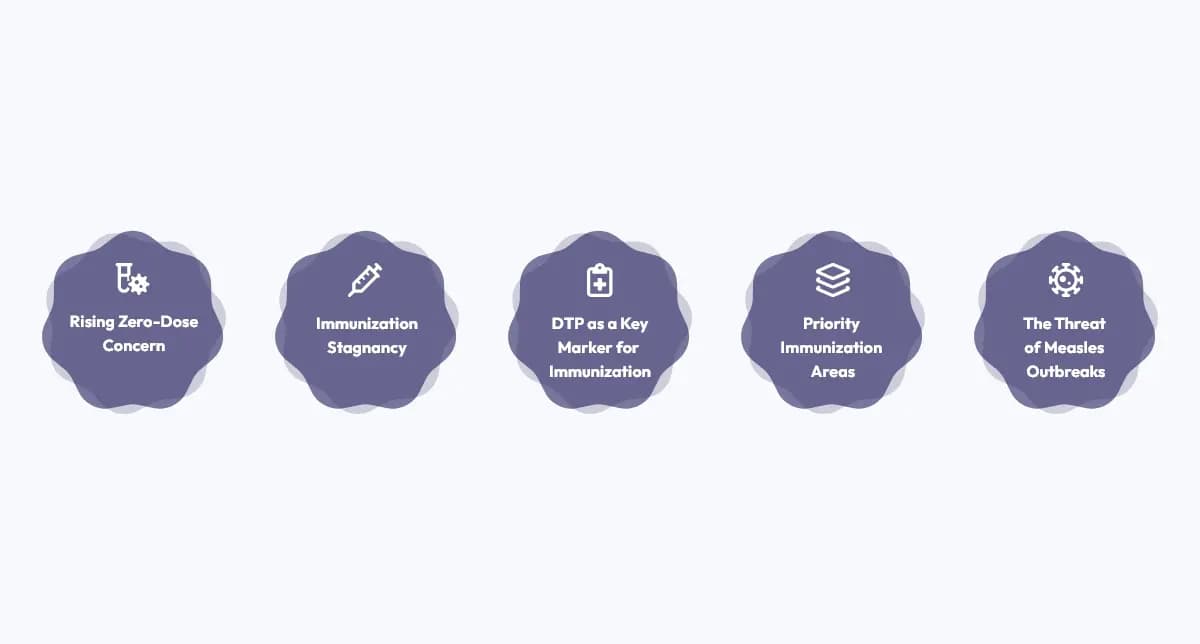
- Rising Zero-Dose Concern: A concerning number of children still receive no essential childhood vaccines. According to the latest WHO/UNICEF Estimates of National Immunization Coverage (WUENIC), there were 11 million 'zero-dose children' in Gavi-supported countries in 2023, an increase of 0.5 million from 2022. While the number of zero-dose children in Africa is decreasing, innovative strategies in fragile settings may be starting to show results. However, much more effort is required. [16]
- Immunization stagnancy: According to WHO and UNICEF data, global childhood immunization coverage remained stagnant in 2023, with 2.7 million more children left un- or under-vaccinated compared to pre-pandemic levels in 2019.
- DTP as a key marker for immunization: Global childhood immunization coverage for the three doses of the diphtheria-tetanus-pertussis (DTP) vaccine remained at 84% (108 million) in 2023. Alarmingly, 14.5 million children missed out on any dose of DTP in 2023, a rise from 13.9 million in 2022. Importantly, 6.5 million children did not complete their third dose of the DTP vaccine, which is necessary to achieve disease protection in infancy and early childhood. This report underscores the need for ongoing catch-up, recovery, and system strengthening.
- Priority Immunization Areas: Over half of unvaccinated children live in 31 countries affected by conflict and instability, where access to essential health services, nutrition, and security is severely disrupted, leaving them vulnerable to preventable diseases. [1 & 4]
- The Threat of Measles Outbreaks: In 2023, only 83% of children received their first dose of the measles vaccine, a drop from 86% in 2019. Measles, with its high transmissibility, serves as an early warning system, revealing immunity gaps in the population. Alarmingly, 22.2 million children missed their routine first dose, a significant rise from 19.3 million in 2019, highlighting the urgent need to address these gaps in immunization. [4]
 2. Record-Breaking Vaccine Coverage
With GAVI's support, 69 million children were immunized globally in 2023.
- GAVI’s Support and Alliance: In 2023, Gavi helped deliver routine immunizations to 69 million unique children, the second-highest annual figure after 2019. This achievement brings the total number of children immunized during Gavi's current strategic period (2021–2025) to over 205 million, putting the Alliance well on track to meet its goal of vaccinating 300 million children by 2025. [16]
- HPV Distribution and Coverage: Global coverage for the first dose of the Human Papillomavirus (HPV) vaccine among girls saw a significant increase, rising from 20% in 2022 to an encouraging 27% in 2023. [1] This rise is Driven mainly by successful introductions in Gavi-supported countries like Bangladesh, Indonesia, and Nigeria. [16] In 2023, UNICEF distributed 24.3 million doses of the HPV vaccine, reaching 25% of the world's countries and greatly lowering the risk of cervical cancer among girls. [2]
 3. Disparities in Global Vaccine Coverage
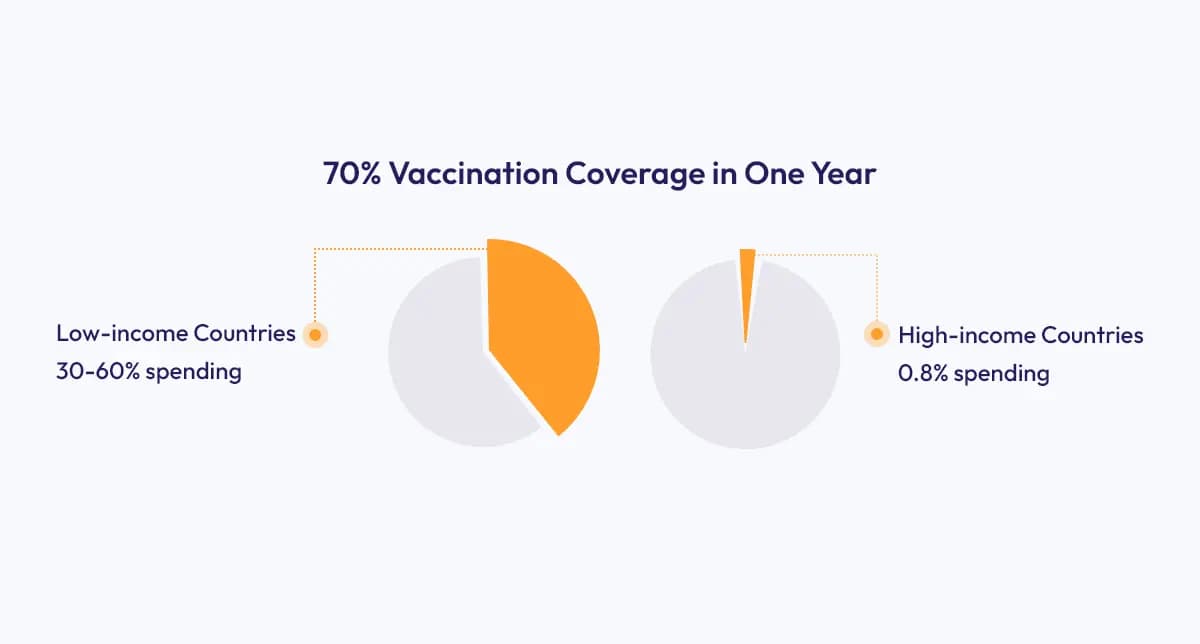
Low-income countries spend 30-60%, while high-income countries spend 0.8% for 70% coverage.
- High-Income Countries and Coverage Scope: 79.86% of people in high-income countries have received at least one vaccine dose as of November 29, 2023.
- Cost and Benefit: Vaccination programs will raise healthcare costs worldwide, but low-income countries face a significant challenge, needing to boost their health spending by 30-60% to vaccinate 70% of their population in one year. In contrast, high-income countries only need to increase spending by 0.8% to achieve the same rate. [3]
 4. Immunization Gaps, Progress, and Challenges in Africa
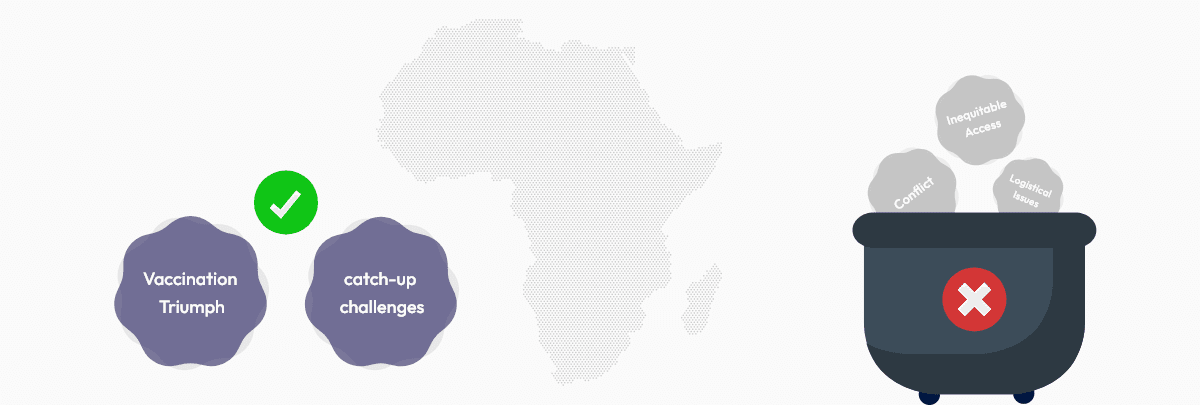
Immunization in Africa faces progress with catch-up efforts, but conflict and access remain key challenges.
- Immunization Crisis: Immunization challenges in Africa persist, driven by conflict, inequitable access, and logistical issues. Sudan's vaccination coverage fell drastically from 75% in 2022 to 57% in 2023, leaving 701,000 children unvaccinated. More than half of unvaccinated children live in conflict zones where healthcare is severely disrupted. [5]
- Ongoing Catch-Up Challenges: Despite the global 'Big Catch-Up' effort launched in 2023 by organizations like the World Health Organization (WHO), UNICEF, Gavi, and the Bill & Melinda Gates Foundation to vaccinate millions of children and restore immunization progress lost during the COVID-19 pandemic, more work is needed. Catch-up campaigns and stronger health systems are still essential to fully recover and surpass pre-pandemic vaccination levels. [6]
- Immunization Triumph: A systematic review and meta-analysis in 2024 identified the pooled prevalence estimate of HPV uptake among adolescent girls in sub-Saharan Africa as 28.53%. [7] However, Rwanda remains a standout, consistently achieving over 90% coverage for children under five, making it a key Gavi partner. [8]
 5. Expanded Protection Against Multiple Diseases
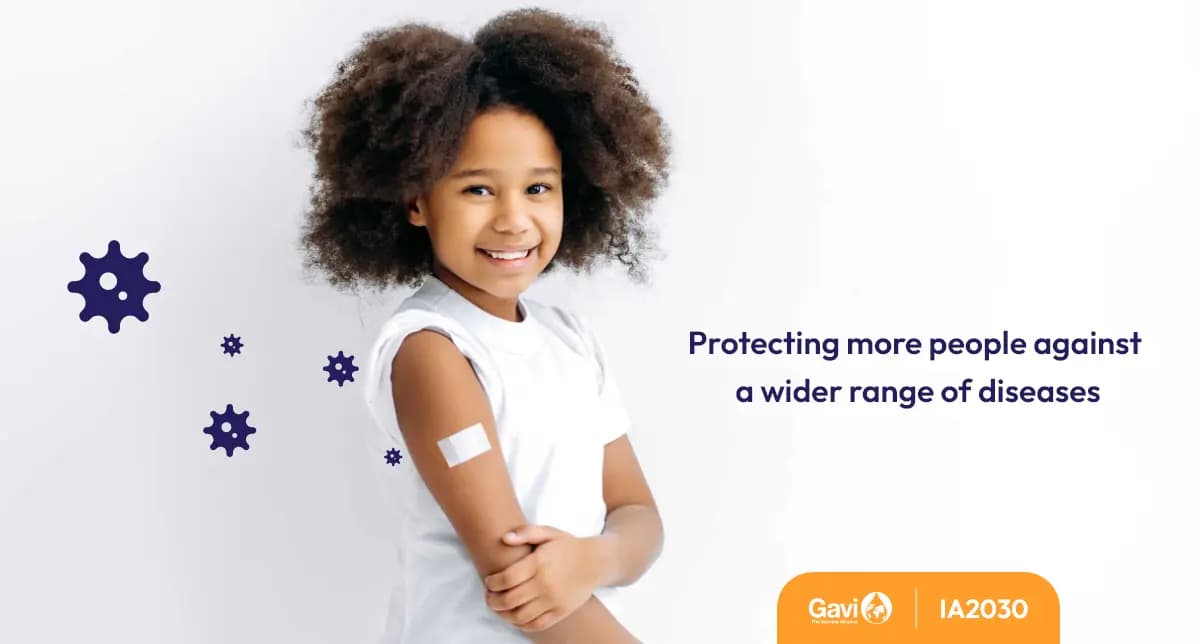
Protecting more people against a broader range of diseases in 2023.
- Expanded Vaccine Protection: With Gavi's support, countries are now protecting children from more diseases than ever. A key measure, 'breadth of protection', reflects the average coverage of vaccines against ten diseases, including polio, HPV, measles, and yellow fever. In 2023, the average coverage reached 56%, up three points from 2022 and 12 points higher than 2019. The expansion of vaccines for polio, pneumococcus, measles, rotavirus, and HPV has driven this progress. [16]
- Gavi's Policy: The Gavi's Policy team expanded its vaccine portfolio from 6 diseases in 2001–2005 to 19 today, including approvals for Ebola in 2019, COVID-19 in 2021, and malaria in 2022.
These updates build on Gavi's growing portfolio with considerations for new vaccine technologies, climate change impacts, and post-pandemic challenges. [9]
- Gavi's 2024 Vaccine Investment Strategy (VIS) has approved several new programs and learning agendas, expanding protection to:
- Tuberculosis: Now includes adolescents and adults.
- Group B Streptococcus: Targets pregnant women.
- Dengue: Conditionally approved for ages 2-16, pending African burden data.
- Hepatitis E and Mpox: Added to global stockpiles and learning agendas for outbreak response.
- Shigella: Approved for a learning agenda aiming at infant protection.
- IA2030: Immunization Agenda 2030 (IA2030) aims to expand global immunization coverage, protecting more people against a wider range of diseases. [10]
 6. Climate Change: A New Opportunity for Strengthening Immunization
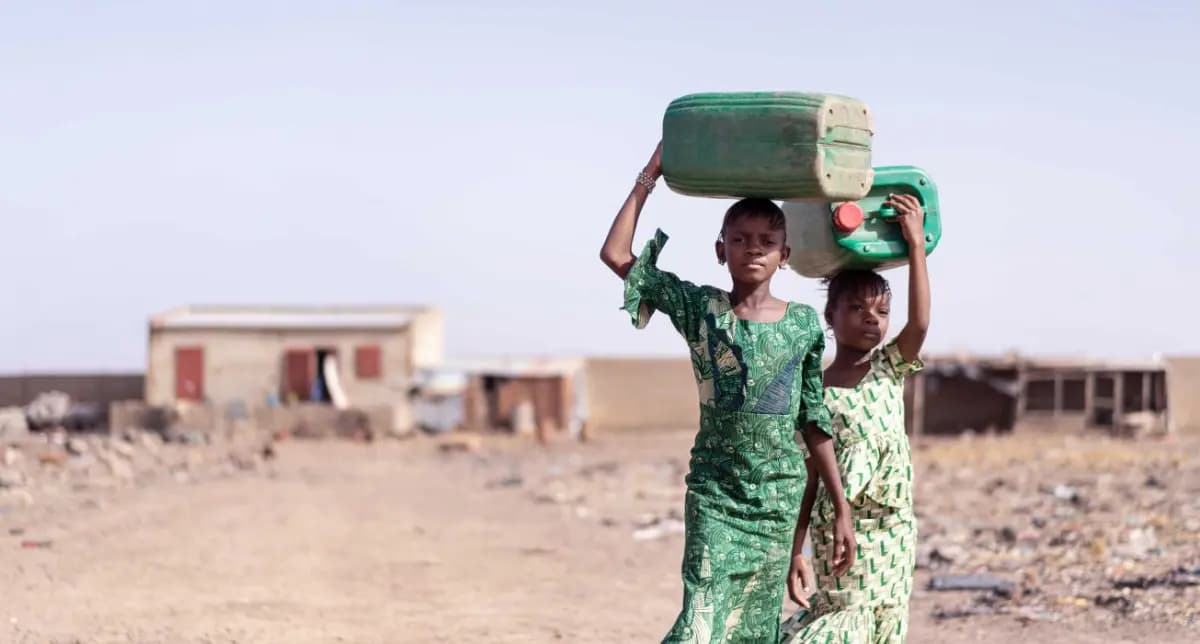
Climate change worsens vaccine access and spreads vector- and waterborne diseases, especially in vulnerable areas.
- Climate Change Recognition: There's growing recognition of the role and influence of climate change on infectious diseases—and, concurrently, a sense of urgency in enhancing our preparedness for climate-influenced, vaccine-preventable diseases,'said Maya Malarski, a senior manager on GAVI's policy team.
- Climate-Driven Vaccine Challenges: Rising temperatures, along with increasing precipitation and humidity, are expanding the geographical range of vectorborne and waterborne diseases. Climate change is also disrupting vaccine distribution, storage, and delivery systems, with floods and droughts further complicating immunization programs in affected regions. Additionally, higher temperatures challenge vaccine stability and cold chain logistics, making it harder to maintain the effectiveness of vaccines during transport and storage. [11]
- Combating Climate-Induced Disease Burden: To address the growing burden of climate-sensitive diseases, global health organizations and vaccine developers are implementing innovative strategies. These include developing thermostable vaccines, improving cold chain technologies, and expanding vaccination programs to target emerging disease hotspots. [12 & 13] For instance, GAVI is actively considering the effects of climate change on its portfolio of vaccines for children in low-income countries, adapting its approach to ensure continued protection against climate-influenced, vaccine-preventable diseases. [11]
 7. mRNA Technology Revolution
mRNA vaccines revolutionize global health with tailored solutions for diseases like malaria and HIV.
- mRNA Vaccine Breakthrough Post-COVID-19: The success of mRNA vaccines, particularly against COVID-19, has sparked a revolution in global health, promising tailored vaccines for diseases like malaria, tuberculosis, and HIV.
- Prospective mRNA Vaccines: Future vaccines are expected to be more stable, eliminating the need for cold-chain logistics and reducing costs, making distribution to low-income regions easier.
- Manufacturing Facilities and Refinements: BioNTech is already constructing local mRNA manufacturing facilities in places like Rwanda. This rapid evolution in mRNA technology continues, with the CDC approving updated mRNA COVID-19 vaccines for the 2024-2025 season, displaying the ongoing refinement of this groundbreaking innovation. [14 & 11]
- Multiple vaccine programs advancing: Moderna, a leader in mRNA technology, announced in March 2024 that it is advancing five vaccine candidates against viruses that cause latent infections to late-stage clinical trials. [15]
CIMA Care's Holistic Approach to Complete Vaccination
As we strive to protect every child from vaccine-preventable diseases, innovative solutions like digital innovations and collaborative efforts are more important than ever.
CIMA Care strives to achieve a complete vaccination record for every child, ensuring they reach their full potential. Aiming to transform care with innovation and heart, CIMA Care's holistic approach unites parents, clinics, and healthcare professionals by addressing key challenges such as zero-dose children, parental misinformation, defaulter tracing, health staff vaccine hesitancy, and the requirement for continuous professional development.
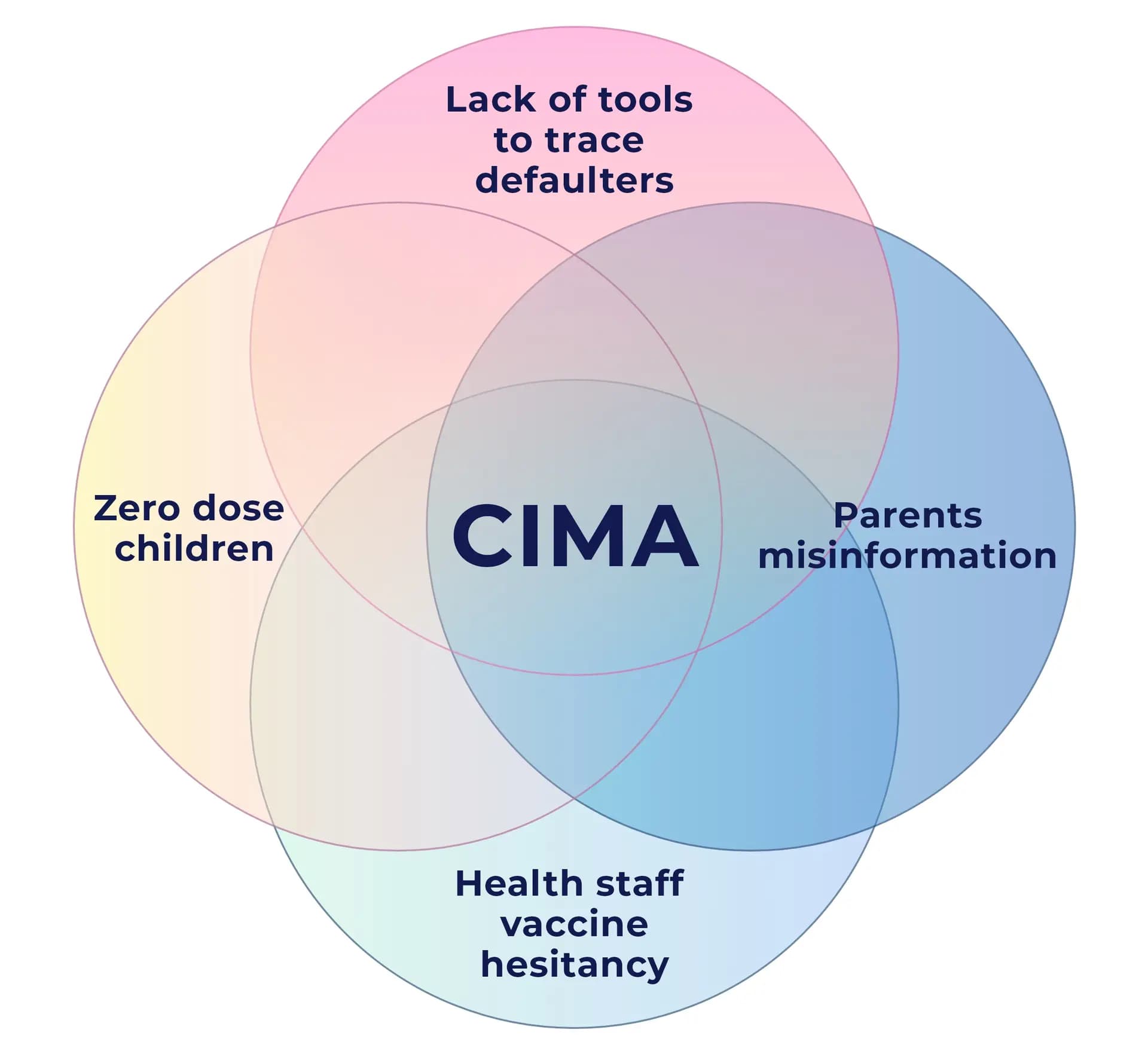
CIMA's holistic approach addresses zero-dose children, misinformation, defaulter tracing, and vaccine hesitancy.
Image References
- 1- Adobe Stock. [Internet]. 2025 [cited 2025 Aug 19]. Available from: https://stock.adobe.com/nl/786268380
- 2- Adobe Stock. [Internet]. 2025 [cited 2025 Aug 19]. Available from: https://stock.adobe.com/nl/483821241
- 3- Adobe Stock. [Internet]. 2025 [cited 2025 Aug 19]. Available from: https://stock.adobe.com/nl/321763971
- 4- Adobe Stock. [Internet]. 2025 [cited 2025 Aug 19]. Available from: https://stock.adobe.com/nl/427721474
Blog Resources
- 1- Global childhood immunization levels stalled in 2023, leaving many without life-saving protection [Internet]. www.who.int. Available from: Global childhood immunization levels stalled in 2023, leaving many without life-saving protection
- 2- 2023 End of Year Results Summary Extended Narrative [Internet]. NNICEF. Denmark: UNICEF; 2024 Apr [cited 2024 Sep 8] p. 1–10. Available from: https://www.unicef.org/media/155741/file/Supply-Division-2023-COAR.pdf
- 3- United Nations Development Programme. Global Dashboard for Vaccine Equity | Data Futures Platform [Internet]. UNDP. 2021. Available from: Global dashboard for vaccine equity | Data Futures Exchange
- 4- WHO. Immunization coverage [Internet]. Who.int. World Health Organization: WHO; 2023. Available from: Immunization coverage
- 5- 1.AMB. UN: “700k+ children unvaccinated as immunisation plummets in Sudan” - Dabanga Radio TV Online [Internet]. Dabanga Radio TV Online. Radio Dabanga; 2024 [cited 2024 Sep 9]. Available from: UN: ‘700k+ children unvaccinated as immunisation plummets in Sudan’ - Dabanga Radio TV Online
- 6- Global partners announce a new effort – “The Big Catch-up” – to vaccinate millions of children and restore immunization progress lost during the pandemic [Internet]. www.who.int. Available from: Global partners announce a new effort – “The Big Catch-up” – to vaccinate millions of children and restore immunization progress lost during the pandemic
- 7- Asgedom YS, Kebede TM, Seifu BL, Mare KU, Asmare ZA, Asebe HA, Kase BF, Shibeshi AH, Tebeje TM, Sabo KG, Fente BM. Human papillomavirus vaccination uptake and determinant factors among adolescent schoolgirls in sub-Saharan Africa: A systematic review and meta-analysis. Human Vaccines & Immunotherapeutics. 2024 Dec 31;20(1):2326295.
- 8- Asempah E, Wiktorowicz ME. Understanding HPV Vaccination Policymaking in Rwanda: A Case of Health Prioritization and Public-Private-Partnership in a Low-Resource Setting. International Journal of Environmental Research and Public Health. 2023 Oct 30;20(21):6998.
- 9- Vaccine Investment Strategy 2024 [Internet]. Gavi, the Vaccine Alliance. Available from: Vaccine Investment Strategy 2024
- 10- Explaining the Immunization Agenda 2030 [Internet]. www.who.int. Available from: https://www.who.int/teams/immunization-vaccines-and-biologicals/strategies/ia2030/explaining-the-immunization-agenda-2030
- 11- Leedom M. How climate change is changing vaccination planning. BMJ: British Medical Journal (Online). 2024 Mar 19;384:q360.
- 12- Kim CL, Agampodi S, Marks F, Kim JH, Excler JL. Mitigating the effects of climate change on human health with vaccines and vaccinations. Frontiers in Public Health. 2023 Oct 12;11:1252910.
- 13- A one health approach to vaccine and climate research | Science for Africa Foundation [Internet]. Scienceforafrica.foundation. 2024 [cited 2024 Sep 7]. Available from: A one health approach to vaccine and climate research | Science for Africa Foundation
- 14- Matarazzo L, Bettencourt PJ. mRNA vaccines: a new opportunity for malaria, tuberculosis and HIV. Frontiers in Immunology. 2023 Apr 24;14:1172691.
- 15- Moderna Advances Multiple Vaccine Programs to Late-Stage Clinical Trials [Internet]. Investor Relations Overview. Available from: Moderna Advances Multiple Vaccine Programs to Late-Stage Clinical Trials
- 16- Global immunisation in 2023: 7 things you need to know [Internet]. Gavi, the Vaccine Alliance. 2023 [cited 2024 Sep 7]. Available from: Global immunisation in 2023: 7 things you need to know
Enjoyed this article?
Share it with your friends on LinkedIn: Global Immunization in 2023: 7 Key Insights 
Follow us on LinkedIn for more updates and insights: Cima Care GmbH